
Oncology Fundamentals
Build the foundational knowledge needed to understand and support cancer care. The NCODA Oncology Fundamentals course provides a practical introduction to cancer biology, oncology treatments, biomarker testing, medication dosing, supportive care, treatment-related toxicities, and oncologic emergencies.

Earn 11 CE credit hours in this self-paced, multidisciplinary introductory course designed for healthcare professionals seeking to build a stronger foundation in oncology care or revisit essential concepts commonly encountered in practice. The course provides an overview of key oncology concepts to reinforce confidence in clinical considerations that impact cancer care.
Course Objectives
- Summarize the etiology, pathogenesis, clinical manifestations, diagnostic evaluation, biomarker-based characterization, and evidence-based treatment approaches associated with cancer.
- Describe the mechanisms of action, key clinical features, and adverse-effect profiles of oncology pharmacologic classes.
- Identify supportive care needs, counseling considerations, and drug interactions associated with oncologic pharmacotherapy classes.
- Describe common oncologic emergencies and their appropriate evidence-based management strategies.
- Complete oncology pharmacy calculations using patient-specific clinical information and dose-rounding principles to support safe and accurate anticancer medication dosing.
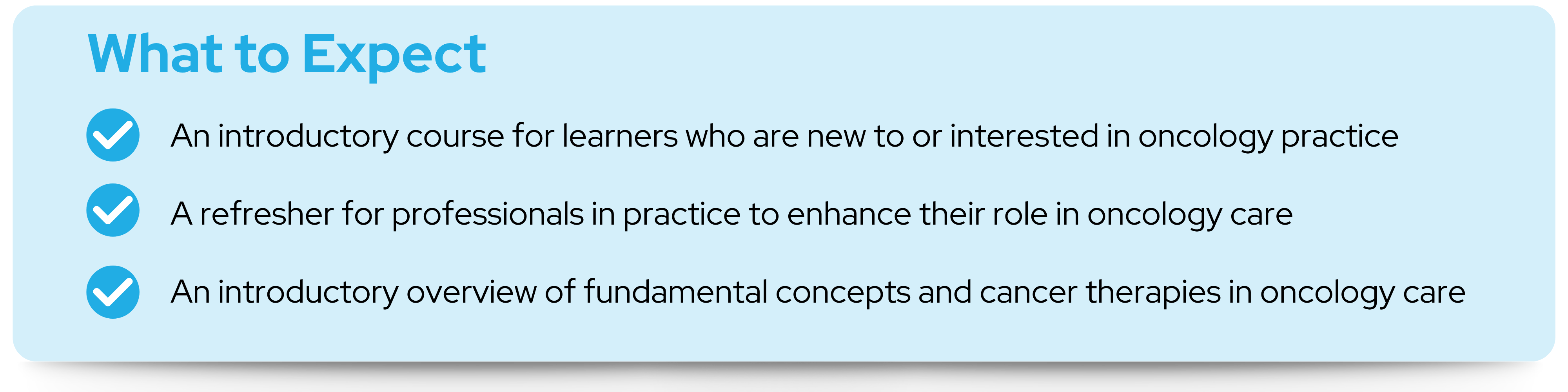

Oncology Fundamentals is designed for pharmacists, advanced practice providers, and nurses, the course offers continuing education credits and real-world clinical insights you can apply immediately.
This course offers 11.0 CE Credit Hours.
Course Pricing
Pharmacists / APPs – $200
Nurses – $175
Residents / Fellows – $150
Technicians – $100
Students / No CE Credit – $75
Course Modules
In module 1, you will build a foundation for understanding how cancer develops, progresses, and is evaluated. You will also explore how patient-specific factors, staging, grading, and evidence-based guidelines help guide treatment decisions.
CE Credit: 1.0 Hour
Learning Objectives:
- Review the etiology, risk factors, hallmarks, staging, and grading of cancer to explain their collective role in disease progression and prognosis.
- Explain patient performance status and diagnostic information to determine implications for treatment selection and outcomes.
- Identify evidence-based oncology treatment guidelines (NCCN®, ASCO®) to distinguish between curative, adjuvant, neoadjuvant, and palliative approaches in clinical practice.
In this module, you will practice key oncology pharmacy calculations to support safe and accurate medication dosing. You will also review how patient factors, laboratory values, and dose-rounding principles influence treatment recommendations.
CE Credit: 1.0 Hour
Learning Objectives:
- Describe the importance of accurate calculations in oncology pharmacy.
- Review the principles of oncology pharmacy dosage calculations and conversions of measurements.
- Calculate the appropriate dose of anticancer medications based on patient factors and laboratory values.
- Define the parameters for dose rounding.
In Module 3, you will learn how biomarker testing supports precision oncology and informs patient-specific treatment decisions. You will compare testing approaches, interpret the clinical role of actionable biomarkers, and examine current and emerging applications in cancer care.
CE Credit: 1.0 Hour
Learning Objectives:
- Differentiate between diagnostic, prognostic, and predictive biomarkers.
- Compare tissue-based versus liquid biopsy biomarker testing.
- Match key actionable biomarkers to associated cancer(s) and targeted therapies.
- Identify common challenges and strategies to bridge gaps in implementing precision medicine.
- Discuss emerging trends and innovations in biomarker testing.
Module 4 will introduce you to how traditional chemotherapy agents work and why they remain an important part of cancer treatment. You will also learn how to recognize common adverse effects and drug interactions to support safer medication use.
CE Credit: 1.0 Hour
Learning Objectives:
- Classify chemotherapy agents by mechanisms of action.
- Recall common adverse effects associated with classes of chemotherapy.
- Identify potential drug interactions with various chemotherapy agents.
In this module, you will learn how hormonal therapies are used to treat selected hormone-sensitive cancers. You will review major drug classes, common adverse effects, and drug interactions that affect safe treatment management.
CE Credit: 1.0 Hour
Learning Objectives:
- Classify hormonal agents by mechanisms of action.
- Recall common adverse effects associated with hormonal therapy.
- Identify potential drug interactions with various hormonal therapies.
Module 6 explores how immunotherapy uses the immune system to help treat cancer. You will review major immunotherapy classes, key clinical features, and common adverse effects to support appropriate monitoring and patient care.
CE Credit: 1.0 Hour
Learning Objectives:
- Classify immunotherapy agents by mechanisms of action.
- Recall common adverse effects associated with immunotherapy.
- Review key clinical features of immunotherapy.
You will learn in Module 7 how targeted therapy connects precision-based pharmacology to the treatment of cancer. You will review major targeted therapy classes, key clinical features, drug interactions, and common adverse effects to support appropriate and safe patient care.
CE Credit: 2.0 Hours
Learning Objectives:
- Recall the mechanism of action of targeted therapies used for the treatment of hematologic and solid tumor malignancies.
- Recognize common and unique adverse effects of targeted therapies and associated prevention and management strategies.
- Identify important counseling points and monitoring parameters for targeted agents.
- Review potential drug interactions with various targeted therapy agents.
In this module, you will learn to recognize urgent cancer-related complications requiring rapid evaluation and timely intervention. You will review treatment and prophylactic considerations, monitoring parameters, and counseling points that support safe use.
CE Credit: 1.0 Hour
Learning Objectives:
- Identify the various types of oncologic emergencies.
- Review the pathophysiology and management of tumor lysis syndrome (TLS).
- Discuss the pathophysiology and management of hypercalcemia of malignancy (HCM).
- Describe the management of febrile neutropenia (FN).
Supportive care is split into two parts. In part one, you will learn how to anticipate and manage common treatment-related toxicities, including nausea, vomiting, diarrhea, constipation, and oral mucositis. You will review guideline-informed supportive care strategies to help improve symptom management across oncology settings.
CE Credit: 1.0 Hour
Learning Objectives:
- Evaluate the emetogenic risk of chemotherapy regimens and apply NCCN®-guided strategies for the prevention and management of CINV.
- Differentiate causes of chemotherapy-, targeted-, and immunotherapy-induced diarrhea and recommend evidence-based interventions by severity grade.
- Identify agents commonly associated with constipation and develop proactive bowel regimens for prevention and management.
- Select preventive and supportive interventions for oral mucositis based on evidence-based guidelines.
In Part 2 of Supportive Care, you will focus on myelosuppression and dermatologic toxicities. You will review prevention and management strategies that support patient safety, treatment continuity, and quality of care.
CE Credit: 1.0 Hour
Learning Objectives:
- Describe the types and clinical impact of myelosuppression in oncology patients.
- Apply evidence-based strategies for the prevention and management of neutropenia, anemia, and thrombocytopenia.
- Review common dermatologic toxicities associated with anticancer therapy
Questions? Let’s Connect.

Send your feedback
Please do not include any personal information or details.
"*" indicates required fields
Was this page
helpful?
Send your feedback
Please do not include any personal information or details.
"*" indicates required fields