
Business of Oncology
Clinical expertise is only part of delivering exceptional oncology care. The NCODA Business of Oncology course provides the practical knowledge often missing from traditional training, helping professionals better understand reimbursement, Medicare, practice operations, health policy, inventory management, regulatory compliance, and emerging technologies.

Earn 10 CE credit hours in this self-paced, introductory course equips oncology professionals with the essential knowledge needed to navigate the operational, financial, and regulatory aspects of oncology practice. By combining clinical insights with administrative and financial skills, participants develop practical skills to manage oncology services efficiently. The curriculum addresses gaps often left by traditional clinical training, offering tools to enhance leadership, optimize workflows, and align practice management with changing healthcare policies.
Course Objectives
- Summarize financial, operational, and policy factors that influence oncology practice.
- Differentiate oncology practice models and key stakeholders.
- Review Medicare, commercial insurance, and financial assistance considerations that affect patient access and practice sustainability.
- Explain core pharmacy operations, including workforce development and inventory management.
- Identify accreditation and regulatory requirements that support high-quality oncology practice.
- Recognize emerging technologies, digital health tools, and drug development processes that shape the future of oncology care.
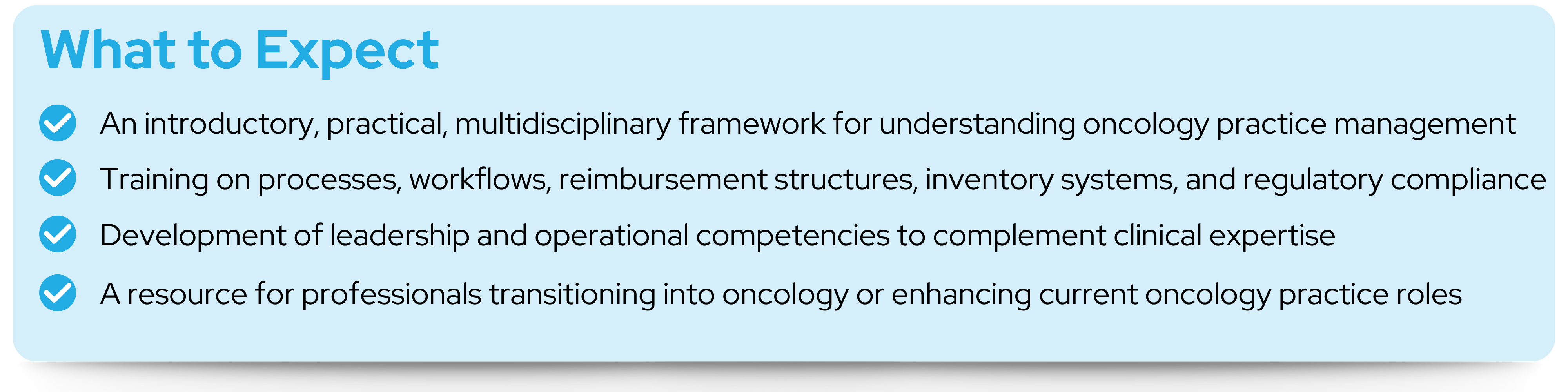

The new NCODA Business of Oncology course helps oncology professionals build the business and operational knowledge that supports high-quality patient care.
Through 10 hours of self-paced, CE education, participants gain practical insights into reimbursement, Medicare, practice operations, health policy, inventory management, regulatory compliance, emerging technologies, and more.
Designed primarily for pharmacists, APPs, nurses, and other oncology professionals, the course also provides valuable foundational knowledge for pharmacy technicians, fellows, residents, students, and anyone interested in the operational side of oncology care.
This course offers 10.0 CE Credit Hours.
Course Pricing
Pharmacists / APPs – $200
Nurses – $175
Residents / Fellows – $150
Technicians – $100
Students / No CE Credit – $75
Course Modules
In module 1, you will build a foundation for understanding different oncology practice models and care settings. You will also review key stakeholders, departments, and how oral and intravenous therapies differ in workflow and billing.
CE Credit: 1.0 Hour
Learning Objectives:
- Compare and contrast different oncology practice models.
- Review the key stakeholders within oncology practices.
- Identify the key departments within oncology practices.
- Describe the key differences between oral and intravenous oncolytic therapies, including variations in billing processes
Module 2 explains how oncology drug pricing, reimbursement, and contracting affect practice operations. You will also explore 340B, prior authorizations, group purchasing organizations, and distributor partnerships.
CE Credit: 1.0 Hour
Learning Objectives:
- Summarize key factors, including drug reimbursements and the 340B health system program, including its use, when considering pricing and reimbursement for oncology drugs in various settings.
- Describe the process and key considerations involved in contracting with Pharmacy Benefit Managers (PBMs) and payers for oncology services.
- Identify strategies to manage prior authorizations.
- Define common group purchasing organization (GPO) practices and contract negotiations.
- Explain how collaborations with specialty distributors and pharmaceutical manufacturers support medication access, affordability, and operational efficiency in oncology practices.
In Module 3, you will learn how Medicare coverage works across Parts A, B, C, and D. You will also review enrollment, billing, reimbursement, policy changes, and compliance considerations.
CE Credit: 1.0 Hour
Learning Objectives:
- Describe the purpose and key features of Medicare Parts A, B, C, and D.
- Summarize the enrollment and eligibility requirements of Medicare plans.
- Explain how policy changes will affect patients enrolled in Medicare.
- Review Medicare reimbursement and billing.
- Identify Medicare audit and compliance structures.
Module 4 discusses how commercial insurance affects prescription access and fulfillment. You will also learn about financial toxicity, assistance programs, and social factors that influence access to care.
CE Credit: 1.0 Hour
Learning Objectives:
- Describe the structure and function of commercial insurance, and the impact on prescription fulfillment.
- Discuss financial toxicity mitigation strategies.
- Review the financial assistance programs available for oncology patients.
- Explain how social determinants of health (SDOH) influence access to therapy and contribute to financial toxicity.
In this module, you will learn how health policy and legislation affect oncology practice and patient outcomes. You will review ways to stay informed and advocate for policies that support patient-centered care.
CE Credit: 1.0 Hour
Learning Objectives:
- Explain why health policy and legislation are important to oncology practice and patient outcomes.
- Identify key policy areas that influence oncology care.
- Recognize reliable sources for monitoring legislative and regulatory updates.
- Describe actionable ways oncology professionals can advocate for policies that improve patient access, quality, and value.
Module 6 focuses on staffing models, team roles, and workflow strategies that support safe oncology care. You will also examine quality improvement, staff development, retention, and professional resources.
CE Credit: 1.0 Hour
Learning Objectives:
- Describe oncology pharmacy staffing models and strategies to support safe and efficient patient care.
- Explain how multidisciplinary collaboration and electronic health record integration enhance workflow.
- Identify strategies to prevent medication errors and establish a culture of continuous quality improvement.
- Discuss approaches to workforce development, including staff retention, career growth, and burnout prevention.
- Recognize key educational resources and professional organizations that support oncology pharmacy practice.
Module 7 examines how oncology drugs and supplies are purchased, stored, and monitored. You will also explore shortage management, supply chain workflows, and financial reports used to evaluate practice health.
CE Credit: 1.5 Hours
Learning Objectives:
- Describe processes of procuring oncology drugs and drug supplies.
- Discuss how drug inventory is managed and monitored.
- Identify key workflows to manage and communicate common drug shortages.
- Explain the key components of supply chain optimization in an oncology practice.
- Summarize key financial statements used to evaluate the monetary health of an oncology practice.
You will review key regulatory and accreditation standards that support safe oncology pharmacy practices. You will also identify continuing education and safety reporting programs. .
CE Credit: 1.0 Hour
Learning Objectives:
- Describe the purpose of USP <800>, <797>, and <795>, and best practices for compliance with these standards.
- List the major oncology pharmacy accreditation entities and the core requirements for obtaining and maintaining accreditation.
- Discuss the role of regulatory authorities in ensuring safety, quality, and operational excellence in oncology practice settings.
- Explain the Drug Enforcement Administration (DEA) and state pharmacy board regulations related to the dispensing, storage, and documentation of oncolytics.
- Identify certification, training, and continuing education opportunities available for oncology pharmacists and pharmacy technicians, including required competencies and skill areas.
- Review programs to enhance patient safety, including Risk Evaluation and Mitigation Strategies (REMs), and safety reporting.
Module 9 explores how artificial intelligence and telepharmacy are being used in oncology practice. You will also review how digital tools can support decision-making, workflow, and medication management.
CE Credit: 0.5 Hour
Learning Objectives:
- Discuss the emerging applications of artificial intelligence (AI) in oncology practices, including decision support, risk prediction, and workflow optimization.
- Describe the role and benefits of telepharmacy services in supporting the safe and effective management of oncolytics in oncology settings.
In this module, you will follow how oncology drugs move from development to approval and market availability. You will also examine the pharmacy’s role in clinical trials, practice operations, and regulatory compliance.
CE Credit: 1.0 Hour
Learning Objectives:
- Explain the broad process of how oncology drugs progress from development through regulatory approval to market availability.
- Describe the oncology pharmacy’s role in supporting and managing clinical trials within a practice.
- Identify operational considerations for oncology practices conducting clinical trials.
Questions? Let’s Connect.

Send your feedback
Please do not include any personal information or details.
"*" indicates required fields
Was this page
helpful?
Send your feedback
Please do not include any personal information or details.
"*" indicates required fields