

Impact of technology in sterile intravenous compounding
1Moffitt Cancer Center
Background:
Sterile intravenous (IV) compounding is a critical pharmacy practice that demands precision, safety, and compliance with United States Pharmacopeia (USP) <797> and USP <800> standards. Traditional manual compounding, while effective, is associated with risks such as contamination, human error, and inefficient workflow. Emerging technologies are transforming this field by enhancing accuracy, traceability, and safety in both hazardous and non-hazardous compounding environments.
Objectives:
This poster explores the integration of advanced technologies in sterile intravenous (IV) compounding, highlighting their impact on safety, quality assurance, workflow efficiency, and regulatory compliance.
Methods:
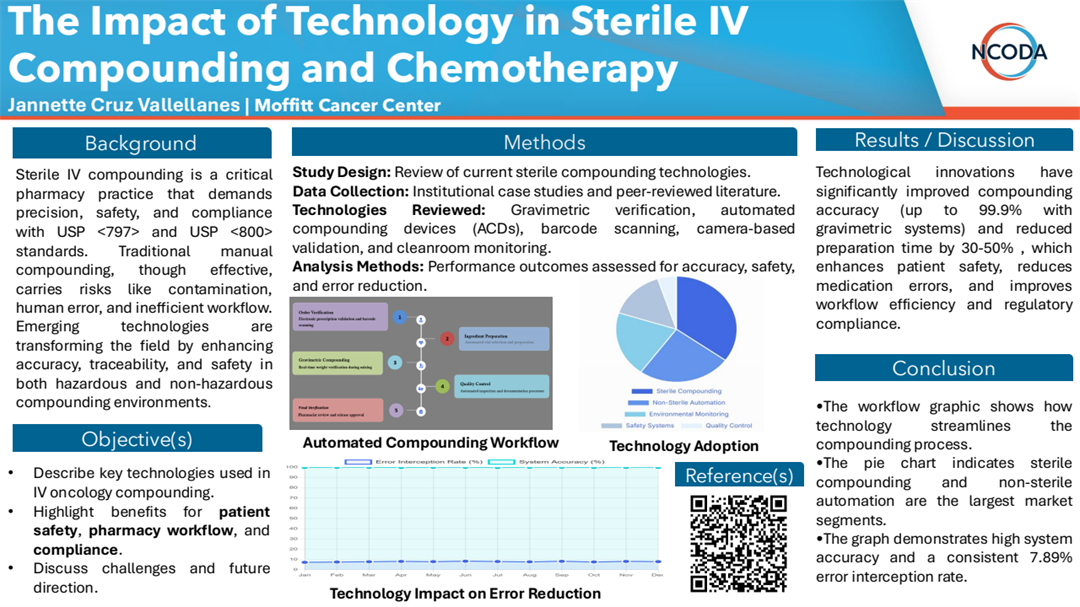
A review of current technologies used in sterile compounding was conducted, including gravimetric verification systems, automated compounding devices (ACDs), barcode scanning, camera-based validation, and cleanroom environmental monitoring tools. Institutional case studies and peer-reviewed literature were examined to evaluate performance improvements and error reduction.
Results:
Technological innovtions have significantly improved compounding accuracy (up to 99.9% with gravimetric systems), reduced preparation time by 30–50%, and enhanced documentation and audit readiness. Integration with eletronic health records (HER) and pharmacy information systems (PIS) has facilitated real-time verification and reduced transcription errors. Closed system drug-transfer devices (CSTDs) and robotic arms have further minimized occupational exposure to hazardous drug.
Conclusions:
The adoption of advanced technologies in sterile IV compounding enhances patient safety, reduces medication errors, improves workflow efficiency, and ensures regulatory compliance. As healtcare demands increase, leveraging technology is essential to optimize sterile compounding practices and support high-quality pharmaceutical care.
Funding: Not applicable.
Send your feedback
Please do not include any personal information or details.
"*" indicates required fields
Was this page
helpful?
Send your feedback
Please do not include any personal information or details.
"*" indicates required fields