
Structure-based identification of ATP13A3 inhibitors targeting polyamine transport in pancreatic ductal adenocarcinoma
1University of Central Florida College of Medicine
Background:
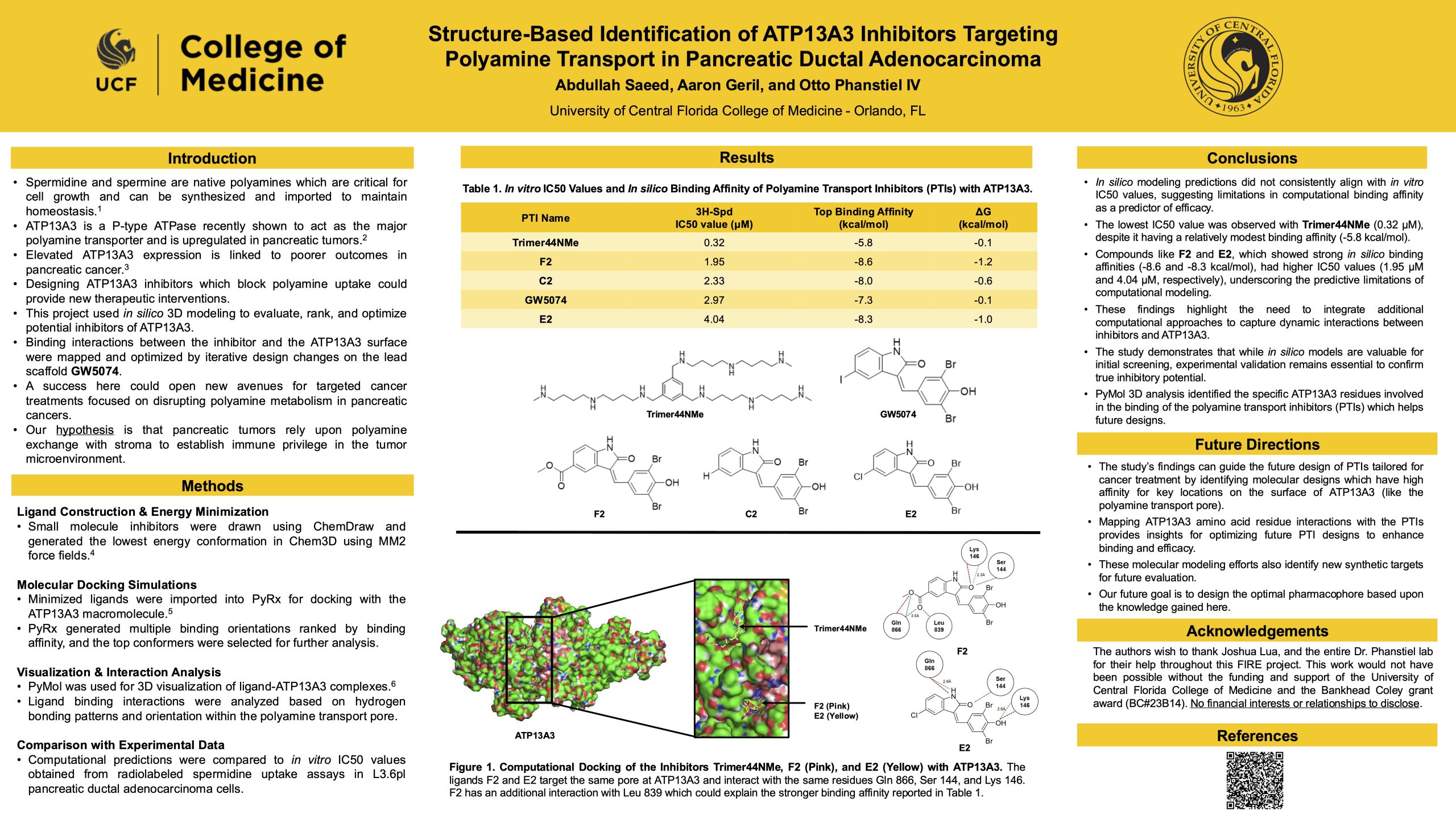
Pancreatic ductal adenocarcinoma (PDAC) is a highly lethal malignancy characterized by extensive metabolic reprogramming, including dysregulated polyamine metabolism. Polyamine biosynthesis inhibitors such as difluoromethylornithine (DFMO) reduce intracellular polyamine levels; however, tumor cells frequently evade therapy by upregulating polyamine import. ATP13A3, a recently identified polyamine transport protein, facilitates this compensatory mechanism and has been implicated in resistance to DFMO, positioning it as a promising therapeutic target.
Objectives:
- Describe the role of ATP13A3-mediated polyamine transport in resistance to polyamine biosynthesis inhibition in pancreatic ductal adenocarcinoma.
- Analyze the application of in silico molecular docking to identify and optimize ATP13A3 inhibitors.
- Evaluate how discrepancies between computational binding affinity and in vitro potency impact inhibitor selection in oncology drug development.
Methods:
Candidate inhibitory ligands were designed using ChemDraw and subjected to energy minimization in Chem3D to obtain low-energy conformations. A predicted 3D structure of ATP13A3 was obtained from AlphaFold. Virtual screening and molecular docking were performed using PyRx, employing the AutoDock algorithm to calculate binding affinities, free energy changes, and ligand binding orientations. Docking outputs were imported into PyMol for three-dimensional visualization, enabling analysis of ligand interactions with amino acid residues within the ATP13A3 polyamine transport channel and adjacent membrane-associated domains. Based on these on these structural insights, iterative ligand modifications were performed based on docking orientation and residue-level interaction analysis to optimize spatial orientation and target engagement prior to in vitroIC₅₀ evaluation.
Results:
Multiple candidate compounds demonstrated variable predicted binding affinities and inhibitory potency. Trimer44NMe emerged as the most potent inhibitor, exhibiting an IC₅₀ of 0.32 μM despite a moderate predicted binding affinity of −5.8 kcal/mol. In contrast, compounds F2 and E2 demonstrated stronger predicted binding affinities (−8.6 and −8.3 kcal/mol, respectively) but higher IC₅₀ values (1.95 μM and 4.04 μM). Structural analysis suggested that effective inhibition depended on ligand orientation and accessibility within the transport channel rather than binding affinity alone.
Conclusions:
ATP13A3 represents a viable therapeutic target for overcoming polyamine transport–mediated resistance in PDAC. Prior studies demonstrate that ATP13A3 expression directly influences DFMO sensitivity, supporting combination strategies targeting both polyamine synthesis and transport. In silico modeling is an effective screening and optimization strategy; however, binding affinity alone does not reliably predict biological potency. Trimer44NMe warrants further optimization and experimental evaluation, particularly in combination with DFMO, to enhance polyamine-targeted therapeutic strategies relevant to oncology pharmacy practice.
Funding: Not applicable.
Send your feedback
Please do not include any personal information or details.
"*" indicates required fields
Was this page
helpful?
Send your feedback
Please do not include any personal information or details.
"*" indicates required fields