

Early response matters: applying the response to ruxolitinib after 6 months model to optimize Janus kinase inhibitor therapy in myelofibrosis
1Florida Cancer Specialists & Research Institute
Background:
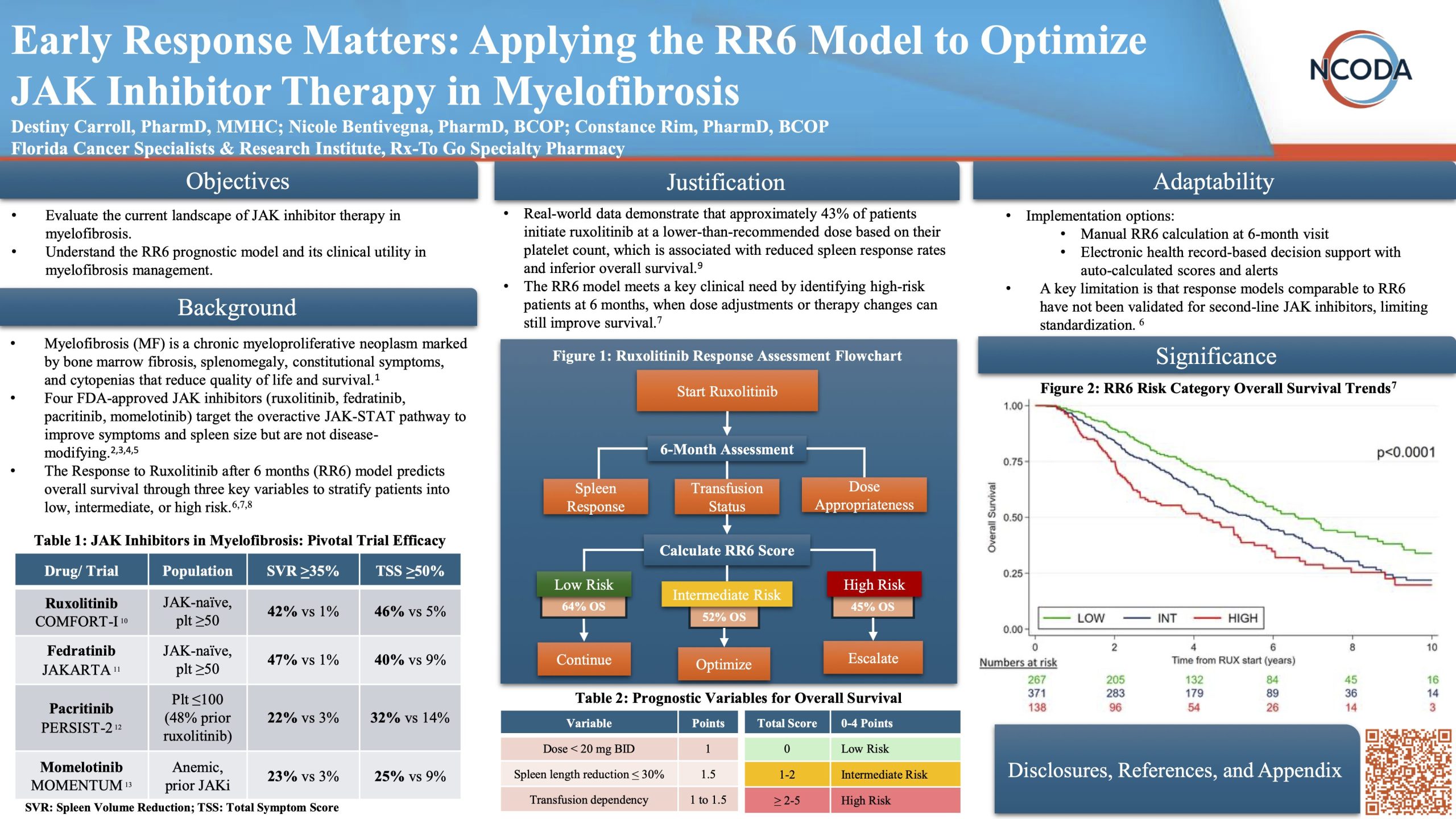
Janus kinase (JAK) inhibitors have transformed myelofibrosis, with four agents approved by the United States Food and Drug Administration (FDA): ruxolitinib, fedratinib, pacritinib, and momelotinib. These agents target the constitutively activated JAK-STAT pathway that characterizes myelofibrosis, providing symptom relief and spleen reduction with no disease-modifying ability. Ruxolitinib established the benchmark for treatment by demonstrating durable spleen volume reduction in approximately 60% of patients with advanced disease. The response to ruxolitinib after 6 months (RR6) model was developed to predict survival in myelofibrosis based on clinical response after 6 months of ruxolitinib. This prognostic tool stratifies patients to low-, intermediate-, and high-risk categories to help guide timely therapeutic decision-making.
Objectives:
- Evaluate the current landscape of JAK inhibitor therapy in myelofibrosis.
- Understand the RR6 prognostic model and its clincal utility in myelofibrosis management.
Justification:
The RR6 model addresses a critical clinical need by identifying patients at risk for poor outcomes through assessment of specific treatment-related factors at 6 months. Key components include ruxolitinib underdosing relative to platelet count (which carries a nearly 4-fold increased risk of mortality in intermediate-1 risk patients), inadequate spleen volume reduction, and transfusion dependence. Real-world data demonstrates that 43% of patients start at a lower than recommended dose, which correlates with reduced spleen response rates and inferior overall survival. The model provides objective criteria for early identification of patients who may benefit from therapy modification to alternative JAK inhibitors or combination strategies.
Adaptability:
Upon ruxolitinib failure identified by RR6 criteria, subsequent therapeutic options are selected based on individual patient factors, though clear evidence-based sequencing remains limited. Low-risk RR6 patients tolerating ruxolotinib may continue long-term if stable, while high-risk patients may need timely escalation to alternative therapies or transplant; this can be implemented clinically by calculating RR6 or through electronic health record (EHR)-based decision support tools that auto-calculate scores and trigger alerts for high-risk patients. Validated response assessment models for second-line agents are needed to improve survival rates after ruxolitinib discontinuation.
Significance:
RR6 integration into the NCCN Clinical Practice Guidelines in Oncology (NCCN Guidelines) allows for early identification of suboptimal responders. As the therapeutic landscape expands with newer JAK inhibitors and combination strategies, validated response assessment tools become increasingly important for optimizing outcomes.
Funding: Not applicable.
Send your feedback
Please do not include any personal information or details.
"*" indicates required fields
Was this page
helpful?
Send your feedback
Please do not include any personal information or details.
"*" indicates required fields