
Gedatolisib plus fulvestrant, with and without palbociclib, versus fulvestrant in patients with HR+/ HER2-/PIK3CA wild-type advanced breast cancer: first results from VIKTORIA-1
1Fred Hutchinson Cancer Center, University of Washington, Seattle, WA, USA; 2The University of Texas MD Anderson Cancer Center, Houston, TX, USA; 3Istituto Europeo di Oncologia, IRCCS, Milano, Italy; 4University of Milano, Milano, Italy; 5Weill Cornell Medical College, New York, NY, USA; 6The Ohio State University Comprehensive Cancer Center, Columbus, OH, USA; 7Moffitt Cancer Center, Tampa, FL, USA; 8Dana-Farber Cancer Center, Boston, MA, USA; 9Celcuity Inc, Minneapolis, MN, USA; 10Gustave Roussy, Villejuif, France
Background:
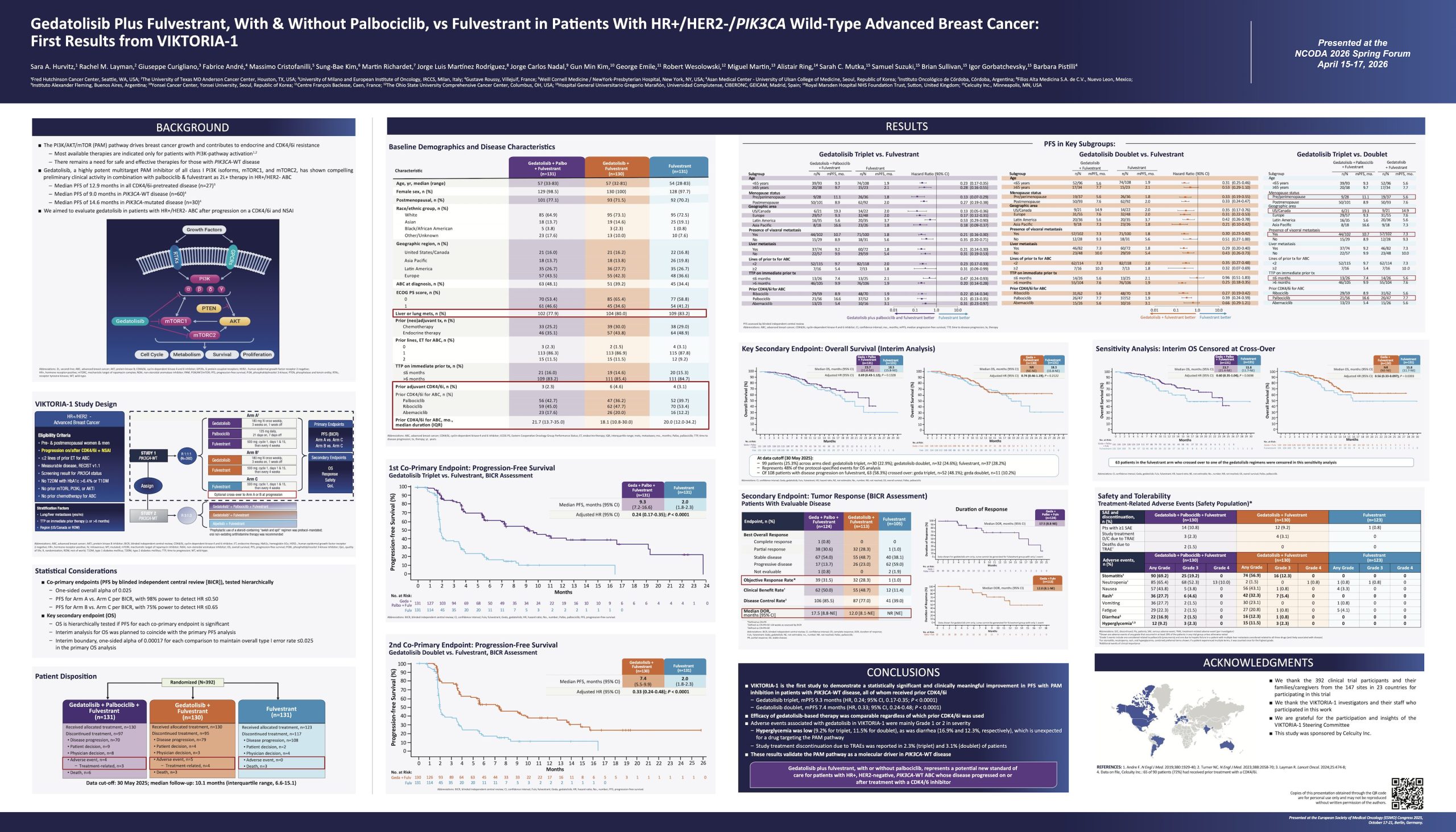
The phosphatidylinositol 3-kinase/protein kinase B/mammalian target of rapamycin (PI3K/AKT/mTOR [PAM]) pathway drives breast cancer growth and resistance to endocrine therapy (ET) and cyclin-dependent kinase 4/6 inhibitors (CDK4/6i). Combining PAM inhibition with ET + CDK4/6i after progression may restore sensitivity. However, most approved agents that target single components of this pathway require direct PI3K-pathway alteration for clinical benefit. Gedatolisib, a potent pan-class I PI3K and mammalian target of rapamycin complex 1/2 (mTORC1/2) inhibitor, blocks PAM signaling regardless of PIK3CA status. The phase 3 VIKTORIA-1 trial evaluates gedatolisib-based therapy in patients with HR+/HER2- advanced breast cancer (ABC) that progressed on or after standard therapy. Patients are enrolled to Study 1 or Study 2 based on PIK3CA status (wild-type [WT] versus [vs] mutated). Here, we encore Study 1 top-line safety and efficacy data.
Objectives:
- Analyze top-line safety and efficacy data from the VIKTORIA-1 trial.
Methods:
Eligible patients with HR+/HER2- ABC that progressed on/after CDK4/6i + nonsteroidal aromatase inhibitor (AI) and radiologically evaluable disease (per RECIST v1.1) with no prior chemotherapy for ABC and no prior PAM inhibitor therapy. Study 1 patients were randomized to gedatolisib plus palbociclib plus fulvestrant (triplet), gedatolisib plus fulvestrant (doublet), or fulvestrant alone, stratified by visceral metastases, time to radiologic disease progression on immediate prior therapy, and geographic region. Patients in the fulvestrant arm could cross over to gedatolisib treatment upon progression. Co-primary endpoints were progression-free survival (PFS), assessed by blinded independent central review (BICR), for the triplet vs fulvestrant and the doublet vs fulvestrant.
Results:
At data cut-off (May 30, 2025), 392 pts with PIK3CA WT disease had been randomized. Median study follow-up was 10.1 months. The trial met its primary endpoints, with median PFS (mPFS) for the triplet vs fulvestrant of 9.3 vs 2.0 months (HR, 0.24; 95% CI, 0.17-0.35; P<0.0001) and for the doublet vs fulvestrant of 7.4 vs 2.0 months (HR, 0.33; 95% CI, 0.24-0.48; P<0.0001), with consistent benefit across prespecified subgroups. Overall survival (OS) data were immature but favored the gedatolisib arms. Safety profiles were generally consistent with the individual agents. Discontinuation rates due to treatment-related adverse events (TRAEs) were low (2.3% for triplet; 3.1% for doublet).
Conclusions:
These data support gedatolisib combination therapy as a potential new standard of care for the second-line treatment of patients with HR+/HER2-/PIK3CA WT ABC.
Funding: Celcuity Inc.
Prior Presentations:
Presented at the European Society of Medical Oncology (ESMO) Congress 2025, October 17-21, Berlin, Germany.
Send your feedback
Please do not include any personal information or details.
"*" indicates required fields
Was this page
helpful?
Send your feedback
Please do not include any personal information or details.
"*" indicates required fields