

Gedatolisib, a multitarget PI3K/AKT/mTOR inhibitor, plus fulvestrant with or without palbociclib for second-line treatment of patients with HR+/HER2-/ PIK3CA-WT advanced breast cancer: updated results from the randomized, phase 3 VIKTORIA-1 trial
1Gustave Roussy, Villejuif, France; 2The University of Texas MD Anderson Cancer Center, Houston, TX, USA; 3Istituto Europeo di Oncologia, IRCCS, Milano, Italy; 4University of Milano, Milano, Italy; 5Weill Cornell Medical College, New York, NY, USA; 6The Ohio State University Comprehensive Cancer Center, Columbus, OH, USA; 7Moffitt Cancer Center, Tampa, FL, USA; 8Dana-Farber Cancer Center, Boston, MA, USA; 9Celcuity Inc, Minneapolis, MN, USA; 10Fred Hutchinson Cancer Center, University of Washington, Seattle, WA, USA
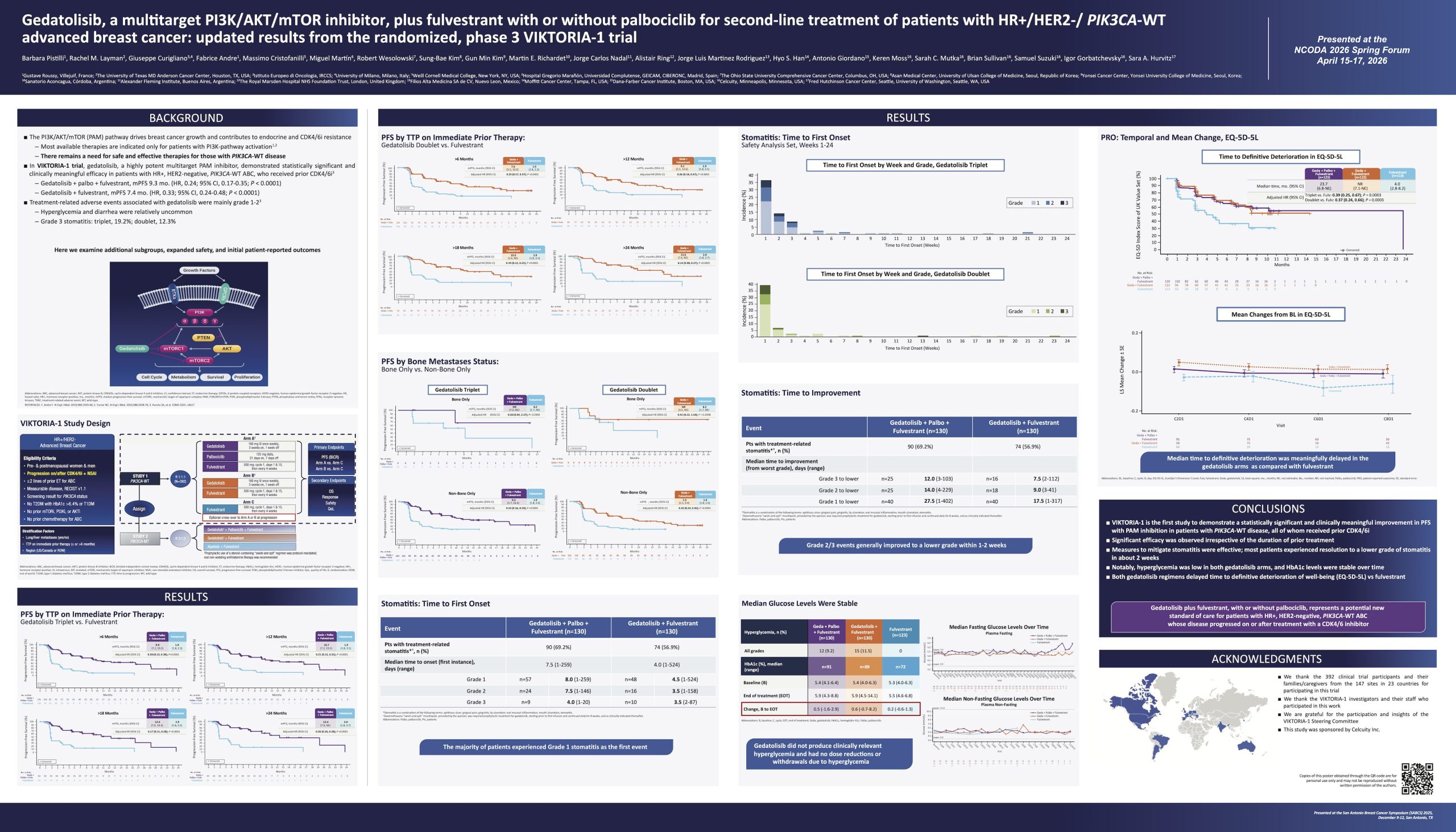
Background: The phosphatidylinositol 3-kinase/protein kinase B/mammalian target of rapamycin (PI3K/AKT/mTOR [PAM]) pathway drives breast cancer growth and resistance to endocrine therapy (ET) and cyclin-dependent kinase 4/6 inhibitors (CDK4/6i). Combining PAM inhibition with ET plus CDK4/6i after progression may restore sensitivity and provide benefit independent of PI3K pathway alterations. Gedatolisib (geda), a potent pan–class I phosphatidylinositol 3-kinase (PI3K) and mammalian target of rapamycin complex 1/2 (mTORC1/2) inhibitor, blocks PAM signaling regardless of PIK3CA status. The phase 3 VIKTORIA-1 trial evaluates gedatolisib-based therapy in patients with hormone receptor–positive (HR+)/human epidermal growth factor receptor 2–negative (HER2−) advanced breast cancer (ABC) that progressed on or after standard therapy. Patients are enrolled into Study 1 or Study 2 based on PIK3CA status (wild-type [WT] versus [vs] mutated). Here, we present updated subgroup, safety, and quality-of-life (QOL) data from Study 1.
Objectives:
Analyze updated subgroup, safety, and quality of life data from the VIKTORIA-1 trial.
Methods:
Eligible patients had HR+/HER2− ABC that progressed on or after CDK4/6i plus a nonsteroidal aromatase inhibitor (AI) and had radiologically evaluable disease per Response Evaluation Criteria in Solid Tumors (RECIST) version 1.1, with no prior chemotherapy for ABC and no prior PAM inhibitor therapy (PAMi). Study 1 patients were randomized to gedatolisib plus palbociclib plus fulvestrant (triplet), gedatolisib plus fulvestrant (doublet), or fulvestrant alone, stratified by visceral metastases, time to radiologic disease progression (TTP) on immediate prior therapy, and geographic region.
Results:
As previously reported, Study 1 met its co-primary endpoints, demonstrating statistically and clinically meaningful progression-free survival (PFS) with gedatolisib (median PFS [mPFS], 9.3 vs 2.0 months for triplet vs fulvestrant [HR, 0.24; 95% CI, 0.17–0.35; P < .0001] and 7.4 vs 2.0 months for doublet vs fulvestrant [HR, 0.33; 95% CI, 0.24–0.48; P < .0001]). Subgroup analyses showed benefit regardless of TTP on immediate prior therapy (>6, >12, >18, and >24 months) and in patients with bone-only disease. Median time to onset of treatment-related stomatitis generally occurred within the first treatment week. Median time to improvement from the worst grade was approximately 2 weeks. Gedatolisib did not produce clinically relevant hyperglycemia. QOL, assessed using the EuroQol 5-Dimension 5-Level (EQ-5D-5L) instrument, showed improvements in median time to deterioration for the gedatolisib arms compared with fulvestrant. EQ-5D-5L scores remained stable with gedatolisib from cycles 1 through 8. With fulvestrant, declines began at cycle 6 and remained below baseline at cycle 8.
Conclusions:
These data support gedatolisib combination therapy as a potential new standard of care for the second-line treatment of patients with HR+/HER2-/PIK3CA WT ABC.
Funding: Celcuity Inc.
Prior Presentations:
Presented at the San Antonio Breast Cancer Symposium (SABCS) 2025, December 9-12, San Antonio, TX.
Send your feedback
Please do not include any personal information or details.
"*" indicates required fields
Was this page
helpful?
Send your feedback
Please do not include any personal information or details.
"*" indicates required fields