
Efficacy and durability of belantamab mafodotin plus pomalidomide and dexamethasone treatment from long-term follow-up of the phase 3 DREAMM-8 study
1Department of Medical Oncology and Hematology, Princess Margaret Cancer Centre, Toronto, ON, Canada; 2Department of Hematology, Ankara Liv Hospital, Istinye University, Ankara, Turkey; 3Department of Internal Medicine, Hematology and Oncology, University Hospital Brno, Brno, Czech Republic; 4General Hospital Evangelismos, Athens, Greece; 5Leningrad Regional Clinical Hospital, Saint Petersburg, Russian Federation; 6University of Melbourne, St Vincent’s Hospital Melbourne, Melbourne, VIC, Australia; 7First Faculty of Medicine, Charles University and General Hospital, Prague, Czech Republic; 84th Department of Internal Medicine – Hematology, University Hospital Hradec Králové, Charles University, Faculty of Medicine in Hradec Králové, Hradec Králové, Czech Republic; 9Medical University of Łódź, Łódź, Poland; 10Sungkyunkwan University, Samsung Medical Center, Seoul, Republic of Korea; 11Department of Medical and Surgical Sciences, University of Bologna, Bologna, Italy; 12Division of Clinical Oncology/Hematology, Department of Internal Medicine, Jikei University School of Medicine, Tokyo, Japan; 13South Region Research Office, Florida Cancer Specialists & Research Institute, Fort Myers, FL, USA; 14GSK, Stevenage, UK; 15GSK, Durham, NC, USA; 16GSK, Collegeville, PA, USA; 17GSK, Warsaw, Poland; 18GSK, London, UK; 19Hematology Department, University Hospital of alamanca/IBSAL/Cancer Research Center-IBMCC (USAL-CSIC), Salamanca, Spain; 20Department of Clinical Therapeutics, School of Medicine, National and Kapodistrian University of Athens, Athens, Greece, Department of Medicine, Korea University, Seoul, Republic of Korea
Background:
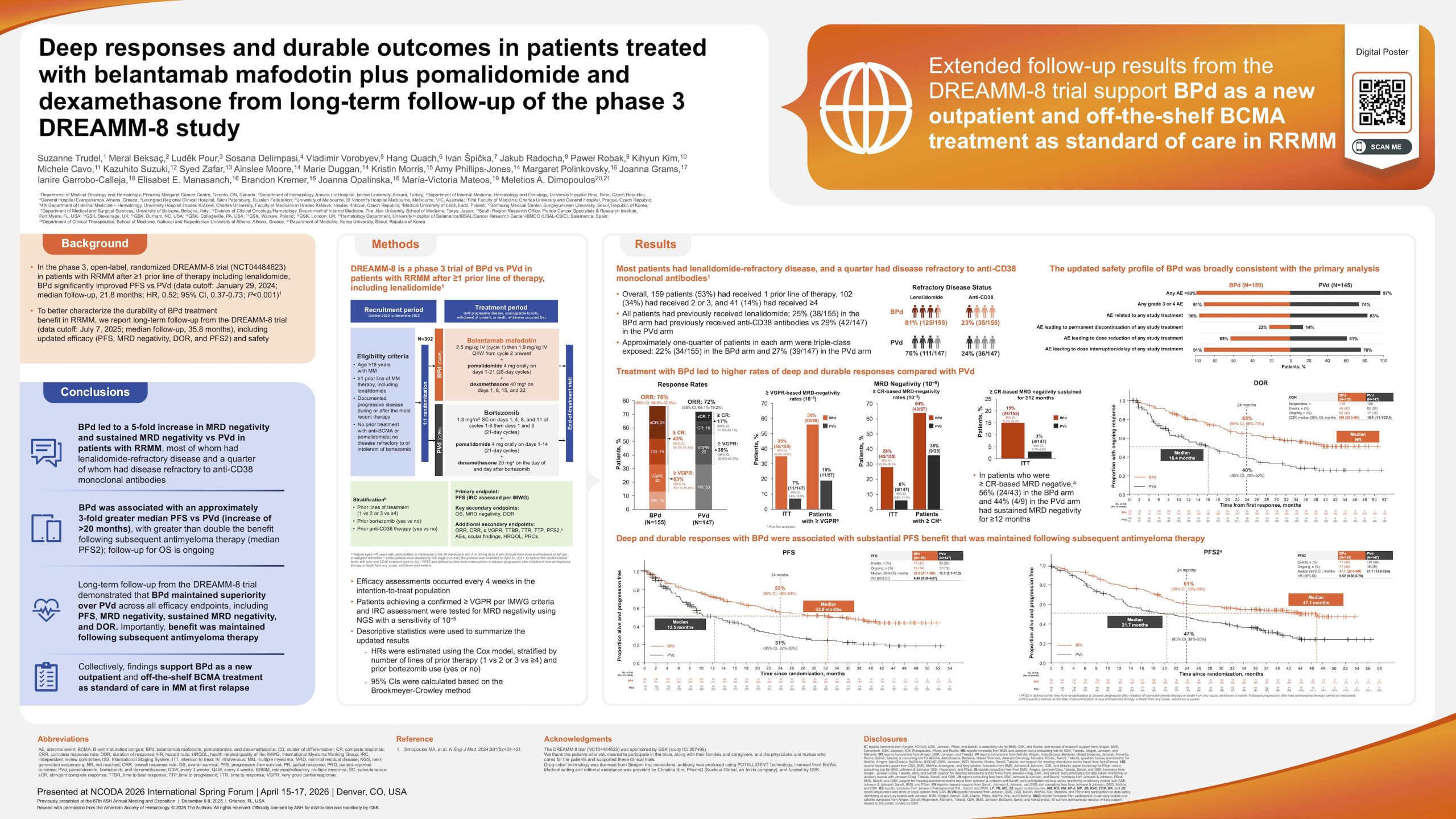
Patients with multiple myeloma (MM) often experience relapse after frontline triplet or quadruplet regimens, indicating a need for effective, durable, and accessible treatments for patients exposed to standardof-care (SOC) therapies at first relapse. In DREAMM-8 (NCT04484623), belantamab mafodotin, pomalidomide, and dexamethasone (BPd) significantly improved progression-free survival (PFS) versus (vs) pomalidomide, bortezomib, and dexamethasone (PVd) in patients with relapsed/refractory multiple myeloma (RRMM) who received ≥1 prior line of treatment (LOT). This long term follow-up was conducted to further examine the durability of BPd treatment benefit.
Objectives:
Characterize the durability of belantamab mafodotin plus pomalidomide and dexamethasone treatment with long-term follow up in patients with relapsed/refractory multiple myeloma who received ≥1 prior line of treatment.
Methods:
DREAMM-8 is a phase 3, open label, randomized study evaluating BPd vs PVd in patients with RRMM with ≥1 prior LOT, including lenalidomide. Treatment efficacy was assessed every 4 weeks. The primary endpoint was PFS; secondary endpoints included duration of response (DOR), minimal residual disease (MRD) negativity, progression-free survival-2 PFS2, response rates, and safety.
Results:
At a median follow-up of 35.8 months, 302 patients received either BPd (n=155) or PVd (n=147) treatment (data cutoff (DCO): July 7, 2025). Median PFS (95% CI) was 32.6 months (21.1 months-not reached [NR]) with BPd and 12.5 months (9.1-17.6 months) with PVd (hazard ratio [HR], 0.49; 95% CI, 0.36-0.67). Median DOR with BPd vs PVd (95% CI) was NR (29.5 months-NR) vs 16.3 months (11.1-22.5 months), respectively. The BPd arm continued to demonstrate benefits after first subsequent therapy, with median PFS2 (95% CI) of 47.1 months (28.4 months-NR) with BPd and 21.7 months (13.8-28.6 months) with PVd (HR, 0.52; 95% CI, 0.38-0.70). Patients treated with BPd vs PVd had deeper responses: 43% vs 17% had complete response or better (≥ CR), 28% vs 6% had MRD negativity plus ≥ CR, and 15% vs 3% had sustained MRD negativity for ≥ 12 months, respectively. Grade 3/4 adverse events (AEs) and fatal serious AEs occurred in 91% and 14% of patients treated with BPd, respectively, compared with 74% and 13% with PVd; 22% of patients treated with BPd and 14% with PVd experienced AEs that led to treatment discontinuation.
Conclusions:
Extended follow-up of the DREAMM-8 trial demonstrated that BPd continued to have deeper and more durable responses vs PVd, with higher rates of ≥ CR and MRD negativity and longer PFS and PFS2. Safety results were consistent with the primary analysis. These results, along with the ease of administration in the outpatient setting, further support the use of BPd as a new SOC in RRMM.
Funding: GSK.
Prior Presentations:
Presented at the American Society of Hematology (ASH) Annual Meeting 2025, December 6-9, Orlando, FL.
Send your feedback
Please do not include any personal information or details.
"*" indicates required fields
Was this page
helpful?
Send your feedback
Please do not include any personal information or details.
"*" indicates required fields