

Development of ambulatory oncology clinical pharmacy key performance indicators using a modified Delphi consensus approach
1University of Waterloo, Waterloo, Ontario, Canada
Background:
Consensus is lacking on a means of tracking and measuring the impact of ambulatory oncology pharmacy services. Key performance indicators (KPIs), which are defined as quantifiable measures used to track the quality of various processes while determining whether institutional goals are being met, are often used in health care for this purpose. While KPIs have been developed in other pharmacy therapeutic settings, no such effort has been made to date in ambulatory oncology practice.
Objectives:
- Describe what an ambulatory oncology clinical pharmacy key performance indicator (AOcpKPI) is and what it is used for.
- Explain the need for AOcpKPIs in oncology pharmacy practice and how they are involved in qualitycare and innovation.
- Understand the process by which consensus AOcp-KPIs were created.
- Identify barriers and facilitators to implementation of AOcpKPIs into clinical practice and pharmacy workflow.
Methods:
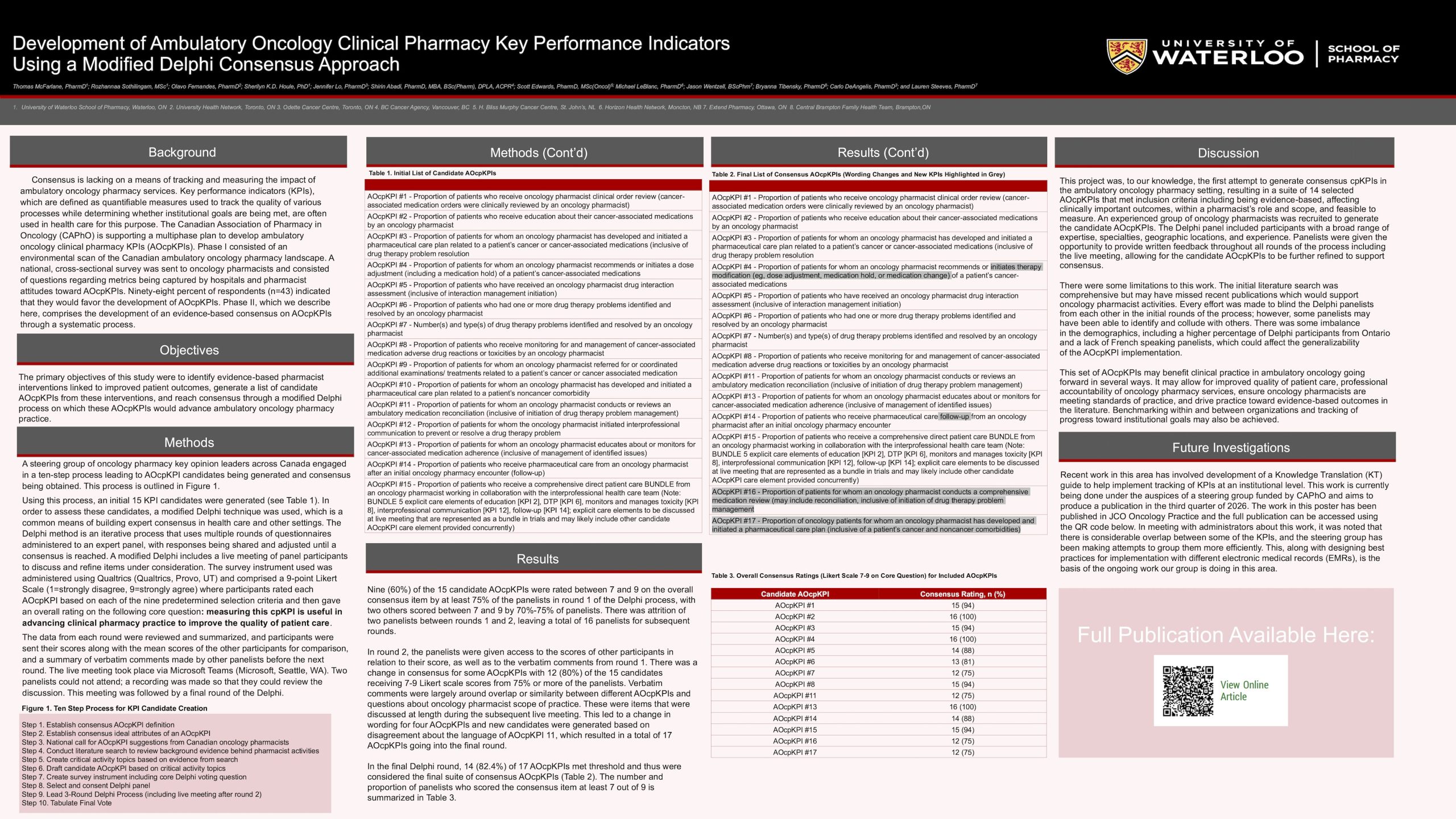
A systematic, modified Delphi process was used to reach consensus on AOcpKPIs. Following an environmental scan of current oncology pharmacy practices across Canada, a literature review identified critical activities linked to patient-centered outcomes. A panel of oncology pharmacists engaged in three Delphi rounds and a virtual live meeting, assessing and refining candidate AOcpKPIs on the basis of predefined criteria. A total of 17 candidate AOcpKPIs were evaluated.
Results:
Consensus was achieved on 14 AOcpKPIs. These AOcpKPIs reflect critical pharmacist activities including clinical order review, patient education, medication adherence assessment, and management of drug therapy problems. This suite of AOcpKPIs provides a standardized approach for evaluating oncology pharmacist activities in ambulatory care, facilitating benchmarking and supporting evidence-based improvements in patient outcomes.
Conclusions:
This work represents a significant advancement in defining quality metrics for ambulatory oncology pharmacy practice. The consensus-based AOcpKPIs provide a foundation for enhanced patient care, professional accountability, and continuous quality improvement within oncology pharmacy. Implementing these AOcpKPIs has the potential to elevate oncology pharmacy practice, supporting pharmacists in meeting evolving health care demands and fostering evidence-based patient outcomes. Next steps include defining and grouping AOcpKPIs to be more useable and developing a knowledge translation guide for implementation.
Funding: Not applicable
Send your feedback
Please do not include any personal information or details.
"*" indicates required fields
Was this page
helpful?
Send your feedback
Please do not include any personal information or details.
"*" indicates required fields