
Building competency in oral anticancer medication adherence: A survey-driven education and training initiative across a multi-site oncology system
1Ambulatory Professional Development UCHealth University of Colorado, Aurora, CO, USA; 2UCHealth University of Colorado Cancer Center, Aurora, CO, USA
Background:
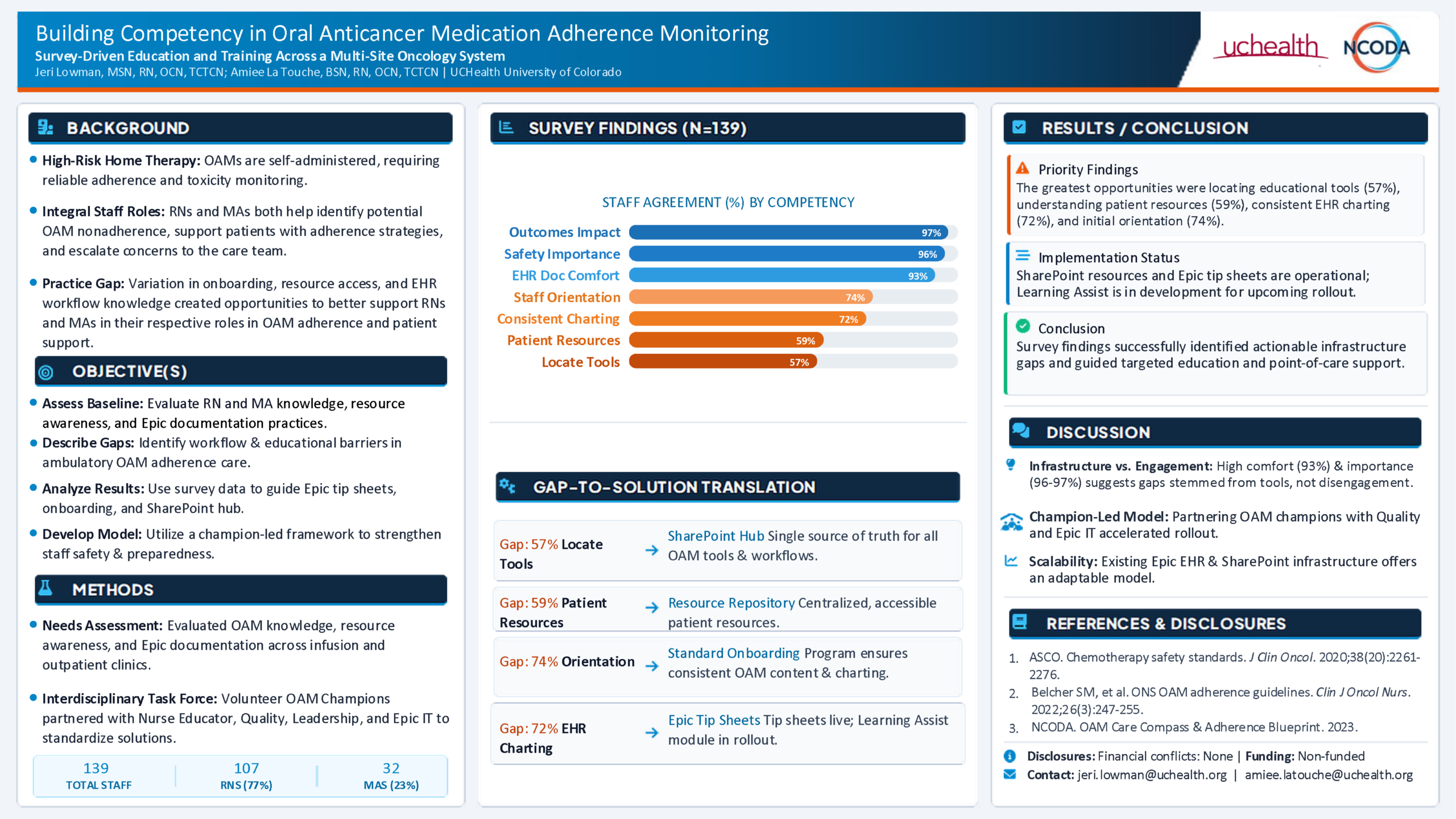
Oral anticancer medications (OAMs) are highrisk therapies because patients self-administer treatment at home, requiring oncology staff to consistently assess adherence, provide education, monitor toxicity, and document care to support safe outcomes. Across a multi-site ambulatory oncology system, variability in onboarding, resource awareness, documentation training, and workflow expectations contributed to inconsistent staff preparedness to support OAM adherence.
Objectives:
- Describe educational and workflow gaps affecting oral anticancer medication adherence support across ambulatory oncology settings.
- Analyze survey findings used to guide development of centralized resources, onboarding support, Epic tip sheets, and education.
- Evaluate a champion-led education model to strengthen staff preparedness, documentation consistency, and patient safety.
Justification:
Oncology nurses and medical assistants play a critical role in OAM safety through patient education, adherence assessment, documentation, and identification of adherence barriers. Internal review suggested that practice variation was driven less by lack of clinician engagement and more by inconsistent educational infrastructure, decentralized resources, and unclear documentation expectations. Strengthening education, onboarding, and training was therefore identified as a system-level priority to improve staff preparedness and support safer, more consistent OAM management.
Assessment:
A learning needs assessment evaluated staff knowledge, preparedness, resource awareness, and documentation practices related to OAM adherence management. A total of 139 oncology staff participated, including 107 registered nurses and 32 medical assistants from infusion and clinic settings. Results demonstrated strong engagement: 96% agreed OAM adherence monitoring and documentation are important for patient safety, 97% recognized its impact on clinical outcomes, and 93% felt comfortable documenting adherence in the electronic health record (EHR). However, opportunities for improvement were identified, with only 74% reporting adequate orientation, 72% perceived documentation practices as consistent, 57% knowing how to locate educational tools, and 59% understanding available patient resources. These findings indicated a need for consistent orientation, easier access to resources, clearer documentation guidance, and standardized training, prompting targeted interventions such as centralized resources, onboarding support, competency-based materials, Epic documentation guidance, and additional educational tools.
Adaptability:
Using survey findings, volunteer members of the OAM Champion Group formed a task force with clinical quality, nurse education, leadership, and Epic information technology to translate learning gaps into targeted educational interventions. Actions included a centralized SharePoint hub as a single source of truth for OAM resources, standardized Epic tip sheets to support adherence documentation workflows, and onboarding resources focused on role-specific OAM practice expectations. An Epic Learning Assist module is currently in development to provide standardized, just-in-time education and reinforce competency in OAM adherence documentation. Once finalized, mandatory completion is planned for applicable oncology staff responsible for addressing OAM adherence and will be incorporated into orientation for new staff in relevant oncology roles. This model leverages existing electronic health record functionality and centralized resource management, making it adaptable for oncology programs seeking to reduce practice variation, improve adherence monitoring, and enhance patient safety.
Conclusion:
This initiative demonstrates how a survey-driven learning needs assessment can identify educational gaps, guide targeted resource development, and establish sustainable competency support for oncology staff managing OAMs. Aligning champion-led education, centralized resources, onboarding support, standardized Epic guidance, and future mandatory Learning Assist completion provides a scalable framework to improve staff preparedness, documentation consistency, and patient safety while supporting long-term competency development in OAM management across oncology practice settings.
Funding: Not applicable.
Send your feedback
Please do not include any personal information or details.
"*" indicates required fields
Was this page
helpful?
Send your feedback
Please do not include any personal information or details.
"*" indicates required fields