
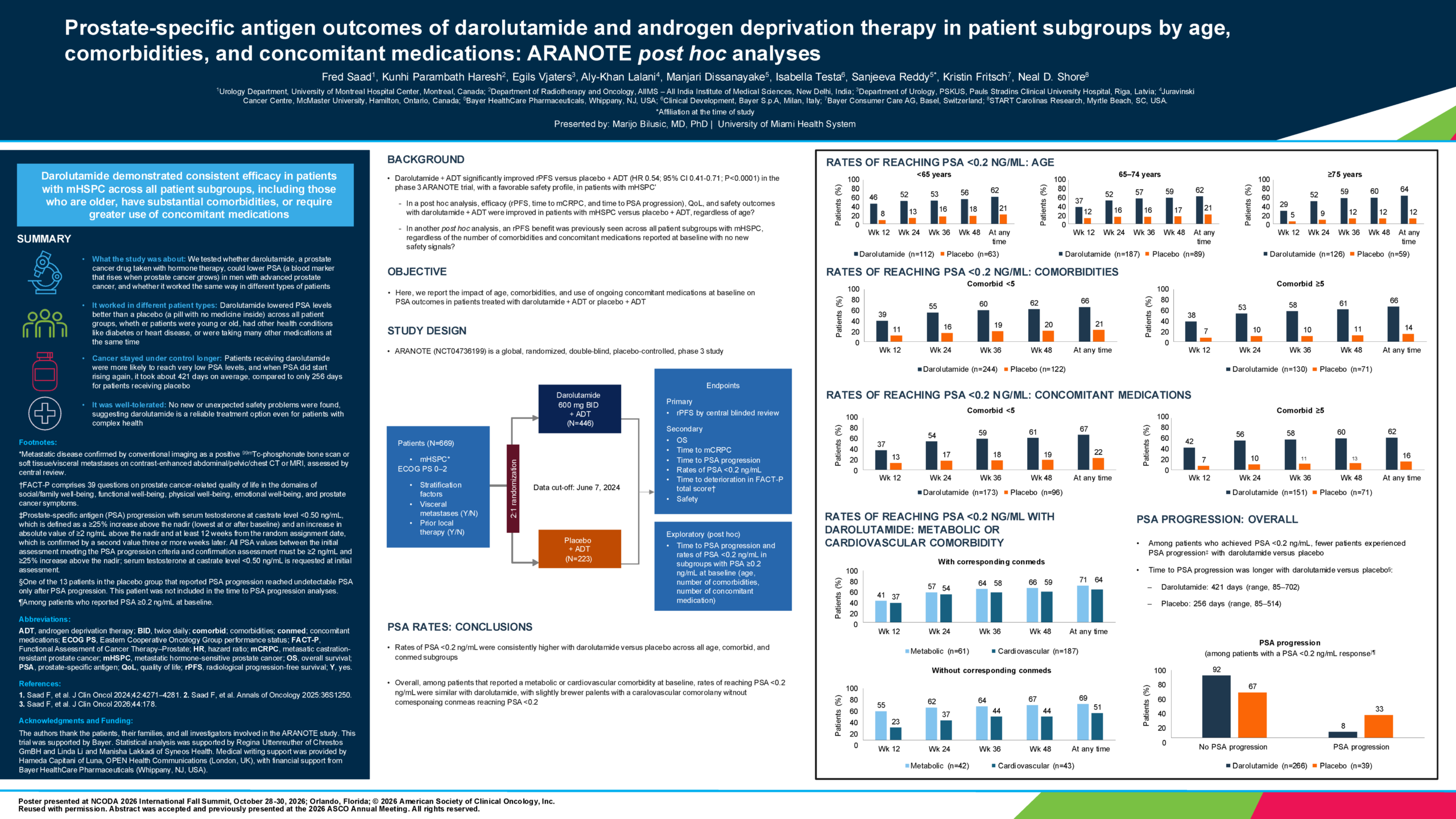
Prostate-specific antigen outcomes of darolutamide and androgen deprivation therapy in patient subgroups by age, comorbidities, and concomitant medications: ARANOTE post hoc analyses
1Urology Department, University of Montreal Hospital Center, Montreal, Canada; 2Department of Radiotherapy and Oncology, AIIMS – All India Institute of Medical Sciences, New Delhi, India; 3Department of Urology, PSKUS, Pauls Stradins Clinical University Hospital, Riga, Latvia; 4Juravinski Cancer Centre, McMaster University, Hamilton, Ontario, Canada; 5Bayer HealthCare Pharmaceuticals, Whippany, NJ, USA; 6Clinical Development, Bayer S.p.A, Milan, Italy; 7Bayer Consumer Care AG, Basel, Switzerland; 8START Carolinas Research, Myrtle Beach, SC, USA.
*Affiliation at the time of study
Background:
Darolutamide (DARO) plus androgen deprivation therapy (ADT) significantly improved radiological progression-free survival (hazard ratio [HR], 0.54; 95% confidence interval [CI], 0.41–0.71; P<0.0001) versus placebo (PBO) plus ADT in patients with metastatic hormone-sensitive prostate cancer (mHSPC) in the phase 3 ARANOTE trial (NCT04736199), with a favorable safety profile.
Objectives:
- Identify prostate-specific antigen (PSA) outcomes with darolutamide in patients with mHSPC across subgroups defined by age, comorbidities, and concomitant medication use.
- Evaluate the efficacy benefit of darolutamide in patients with mHSPC with older age, substantial comorbidities, and greater use of concomitant medications.
Purpose:
To report the impact of age, comorbidities, and use of concomitant medications ongoing at baseline on PSA outcomes in patients treated with DARO or PBO.
Methods:
Patients were randomized 2:1 to DARO 600 mg orally twice daily or PBO, both with ADT. Patients were grouped by age and number/type of comorbidities or concomitant medications reported at baseline. Descriptive statistics (post hoc) summarized baseline demographics, disease characteristics, and PSA outcomes by age, comorbidity, and concomitant medication subgroups.
Results:
Baseline demographics and disease characteristics were generally similar between DARO (n=446) and PBO (n=223) across all subgroups by age (<65, 65–74, or ≥75 years), comorbidities (<5 or ≥5), and concomitant medications (<5 or ≥5), respectively. Rates of reaching PSA <0.2 ng/mL at any time were consistently higher with DARO versus PBO across all age (<65 years, 62% [n=69/112] versus 21% [n=13/63]; 65–74 years, 62% [n=116/187] versus 21% [n=19/89]; ≥75 years, 64% [n=81/126] versus 12% [n=7/59]), comorbidity (<5, 66% [n=160/244] versus 21% [n=26/122]; ≥5, 66% [n=86/130] versus 14% [n=10/71]), and concomitant medication (<5, 67% [n=115/173] versus 22% [n=21/96]; ≥5, 62% [n=93/151] versus 16% [n=11/71]) subgroups. With DARO, rates of reaching PSA <0.2 ng/mL at any time were consistent among patients with metabolic disorders with or without corresponding concomitant medications (71% [n=43/61] versus 69% [n=29/42]). The rate of reaching PSA <0.2 ng/mL was slightly lower in patients with cardiovascular disorders who were not receiving corresponding concomitant medications at baseline (51% [n=22/43]) compared with those receiving corresponding concomitant medications (64% [n=119/187]). A substantially lower rate of PSA progression was observed with DARO (8% [n=22/266]) versus PBO (33% [n=13/39]) among patients who reached PSA <0.2 ng/mL. Median time to PSA progression among patients who reached PSA <0.2 ng/mL was 421 days (range, 85–702) and 256 days (range, 85–514) for DARO and PBO, respectively.
Conclusion:
Overall, an efficacy benefit was observed with DARO irrespective of age and the number of comorbidities or concomitant medications reported at baseline in patients with mHSPC, including those with cardiovascular or metabolic disorders, with or without corresponding concomitant medications. These results support the use of DARO in mHSPC, even in patients with older age, substantial comorbidities, and greater use of concomitant medications.
Funding: Bayer.
Prior Presentations:
Presented at the 2026 American Society of Clinical Oncology (ASCO) Annual Meeting, May 29–June 2, 2026, in Chicago, IL, USA.
© 2026 American Society of Clinical Oncology, Inc. Reused with permission. This abstract was accepted and previously presented at the 2026 ASCO Annual Meeting. All rights reserved.
Send your feedback
Please do not include any personal information or details.
"*" indicates required fields
Was this page
helpful?
Send your feedback
Please do not include any personal information or details.
"*" indicates required fields