
Pharmacokinetic assessment of revumenib in patients with relapsed/refractory acute leukemias harboring a lysine methyltransferase 2A rearrangement or nucleophosmin 1 mutation: Impact of food and concomitant medications
1Syndax Pharmaceuticals, Inc., New York, NY; 2Certara Drug Development Solutions, Princeton, NJ; 3The University of Texas MD Anderson Cancer Center, Houston, TX
Background:
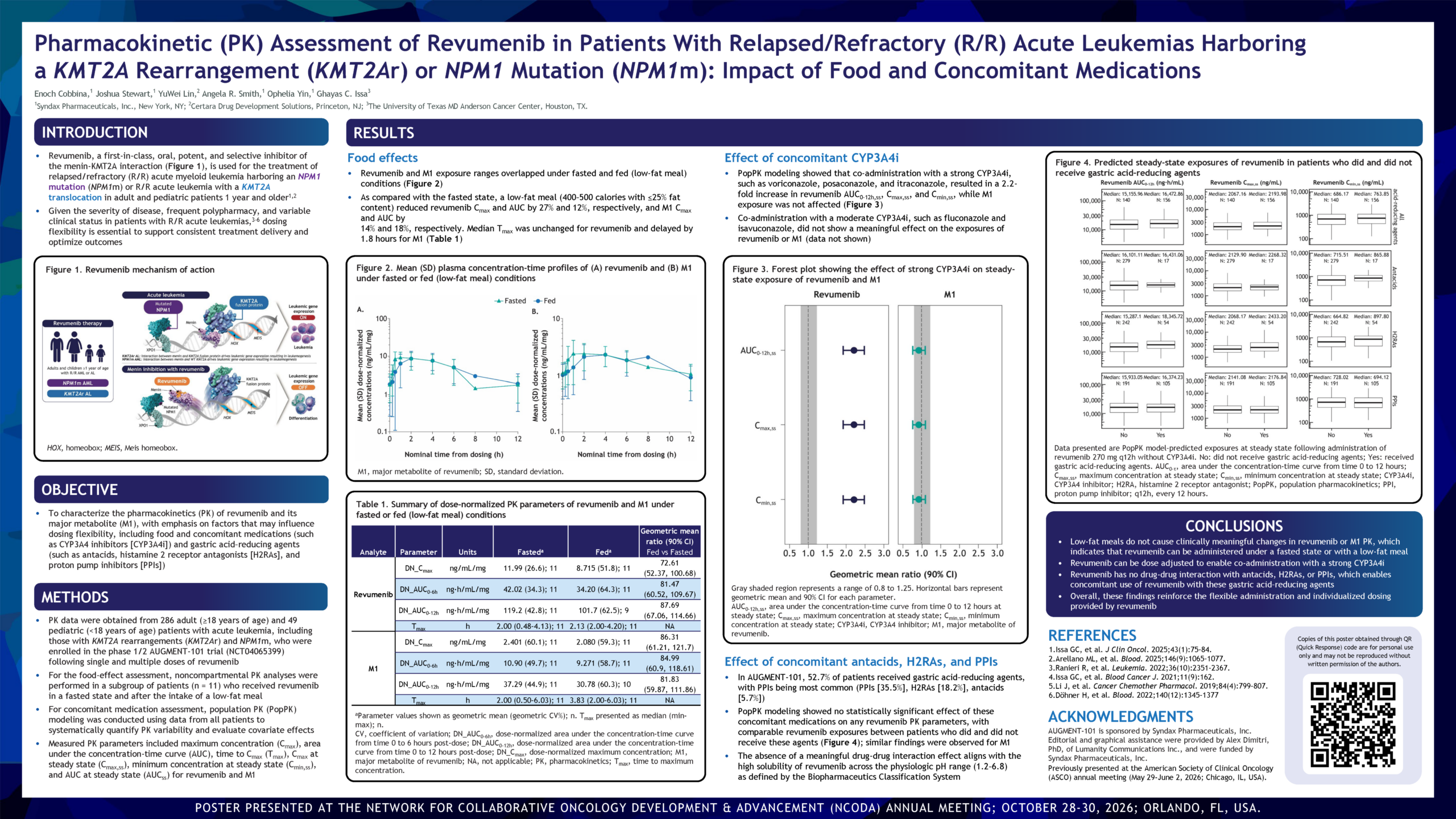
Revumenib is a first-in-class, oral, potent, and selective inhibitor of the menin-KMT2A interaction that disrupts multiple drivers of leukemogenesis, such as KMT2A rearrangements (KMT2Ar) and NPM1 mutations (NPM1m). Revumenib is approved in the United States for patients aged 1 year and older for the treatment of relapsed/refractory acute leukemia with a KMT2A translocation or relapsed/ refractory acute myeloid leukemia with a susceptible NPM1 mutation who have no satisfactory alternative treatment options. Given the severity of disease, frequent polypharmacy, and variable clinical status in this population, dosing flexibility is essential to support consistent treatment delivery and optimize outcomes.
Objectives:
- Describe how food intake, CYP3A4 inhibitors, and gastric acid-reducing agents (antacids, H2 blockers, and proton pump inhibitors) affect revumenib and the pharmacokinetics of its major metabolite (M1) and evaluate how these findings support flexible dosing in patients with acute leukemia.
- Identify the pharmacokinetic effects of strong versus moderate CYP3A4 inhibitors on revumenib exposure and explain the dose adjustment implications for patients receiving concomitant medications.
Purpose:
To characterize the pharmacokinetics (PK) of revumenib and its major metabolite (M1), with emphasis on factors that may influence dosing flexibility, including food and concomitant medications such as cytochrome P450 3A4 inhibitors (CYP3A4i) and gastric acid-reducing agents such as antacids, H2 blockers (H2Bs), and proton pump inhibitors (PPIs).
Study Design:
PK data were obtained from 286 adult (≥18 years) and 49 pediatric (<18 years) patients with KMT2Ar or NPM1m acute leukemia enrolled in the phase 1/2 AUGMENT- 101 trial (NCT04065399) following single and multiple doses of revumenib.
Methods:
Noncompartmental analyses were performed in selected subgroups, while population PK modeling was conducted using data from all patients to systematically quantify PK variability and evaluate covariate effects.
Results:
Compared with the fasted state, a low-fat meal (400–500 calories with <25% fat content) reduced revumenib maximum concentration (Cmax) and area under the curve (AUC) by 27% and 12%, respectively, and M1 Cmax and AUC by 14% and 18%, respectively, although exposure ranges overlapped under fasted and fed (low-fat meal) conditions. Median time to maximum concentration (Tmax) was unchanged for revumenib and delayed by 1.8 hours for M1. Coadministration with strong CYP3A4i (eg, voriconazole, posaconazole, itraconazole) resulted in an approximately 2-fold increase in revumenib Cmax and AUC, whereas moderate CYP3A4i (eg, fluconazole, isavuconazole) had no meaningful effect. M1 exposure was unaffected by strong or moderate CYP3A4i. Approximately 52% of patients received antacids, H2Bs, or PPIs; revumenib and M1 Cmax and AUC were not altered, consistent with the high solubility of revumenib across the physiological pH range (1.2–6.8).
Conclusion:
Revumenib exposure increases approximately 2-fold with strong CYP3A4i, supporting dose reduction in this setting, while M1 exposure remains unaffected. Low-fat meals do not cause clinically meaningful changes in revumenib or M1 PK. Similarly, antacids, H2Bs, and PPIs, which are frequently used in this patient population, had no impact on revumenib or M1 PK. These findings reinforce the flexible administration of revumenib, which may support treatment adherence and patient convenience.
Funding: Syndax Pharmaceuticals Inc.
Prior Presentations:
Presented at the 2026 American Society of Clinical Oncology (ASCO) Annual Meeting, May 29–June 2, 2026, in Chicago, IL, USA. © 2026 American Society of Clinical Oncology, Inc. Reused with permission. This abstract was accepted and previously presented at the 2026 ASCO Annual Meeting. All rights reserved.
Send your feedback
Please do not include any personal information or details.
"*" indicates required fields
Was this page
helpful?
Send your feedback
Please do not include any personal information or details.
"*" indicates required fields