
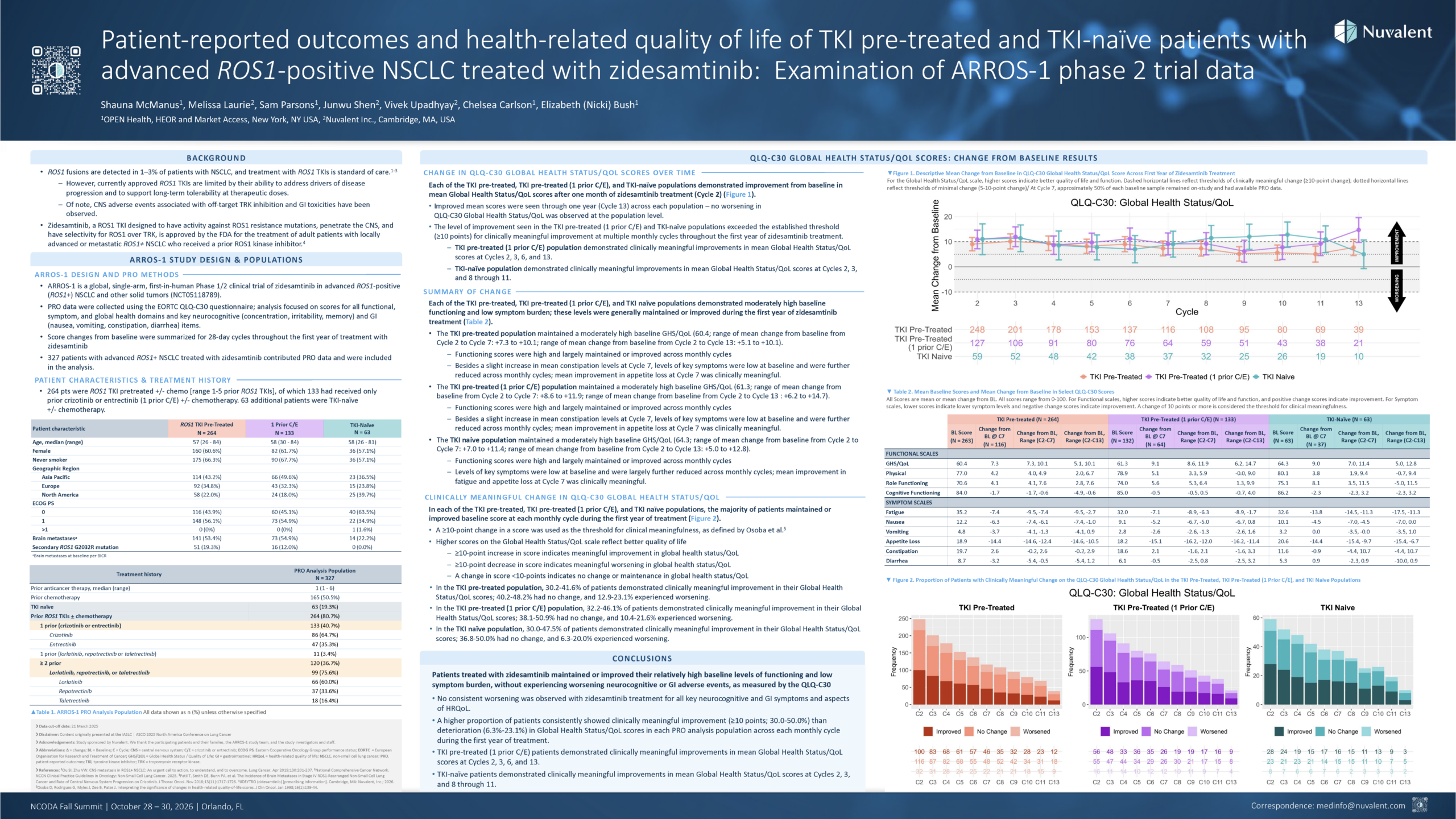
Patient-reported outcomes and healthrelated quality of life in patients with advanced ROS1-positive non-small cell lung cancer treated with zidesamtinib: ARROS-1 phase 2 trial data
1OPEN Health, HEOR and Market Access, New York, NY, USA; 2Nuvalent, Inc., Cambridge, MA, USA
Background:
ROS1 fusions are detected in 1%–2% of patients with non-small cell lung cancer (NSCLC), and treatment with ROS1 tyrosine kinase inhibitors (TKIs) is a standard of care. However, limitations remain in the ability of ROS1 TKIs to address drivers of disease progression and support long-term tolerability at therapeutic doses. Of note, central nervous system (CNS) adverse events associated with off-target tropomyosin-related kinase inhibition and gastrointestinal (GI) toxicities have been observed. Zidesamtinib is an investigational, brain-penetrant, ROS1-selective TKI developed with the aim of addressing the challenges of emergent treatment resistance and brain metastases that may limit the use of currently available ROS1 TKIs and affect patients’ health-related quality of life (HRQoL).
Objectives:
- Evaluate patient-reported outcomes data from TKI-pretreated and TKI-naÏve patients with advanced ROS1-positive NSCLC treated with zidesamtinib in the phase 2 ARROS-1 study.
- Summarize the effect of zidesamtinib treatment on HRQoL, including the impact on neurocognitive and GI symptoms, in patients with ROS1-positive NSCLC enrolled in ARROS-1.
Purpose:
To evaluate HRQoL following treatment with zidesamtinib in patients with advanced ROS1-positive NSCLC.
Study Design:
ARROS-1 (NCT05118789) is a phase 2 study evaluating the efficacy and safety of zidesamtinib in TKI-pretreated and TKI-naÏve patients with advanced ROS1-positive NSCLC and other ROS1-positive solid tumors. This analysis summarizes patient-reported outcomes from patients with advanced ROS1-positive NSCLC.
Methods:
Patient-reported outcomes data were collected using the European Organization for Research and Treatment of Cancer Core 30-item Quality of Life Questionnaire (EORTC QLQ-C30), which assesses HRQoL across functional, symptom, and global health domains, including neurocognitive- and GI-related issues, on a scoring scale of 0–100. Score changes from baseline were summarized for monthly cycles throughout the first year of treatment for all domains and key neurocognitive- and GI-specific items (concentration, irritability, memory, nausea, vomiting, constipation, and diarrhea). The data cutoff date was March 21, 2025.
Results:
Overall, 327 patients with advanced ROS1-positive NSCLC treated with zidesamtinib were included in the analysis: 264 were ROS1 TKI-pretreated (range, 1–5 prior ROS1 TKIs), 133 had received only 1 prior ROS1 TKI of crizotinib or entrectinib, and 63 were TKI-naÏve. Demographic and clinical characteristics were similar across groups at baseline; 59.9% of patients were female, and the median age was 58 years (range, 26–84). Reports of physical and cognitive functioning (score ranges, 77.0–80.1 and 84.0–86.2, respectively) and global health status/quality of life (GHS/QoL; score range, 60.4–64.3) were also similar. All groups demonstrated improvement in mean GHS/QoL scores after 1 month of treatment (cycle 2), with the group that received 1 prior ROS1 TKI of crizotinib or entrectinib and the TKI-naïve group exceeding the established threshold (≥10 points) for a clinically meaningful difference. Improved levels were maintained through 1 year (cycle 13) across all groups. Mean changes from baseline for key neurocognitive and GI symptoms remained stable or improved throughout treatment.
Conclusion:
Despite reporting relatively high levels of function at baseline as measured by the EORTC QLQ-C30, maintenance or improvement was observed with zidesamtinib treatment for all symptoms and aspects of HRQoL regardless of prior treatment, with no meaningful worsening in neurocognitive or GI symptoms.
Funding: Nuvalent, Inc.
Prior Presentations:
Presented at the International Association for the Study of Lung Cancer (IASLC) | American Society of Clinical Oncology (ASCO) 2025 North American Conference on Lung Cancer (NACLC), December 5–7, 2025, in Chicago, IL, USA.
Send your feedback
Please do not include any personal information or details.
"*" indicates required fields
Was this page
helpful?
Send your feedback
Please do not include any personal information or details.
"*" indicates required fields