
Overall survival, progression and nonrelapse mortality with teclistamab plus daratumumab versus daratumumab-based triplets in relapsed/refractory multiple myeloma: MajesTEC-3 post hoc analysis
1Division of Hematology and Oncology, University of Alabama at Birmingham, Birmingham, AL, USA; 2Arnie Charbonneau Cancer Institute, University of Calgary, Calgary, AB, Canada; 3Universite de Toulouse, Centre Hospitalier Universitaire, Service d’Hematologie, Institut Universitaire du Cancer de Toulouse Oncopole, Cancer Research Center of Toulouse, Toulouse, France; 4Emory University, Winship Cancer Institute, Atlanta, USA; 5>Peking University People’s Hospital, Peking University Institute of Hematology, National Clinical Research Center for Hematologic Disease, Beijing, China; 6Royal Marsden NHS Foundation Trust, London, UK; 7Institute of Cancer Research, London, UK; 8Division of Hematology, Department of Molecular Biotechnology and Health Sciences, AOU Città della Salute e della Scienza di Torino, University of Turin, Turin, Italy; 9Department of Clinical Therapeutics, National and Kapodistrian University of Athens, School of Medicine, Athens, Greece; 10Department of Medicine, Korea University, Seoul, South Korea; 11IRCCS Azienda Ospedaliero Universitaria di Bologna, Istituto di Ematologia Serágnoli, Bologna, Italy; 12Dipartimento di Scienze Mediche e Chirurgiche, Università di Bologna, Bologna, Italy;13Stanford University School of Medicine, Palo Alto, CA, USA; 14Cancer Center Clínica Universidad de Navarra, Pamplona, Spain; 15Johnson & Johnson, Spring House, PA, USA; 16Johnson & Johnson, Los Angeles, LA, USA; 17Johnson & Johnson, High Wycombe, UK; 18Johnson & Johnson, Raritan, NJ, USA; 19Johnson & Johnson, Titusville, NJ, USA; 20Hospital Universitario de Salamanca, Instituto de Investigación Biomédica de Salamanca, Instituto de Biología Molecular y Celular del Cáncer (Universidad de Salamanca–Consejo Superior de Investigaciones Científicas), Centro de Investigación Biomédica en Red de Cáncer, Salamanca, Spain
Background:
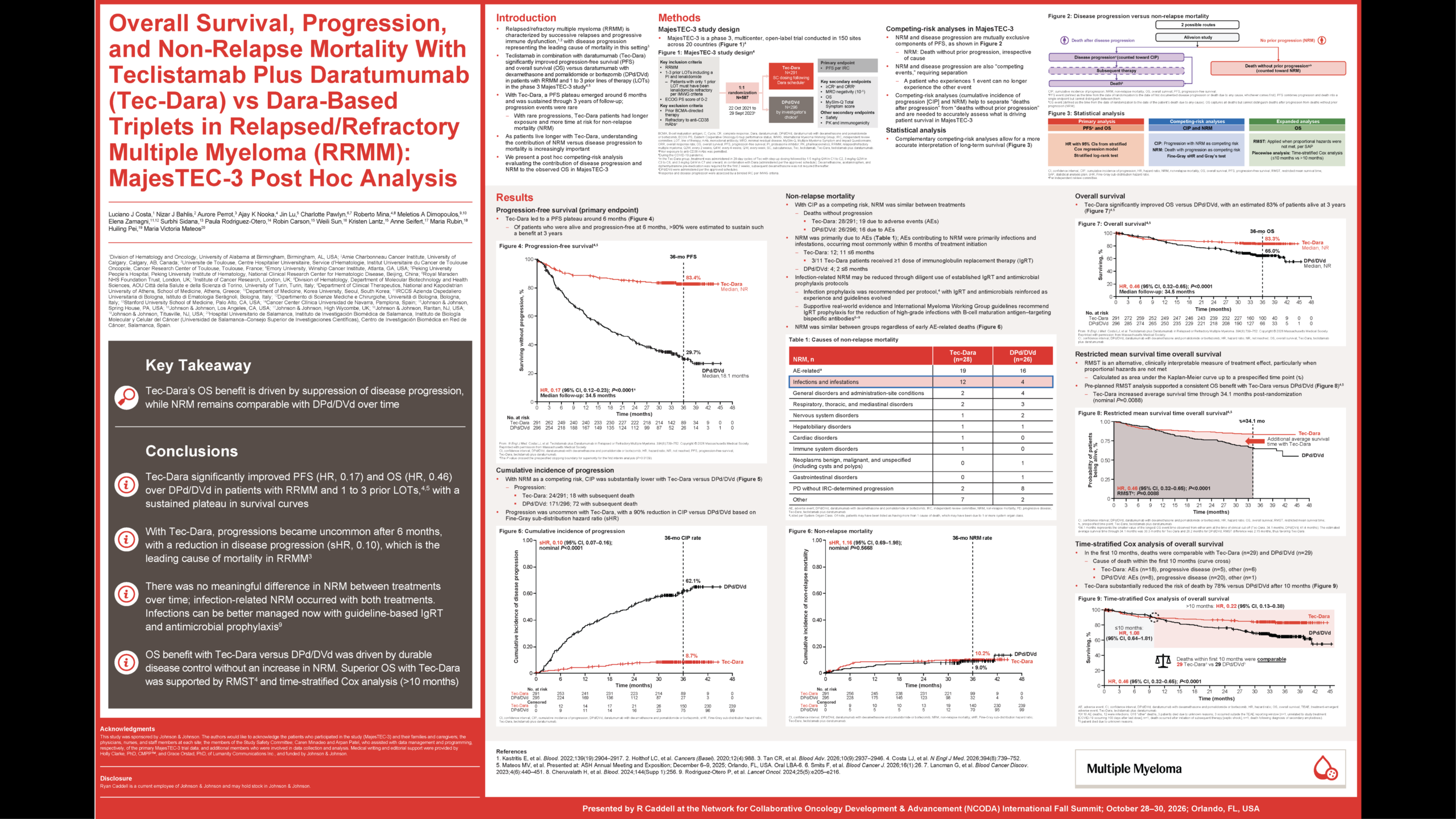
Teclistamab plus daratumumab (Tec-Dara) showed significant survival benefits versus daratumumab plus dexamethasone plus pomalidomide/bortezomib (DPd/ DVd) in MajesTEC-3 in early-line relapsed/refractory multiple myeloma (RRMM), a setting in which disease progression is the leading cause of death. The marked improvement in progression-free survival (PFS) (hazard ratio [HR], 0.17; 95% confidence interval [CI], 0.12–0.23) resulted in substantially different treatment exposure between arms (median treatment duration, 32.4 months with Tec-Dara versus 16.1 months with DPd/DVd).
Objectives:
Evaluate non-relapse mortality and cumulative incidence of progression with Tec-Dara and DPd/DVd in MajesTEC-3 to better understand the contribution of these competing risks to the significant overall survival benefit observed with Tec-Dara.
Purpose:
To evaluate the cumulative incidence of progression (CIP) and non-relapse mortality (NRM) with Tec-Dara versus DPd/DVd and their contribution to observed overall survival (OS).
Study Design:
This was a post hoc analysis of the Majes-TEC-3 trial.
Methods:
Patients had 1–3 prior lines of therapy (LOTs), including a proteasome inhibitor and lenalidomide (len; len-refractory if 1 prior LOT), with progression on or after the last LOT. Patients refractory to anti-CD38 therapy were excluded. Patients were randomized 1:1 to Tec-Dara (n=291) or DPd/DVd (n=296). In the Tec-Dara arm, treatment was administered in 28-day cycles (C) of Tec with step-up dosing followed by 1.5 mg/kg once weekly (QW) in C1–2, 3 mg/kg once every 2 weeks (Q2W) in C3–6, and 3 mg/kg once every 4 weeks (Q4W) from C7 onward, in combination with Dara (administered per the approved schedule). DPd/DVd were administered per approved schedules. OS was a key secondary endpoint, with HR reported from a Cox regression model. Since the proportional hazards assumption was violated, a prespecified analysis of restricted mean survival time (RMST) was also conducted. Competing risk analyses for CIP and NRM were performed using Fine-Gray subdistribution hazard models (subdistribution hazard ratios [sHRs]) and Gray’s test.
Results:
At a median follow-up of 34.5 months, there were 46 deaths with Tec-Dara versus 98 with DPd/DVd (intention-to-treat [ITT] analysis set). Tec-Dara significantly improved OS versus DPd/DVd (HR, 0.46; 95% CI, 0.32–0.65; P<0.0001); estimated 36-month OS rates were 83.3% versus 65.0%. The proportional hazards assumption was not met. OS curves intersected at approximately 10 months, with no OS difference at ≤10 months (HR, 1.08; 95% CI, 0.64–1.81). Beyond 10 months, OS favored Tec-Dara (HR, 0.22; 95% CI, 0.13–0.38), corresponding to a 78% reduction in the hazard of death. CIP was markedly lower with Tec-Dara versus DPd/DVd (sHR, 0.10; 95% CI, 0.07–0.16; P<0.0001); estimated 36-month CIP was 8.7% versus 62.1%. There were 24 progressions with Tec-Dara versus 171 with DPd/DVd (18 versus 72 resulted in death). Death without prior progression occurred in 28 patients with Tec-Dara versus 26 with DPd/DVd. NRM was similar with Tec-Dara versus DPd/DVd (sHR, 1.16; 95% CI, 0.69–1.98; P=0.6), with estimated 36-month NRM of 10.2% versus 9.0%. RMST analysis (area under the OS curve) confirmed superior OS with Tec-Dara (difference, 2.15 months; 95% CI, 0.54–3.77; P=0.009).
Conclusion:
Tec-Dara significantly improved OS over DPd/DVd in patients with RRMM and 1–3 prior LOTs. This analysis demonstrates that the observed OS benefit is driven by a profound reduction in disease progression, the leading cause of mortality in RRMM. Despite early curve crossing, Tec-Dara did not increase NRM. The findings underscore the safety and clinically meaningful and durable survival benefit of Tec-Dara, supporting Tec-Dara as a new standard of care as early as second-line (2L) treatment of RRMM.
Funding: Johnson & Johnson.
Prior Presentations:
Presented at the 23rd Annual International Myeloma Society (IMS) Meeting, September 23–26, 2026, in Glasgow, Scotland.
© 2026 International Myeloma Society. Reused with permission. This abstract was accepted and presented at the 2026 IMS Annual Meeting. All rights reserved
Send your feedback
Please do not include any personal information or details.
"*" indicates required fields
Was this page
helpful?
Send your feedback
Please do not include any personal information or details.
"*" indicates required fields