

Outpatient step-up dosing and safety with talquetamab: A real-world Mayo Clinic study
1Mayo Clinic, Rochester, MN, USA; 2Mayo Clinic, Phoenix, AZ, USA; 3Mayo Clinic, Jacksonville, FL, USA; 4nference Inc., Cambridge, MA, USA; 5Johnson & Johnson, Horsham, PA, USA
Background:
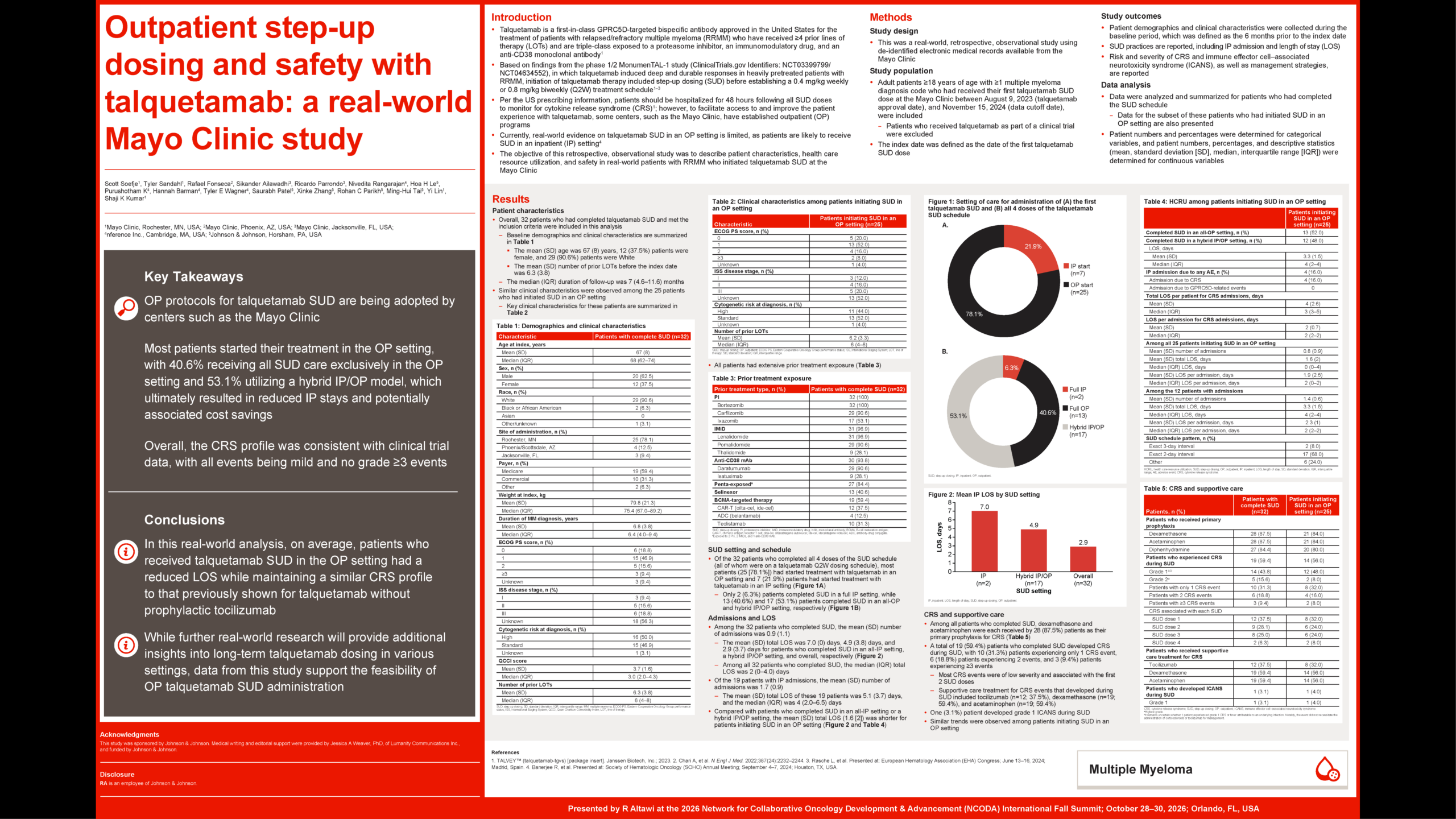
Talquetamab is a first-in-class G protein-coupled receptor class C group 5 member D (GPRC5D)-targeted bispecific antibody (BsAb) for patients with triple-class-exposed relapsed/refractory multiple myeloma (RRMM) who have received ≥4 prior lines of therapy (LOTs). Talquetamab initiation includes step-up dosing (SUD) before establishing a once-weekly (QW) or once-every-2-weeks (Q2W) treatment schedule. Per U.S. prescribing information, patients should be hospitalized for 48 hours following all SUD doses to monitor for cytokine release syndrome (CRS). However, to facilitate access and improve patient experience, some centers, such as Mayo Clinic (Mayo), have established outpatient programs. Currently, real-world data on talquetamab SUD in an outpatient setting are limited.
Objectives:
Evaluate the feasibility, safety (CRS), and healthcare resource utilization associated with outpatient SUD of talquetamab in patients with RRMM in a real-world setting.
Purpose:
To evaluate whether talquetamab SUD can be initiated in the outpatient setting for patients with RRMM and how this approach affects healthcare resource utilization and safety outcomes.
Study Design:
This was a retrospective, observational study.
Methods:
Adult patients with ≥1 multiple myeloma (MM) diagnosis code who received their first talquetamab SUD dose at Mayo between August 9, 2023, and September 15, 2024, were identified using electronic medical records. Patients receiving talquetamab as part of a clinical trial were excluded. The index date was the date of the first talquetamab SUD dose. Demographic and clinical characteristics were collected during the baseline period (6 months prior to the index date). SUD practices, including inpatient length of stay (LOS), and CRS outcomes were reported.
Results:
Among 28 patients with ≥1 SUD dose, mean (median) age at index was 67 (68) years, 35.7% were female, 92.9% were White, and 64.3% had Medicare. Mean (median) weight was 77.0 (74.7) kg, duration of MM diagnosis was 7.0 (6.6) years, and Quan Charlson Comorbidity Index score was 3.75 (3). The mean (median) number of prior LOTs before index was 8.4 (8); 64.3% of patients had prior B-cell maturation antigen (BCMA)-targeted therapy exposure (42.9% chimeric antigen receptor T-cell [CAR-T] therapy; 35.7% BsAb). All patients were on a Q2W dosing schedule, and 26 (92.9%) patients completed all 4 doses of SUD. Most patients (n=24; 85.7%) started talquetamab in an outpatient setting; of 4 patients (14.3%) who started talquetamab in an inpatient setting, only 1 completed fully inpatient SUD. Of the 26 patients who completed SUD, 46.2%, 3.8%, and 50.0% completed SUD in an all-outpatient, all-inpatient, and hybrid inpatient/outpatient setting, respectively. Among these 26 patients, the mean number of admissions was 0.9, and mean (median) total LOS was 2.1 (0.5) days. Of the 14 patients with admissions, the mean number of admissions was 1.9, and mean (median) total LOS was 4.1 (4) days. Overall, 15 (57.7%) patients who completed SUD developed CRS during SUD; most CRS events were of low severity (grade 1, 10 [38.5%]; grade 2, 3 [11.5%]; grade 3, 1 [3.8%]; 1 patient experienced CRS of unknown grade). Supportive care treatment for CRS included tocilizumab (38.5%), dexamethasone (57.7%), and acetaminophen (57.7%).
Conclusion:
Patients receiving talquetamab SUD in the outpatient setting had few admissions on average, with a short total LOS, while maintaining a CRS profile similar to that previously reported for talquetamab. While further real-world research will provide additional insights into longterm talquetamab dosing in various settings, data from this study support the feasibility of outpatient talquetamab SUD administration.
Funding: Johnson & Johnson.
Prior Presentations:
Presented at the European Hematology Association (EHA) 2025 Congress, June 12–15, 2025, in Milan, Italy.
Send your feedback
Please do not include any personal information or details.
"*" indicates required fields
Was this page
helpful?
Send your feedback
Please do not include any personal information or details.
"*" indicates required fields