
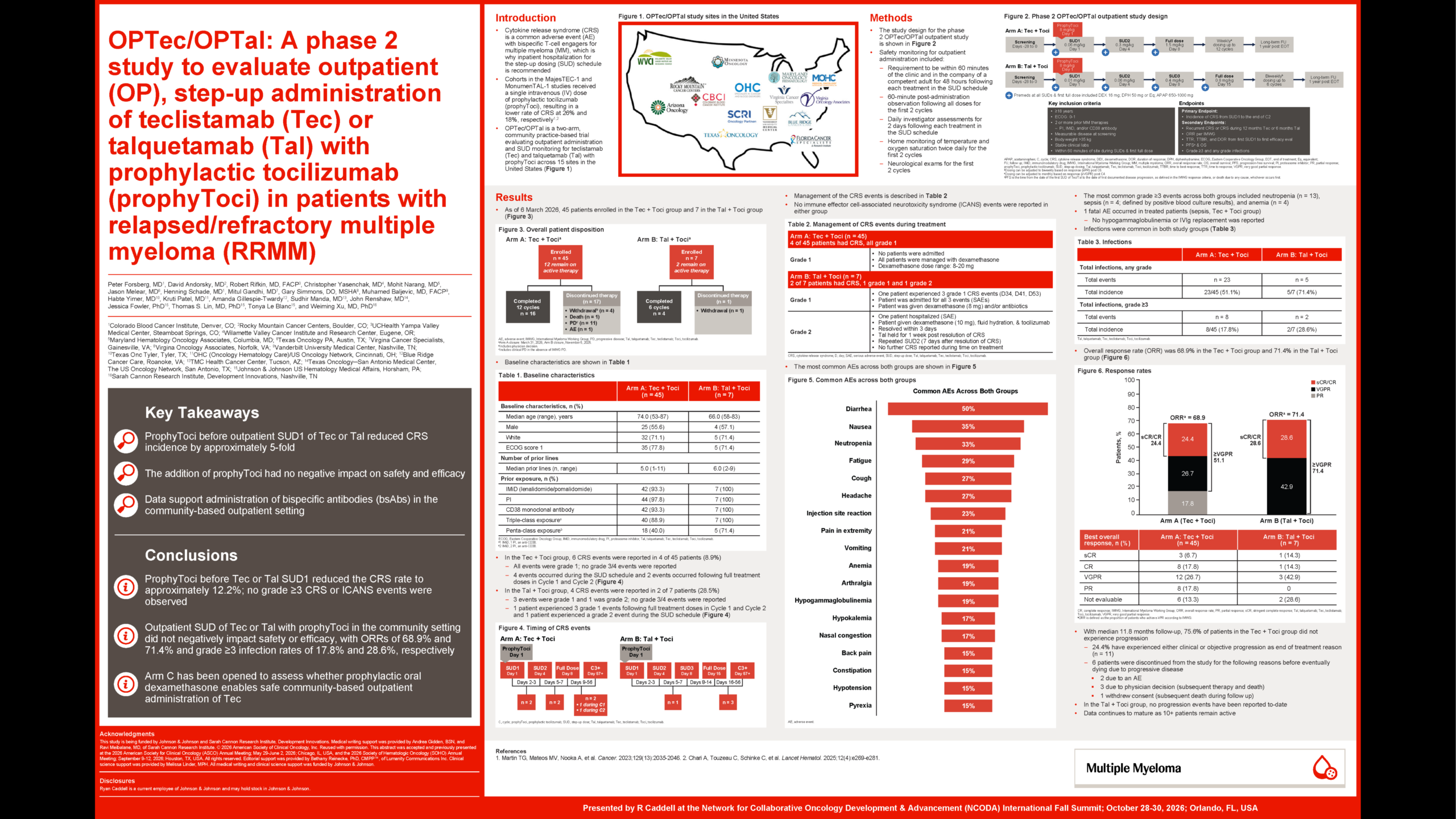
Optec/Optal: A phase 2 study to evaluate outpatient, step-up administration of teclistamab or talquetamab with prophylactic tocilizumab in patients with relapsed/refractory multiple myeloma
1Colorado Blood Cancer Institute, Denver, CO, USA; 2Rocky Mountain Cancer Centers, Boulder, CO, USA; 3UCHealth Yampa Valley Medical Center, Steamboat Springs, CO, USA; 4Willamette Valley Cancer Institute and Research Center, Eugene, OR, USA; 5Maryland Hematology Oncology Associates, Columbia, MD, USA; 6Texas Oncology PA, Austin, TX, USA; 7Virginia Cancer Specialists, Gainesville, VA, USA; 8Virginia Oncology Associates, Norfolk, VA, USA; 9Vanderbilt University Medical Center, Nashville, TN, USA; 10Texas Oncology-Tyler, Tyler, TX, USA; 11OHC (Oncology Hematology Care)/US Oncology Network, Cincinnati, OH, USA; 12Blue Ridge Cancer Care, Roanoke, VA, USA; 13TMC Health Cancer Center, Tucson, AZ, USA; 14Texas Oncology-San Antonio Medical Center, US Oncology Network, San Antonio, TX, USA; 15Johnson & Johnson US Hematology Medical Affairs, Horsham, PA, USA; 16Sarah Cannon Research Institute, Development Innovations, Nashville, TN, USA
Background:
Teclistamab (Tec), a B-cell maturation antigen (BCMA) Å~ cluster of differentiation 3 (CD3) bispecific antibody (bsAb), and talquetamab (Tal), a G protein-coupled receptor class C group 5 member D (GPRC5D) × CD3 bsAb, are approved for relapsed/refractory multiple myeloma (RRMM). Cytokine release syndrome (CRS) occurred in 72% and 73%–79% of patients in the MajesTEC-1 and Monumen-TAL-1 studies, respectively. In cohorts that received prophylactic tocilizumab (prophyToci), CRS rates were lower (26% in MajesTEC-1; 18% in MonumenTAL-1), with no negative impact on safety or efficacy.
Objectives:
Evaluate the impact of a single prophylactic dose of tocilizumab prior to step-up dose 1 of teclistamab or talquetamab on the incidence of CRS, safety, and efficacy in patients with RRMM treated in the outpatient setting.
Purpose:
To evaluate prophyToci in patients with RRMM treated with Tec/Tal using the approved step-up dose (SUD) schedule in the outpatient setting.
Study Design:
This was a nonrandomized, multicenter, prospective study.
Methods:
Patients provided informed consent. ProphyToci 8 mg/kg was administered before SUD1 of Tec/Tal. Safety recommendations (home monitoring, daily investigator assessments after SUD-phase treatments, and neurological examinations) and guidance (caregiving and travel) were provided. The primary endpoint was the incidence of anygrade CRS (cycles 1–2). Secondary endpoints were safety (grade [G] ≥2 CRS, recurrent CRS, infections, neurotoxicity, and neutropenia) and efficacy (intention-to-treat [ITT] population, overall response rate [ORR], best overall response, and progression-free survival [PFS]).
Results:
As of March 6, 2026, 45 patients were enrolled in the Tec group and 7 in the Tal group. Across both groups, the most common G ≥3 adverse events included neutropenia (n=13), sepsis (n=4), and anemia (n=4); one G5 event (sepsis) occurred with Tec. In the Tec group, the CRS rate was 9%, with 6 events reported in 4 patients (all G1). CRS was managed with dexamethasone. No immune effector cell-associated neurotoxicity syndrome (ICANS) events were reported. The infection rate was 51% (n=23 events), with 18% ≥G3 (n=8 events). ORR was 68.9%. After a median follow-up of 11.8 months, 75.6% of Tec patients had not progressed. In the Tal group, the CRS rate was 29%, with 4 events reported in 2 patients (G1, n=3 events; G2, n=1 event). G1 CRS was managed with dexamethasone and/or antibiotics; G2 CRS was managed with dexamethasone, fluid hydration, and Toci. G2 CRS resolved in <3 days. No ICANS events were reported. The infection rate was 71% (n=5 events), with 29% ≥G3 (n=2 events). ORR was 71.4%. Interpretation is limited by the small sample size.
Conclusion:
A single prophyToci dose before SUD1 of Tec/Tal reduced CRS without negatively impacting safety or efficacy, supporting outpatient administration. Per a protocol amendment, a third arm was added to evaluate the effect of prophylactic dexamethasone on CRS with Tec; enrollment is ongoing (NCT05972135).
Funding: Johnson & Johnson and Sarah Cannon Research Institute, Development Innovations.
Prior Presentations:
Presented at the 2026 American Society of Clinical Oncology (ASCO) Annual Meeting, May 29–June 2, 2026, in Chicago, IL, USA; and the Society of Hematologic Oncology (SOHO) Annual Meeting, September 9–12, 2026, in Houston, TX, USA.
© 2026 American Society of Clinical Oncology, Inc. Reused with permission. This abstract was accepted and previously presented at the 2026 ASCO Annual Meeting. All rights reserved.
Send your feedback
Please do not include any personal information or details.
"*" indicates required fields
Was this page
helpful?
Send your feedback
Please do not include any personal information or details.
"*" indicates required fields