

Imetelstat in patients with deletion 5q lower-risk myelodysplastic syndromes: Results from the IMerge clinical trial
1Medical Clinic and Policlinic I, University Hospital Dresden, TU Dresden, Dresden, Germany; 2Geron Corporation, Foster City, CA, USA; 3Moffitt Cancer Center, Tampa, FL, USA
Background:
Myelodysplastic syndromes (MDS) comprise a heterogeneous group of disorders defined by ineffective hematopoiesis. Patients with isolated del(5q) mutations (~10%) have a favorable prognosis versus those with del(5q) and additional cytogenetic abnormalities (≤10%) or with non-del(5q) disease (~80%). The telomerase inhibitor imetelstat is approved for treating certain patients with lower-risk MDS (LR-MDS) and red blood cell (RBC) transfusion-dependent anemia based on the IMerge trial (NCT02598661). In IMerge phase 3, imetelstat demonstrated durable ≥8-week, ≥24-week, and ≥1-year RBC transfusion independence (TI) versus placebo in patients with non-del(5q) LR-MDS. Additionally, RBC-TI with imetelstat correlated with reductions in cytogenetic and molecular clonal burden, suggesting disease-modifying potential. Although patients with del(5q) MDS were excluded from IMerge phase 3, they could enroll in the IMerge phase 2/QTc substudy.
Objectives:
- Describe the results of IMerge in patients with del(5q) LR-MDS treated with imetelstat.
- Discuss the potential to optimize evidence-based treatment decisions for patients with del(5q) LR-MDS.
Purpose:
To evaluate the efficacy of imetelstat in del(5q) LR-MDS, as telomerase activity supports the survival of malignant hematopoietic progenitor cells regardless of cytogenetic subtype.
Study Design:
This post hoc analysis included patients with LR-MDS relapsed/refractory to or ineligible for erythropoietin-stimulating agents (ESAs) from IMerge Phase 2/QTc substudy who received 7.1 mg/kg imetelstat infused every 4 weeks. Prior therapy with lenalidomide or hypomethylating agent (HMA) was allowed.
Methods:
This post hoc analysis included patients with LR-MDS who were relapsed/refractory to or ineligible for erythropoiesis-stimulating agents (ESAs) from the IMerge phase 2/QTc substudy and received 7.1 mg/kg imetelstat infused every 4 weeks. Prior therapy with lenalidomide or a hypomethylating agent (HMA) was allowed.
Results:
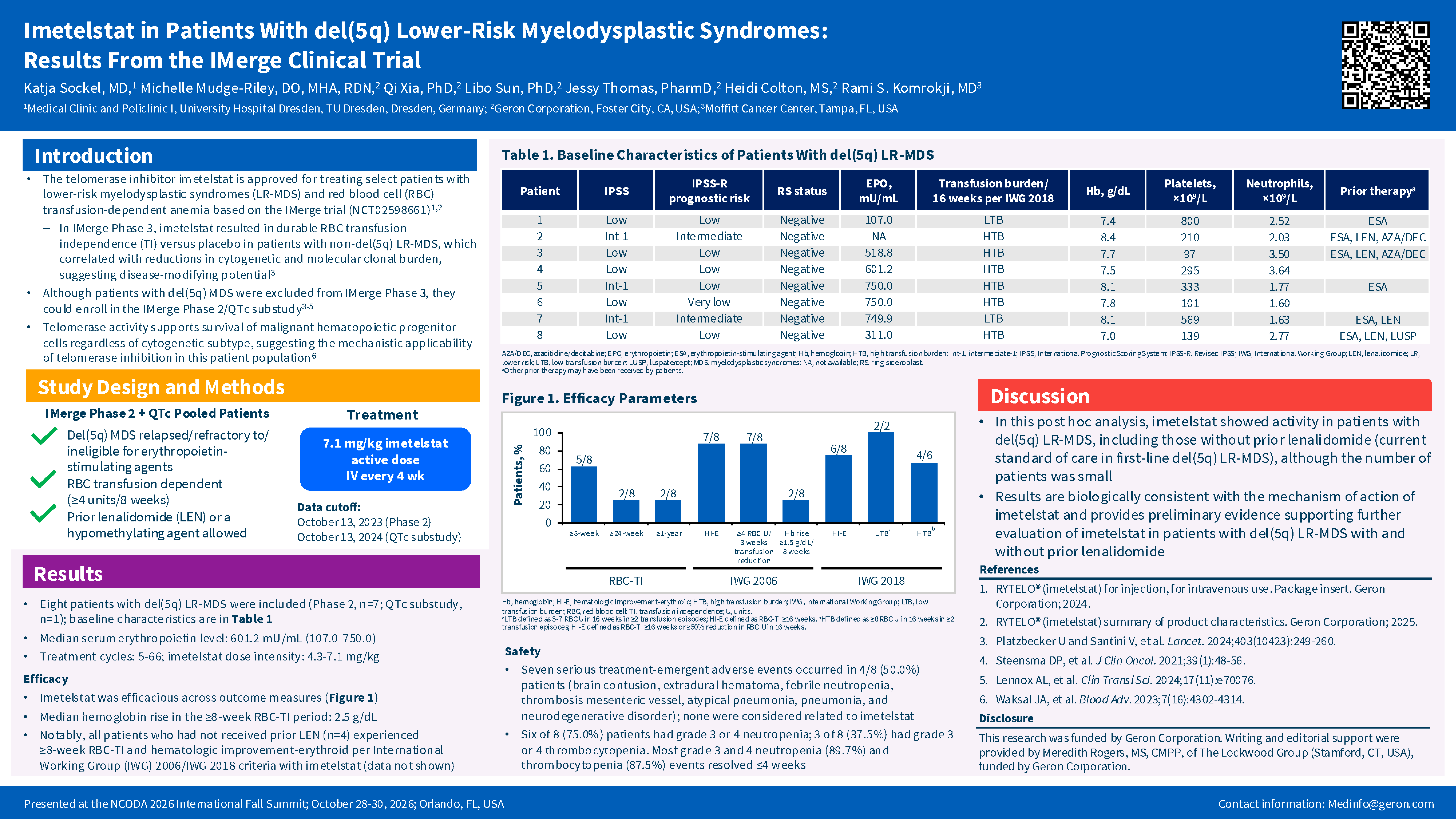
The pooled phase 2/QTc substudy population comprised 108 imetelstat-treated patients, of whom 8 had del(5q) LR-MDS and ring sideroblast-negative disease (phase 2, n=7; QTc substudy, n=1). Median (range) serum erythropoietin level was 601.2 (107.0–750.0) mU/mL. Pretreatment hemoglobin ranged from 69.5 to 84.0 g/L, and baseline platelet and neutrophil counts ranged from 97.0 to 800 × 10⁹/L and 1.6 to 3.6 × 10⁹/L, respectively. Six patients had a high transfusion burden per International Working Group (IWG) 2018 criteria. Six patients had received prior ESAs, 4 had received prior lenalidomide, 2 had received a prior HMA, and 1 had received prior luspatercept. Treatment cycles ranged from 5 to 66; imetelstat dose intensity ranged from 4.6 to 7.5 mg/kg. Five of 8 (62.5%) patients achieved ≥8-week RBC-TI with imetelstat; 2 of 8 (25.0%) patients each achieved ≥24-week and ≥1-year RBC-TI, with a median hemoglobin rise during the ≥8-week TI period of 2.5 g/dL. Per IWG 2006 criteria, 7 of 8 (87.5%) patients experienced transfusion reductions (≥4 units RBC/8 weeks), and 2 of 8 (25%) patients experienced a ≥1.5-g/dL hemoglobin rise every 8 weeks. Six of 8 (75%) patients had an HI-E response per IWG 2018 criteria. Notably, all patients who had not received prior lenalidomide (n=4) experienced ≥8-week RBC-TI and HI-E per IWG 2006/IWG 2018 criteria with imetelstat. Serious treatment-emergent adverse events occurred in 4 of 8 (50.0%) patients; none were hematologic. Six of 8 (75%) patients had grade 3/4 neutropenia, and 3 of 8 (37.5%) had grade 3/4 thrombocytopenia. Most grade 3/4 neutropenia (89.7%) and thrombocytopenia (87.5%) events resolved within 4 weeks.
Conclusion:
In this post hoc analysis, imetelstat showed activity in patients with del(5q) LR-MDS, including those without prior lenalidomide (the current standard of care for first-line del(5q) LR-MDS), although the number of patients was small. Results are biologically consistent with the mechanism of action of imetelstat and could have implications for therapy selection in patients with del(5q) LR-MDS with and without prior lenalidomide.
Funding: Geron Corporation.
Send your feedback
Please do not include any personal information or details.
"*" indicates required fields
Was this page
helpful?
Send your feedback
Please do not include any personal information or details.
"*" indicates required fields