

Targeting hematological cancer stem cells to enhance immunotherapy clinical decision-making
1Aristotle University of Thessaloniki, Thessaloniki, 54124, Greece; 2University of Nicosia, Nicosia, CY-1700, Cyprus; 3Democritus University of Thrace, Alexandroupolis, 68100, Greece; 4Aristotle University of Thessaloniki, Thessaloniki, 54124, Greece
Background:
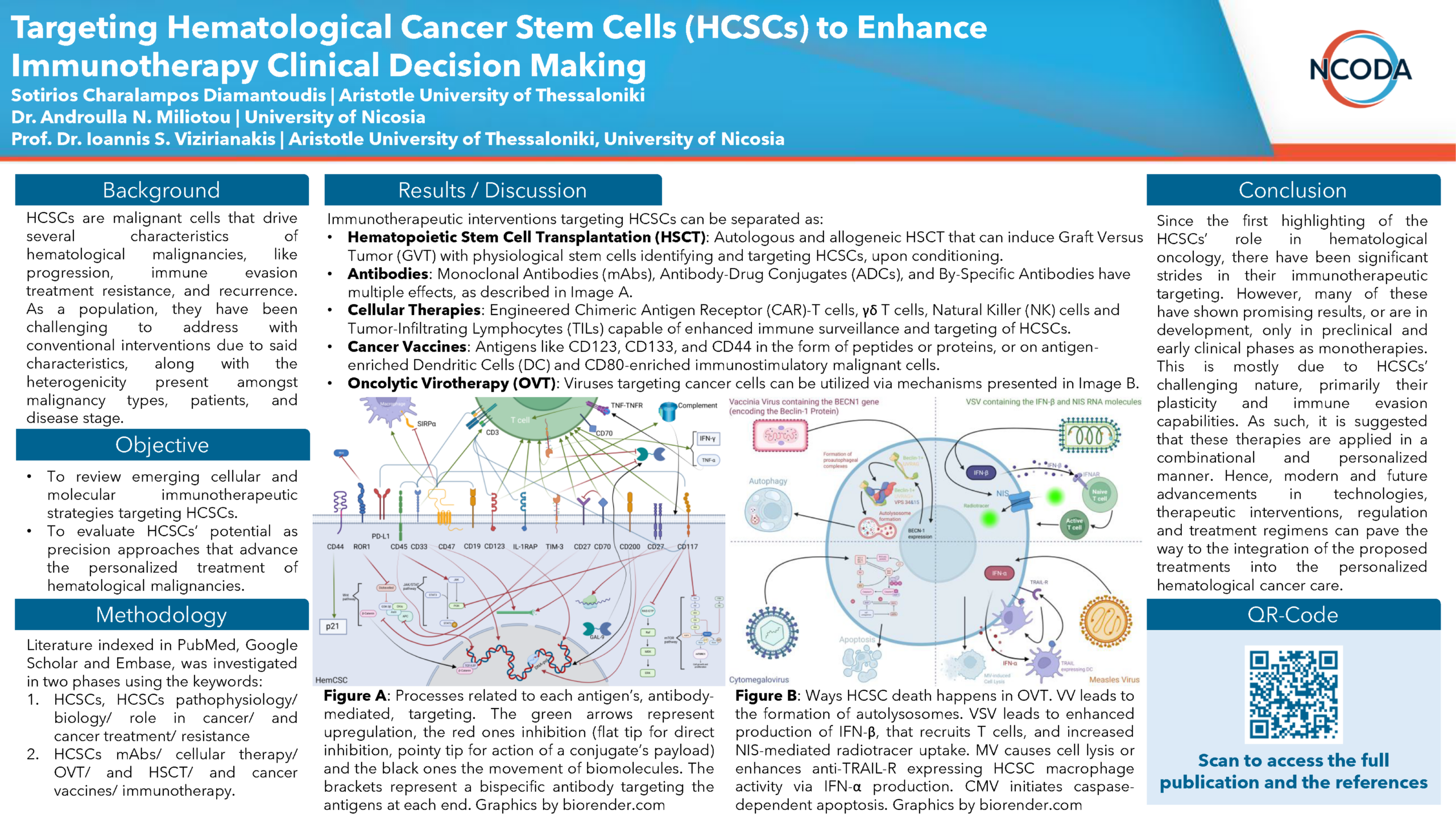
Hematological cancer stem cells (HCSCs) are recognized as key drivers of several hematological malignancies. Given their importance and biomarker repertoire, which can differ among malignancy types, patients, and disease stages, immunotherapeutic and personalized interventions may contribute to improved patient outcomes.
Objectives:
- Define the pathophysiology, role, and effect of HCSCs in the progression of hematological malignancies, including related genetic, epigenetic, signaling, metabolic, and environmental aspects.
- Identify properties of HCSCs that render the treatment of hematological malignancies challenging.
- Analyze various immunotherapeutic approaches addressing HCSCs, including stem cell transplantation (SCT), antibody-based interventions, cell therapies, cancer vaccines, and oncolytic virotherapy (OVT), including their pharmacological background and clinical benefit.
Methods:
Relevant literature indexed in Google Scholar, PubMed, and Embase was investigated to characterize the biological and pathophysiological aspects of HCSCs. Studies describing immunotherapeutic interventions targeting previously established biomarkers were subsequently identified and evaluated based on their relevance, currency, and robustness and presented in a logical manner.
Results:
HCSCs typically originate from hematopoietic stem or progenitor cells that have undergone genetic and epigenetic alterations affecting signaling, antigen patterns, and metabolism. Microenvironments formed in the bone marrow and lymphoid organs support these populations. HCSCs can drive therapeutic resistance through evasion enabled by the aforementioned effects, cellular plasticity, drug efflux, and DNA repair capabilities. Immunotherapies can be deployed to address this issue by directly targeting HCSCs. Hematopoietic stem cell transplantation (HSCT), both autologous and allogeneic, represents one of the earliest immunotherapeutic approaches. Following conditioning therapy, the graft-versus-tumor (GVT) effect can limit the malignancy, partly through donor immune cells that recognize and eliminate HCSCs. Antibodies, a platform already widely adopted in oncology, are at the forefront of anti-HCSC immunotherapy, as they can inhibit HCSC activity, block interactions, enhance the cytotoxicity of other agents (either through combination or conjugation), and attract cytotoxic T cells as bispecific T-cell engagers (BTCEs) by exploiting antigens commonly found on HCSC surfaces. More sophisticated therapies also make use of cells to avoid the trauma commonly associated with conventional chemotherapy and radiotherapy and to overcome immune evasion. These cellular therapies involve chimeric antigen receptor (CAR) T cells, γδ T cells, natural killer (NK) cells, and tumor-infiltrating lymphocytes (TILs) engineered for prolonged immune surveillance and enhanced targeting of HCSCs. Cancer vaccines containing common antigens of HCSCs and oncolytic viruses can also be deployed.
Discussion:
HCSCs have emerged as central therapeutic targets owing to their role in disease progression, relapse, and treatment resistance. Recent trends increasingly support combinatorial approaches that target multiple molecules and mechanisms of pathogenesis directly linked with HCSCs. Additionally, immunotherapies targeting newly identified HCSC-associated antigens have entered the clinic with promising results in late-phase clinical trials. Moreover, new conditioning therapies directly addressing HCSCs have also been proposed to enhance the outcomes of HSCT. Nonetheless, despite these advancements, the heterogeneity within and among different patients, along with the flexibility of these cells, implies that HCSC-targeting immunotherapy demands personalized approaches.
Conclusion:
HCSCs are major contributors to treatment failure and disease recurrence. As such, advancements in anti-HCSC molecular and cellular immunotherapy, treatment protocols, technologies that allow more personalized approaches, and regulation appear to represent major steps toward realizing the full potential of immunotherapies in hematological malignancies.
Funding: Not applicable.
Send your feedback
Please do not include any personal information or details.
"*" indicates required fields
Was this page
helpful?
Send your feedback
Please do not include any personal information or details.
"*" indicates required fields