
Advancing global learning in oncology through international collaboration: NCODA’s Global Congress
1NCODA, Cazenovia, NY, USA; 2University Hospital Waterford, Waterford, Ireland; 3University College Cork, Cork, Ireland; 4Royal College of Surgeons in Dublin, Dublin, Ireland
Background:
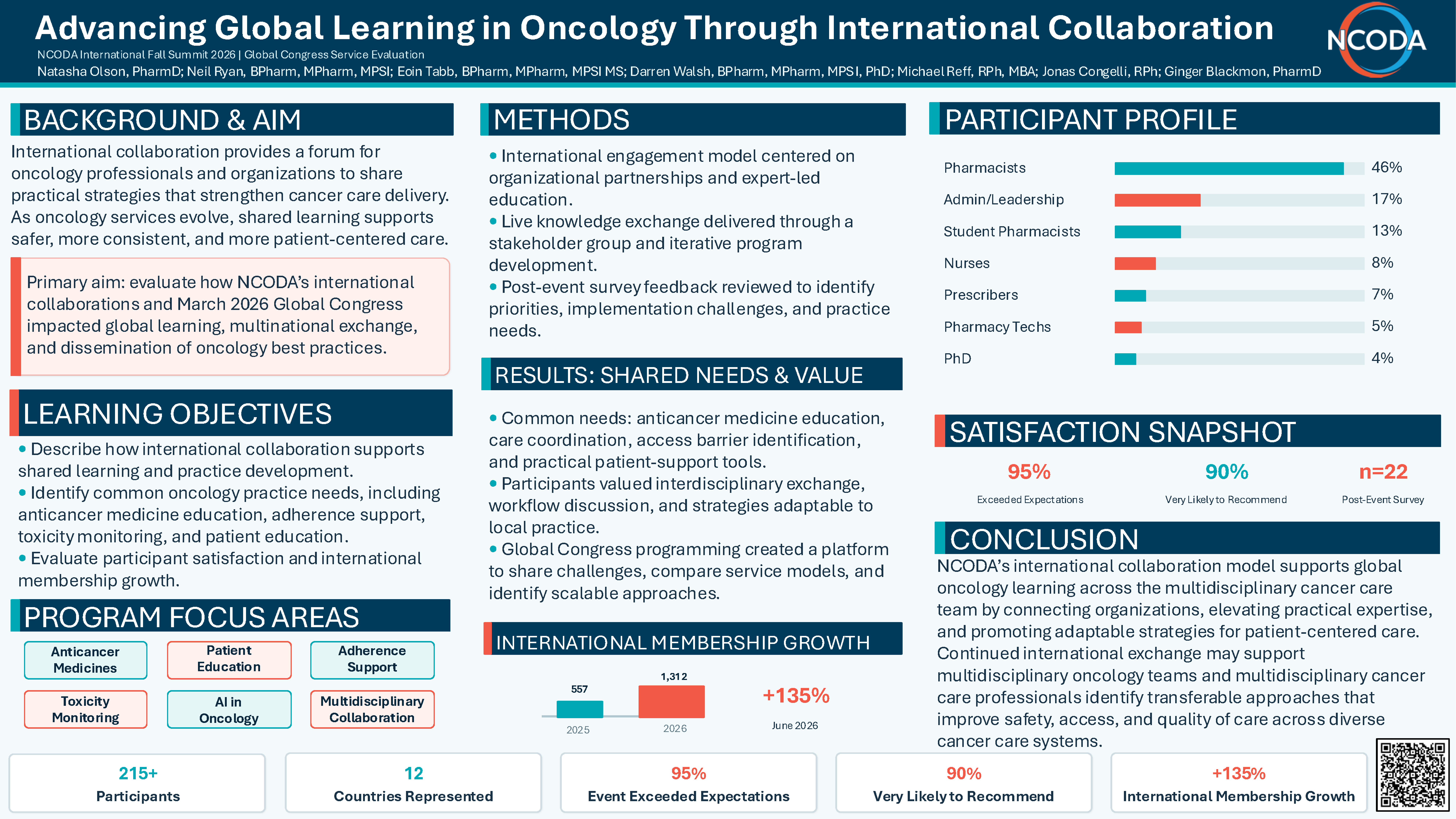
International collaboration provides an opportunity for all stakeholders involved in the planning and delivery of comprehensive evidence-based cancer care to share practical strategies that strengthen cancer care delivery. As oncology services continue to rapidly evolve, shared learning between pharmacy-led and multidisciplinary organizations can support safer, more consistent, and more patient-centered care. The primary aim was to evaluate how the Network for Collaborative Oncology Development & Advancement’s (NCODA) international collaborations and March 2026 Global Congress impacted global learning, multinational exchange, and the dissemination of oncology best practices amongst oncology professionals. Objectives included describing Global Congress participant engagement, identifying shared educational and practice needs, evaluating the role of interdisciplinary exchange in supporting adaptable practice strategies, assessing satisfaction, and measuring international membership growth.
Objectives:
- Describe how international collaboration can support shared learning and practice development within oncology pharmacy.
- Identify common oncology practice needs, including anticancer medicine education, adherence support, toxicity monitoring, and patient education.
- Discuss how multidisciplinary education and cross-country exchange can inform local service improvement, medication optimization, and patient-centered cancer care.
- Evaluate participant satisfaction and international membership growth.
Methods:
NCODA developed an international engagement model focused on organizational partnerships, key opinion leader-led education, and live knowledge exchange through the development of a key stakeholder group and iterative program development. Participation aimed to include pharmacists, pharmacy technicians, nurses, and other oncology professionals, reflecting the multidisciplinary nature of cancer care delivery. Program development focused on anticancer medicine management, patient education, adherence support, toxicity monitoring, artificial intelligence in oncology care, and multidisciplinary collaboration. Feedback through a post-event survey from multinational participants and partner organizations was reviewed to identify shared priorities, implementation challenges, and practice needs across oncology care settings.
Results:
International engagement highlighted common needs across health systems, including education on anticancer medicines, improved care coordination, strategies to identify and address access barriers, and practical tools to support patients throughout treatment. More than 215 participants from 12 countries participated and valued interdisciplinary exchange, workflow discussion, and strategies that could be adapted to local practice environments. Global Congress programming created a platform for oncology professionals and organizations to share challenges, compare service models, and identify scalable approaches to improving patient care. Overall satisfaction from a post-event survey (n=22) showed 95% of responders stated the event exceeded expectations, with 5% reporting the event met expectations. The survey also showed that 90% of responders would very likely recommend the event to a colleague or peer. Following the Global Congress, NCODA experienced substantial growth in international engagement, with international membership increasing by 135%, from 557 members in 2025 to 1,312 members in 2026 (June 2026). While the survey’s descriptive insights are robust and the boost in international membership is encouraging, the low survey response rate (n=22) represents a minor evaluation limitation.
Conclusions:
NCODA’s international collaboration model supports global oncology learning across the multidisciplinary oncology care team by connecting organizations, elevating practical expertise, and promoting adaptable strategies for patient-centered care. For the British Oncology Pharmacy Association (BOPA), this model has relevance to medicines optimization, anticancer medicine governance, adherence support, toxicity monitoring, patient education, and multidisciplinary service development. Continued international exchange will help oncology pharmacy teams and multidisciplinary cancer care professionals identify transferable approaches that improve safety, access, and quality of care across diverse cancer care systems.
Funding: Not applicable.
Editorial and Peer Review Disclosure:
Authors of this abstract serve as an Editorial Fellow and a Peer Reviewer of NOHMA and were recused from the abstract’s peer review, acceptance recommendation, editorial decision-making, and publication review. The abstract was independently reviewed and approved without the authors’ involvement.
Send your feedback
Please do not include any personal information or details.
"*" indicates required fields
Was this page
helpful?
Send your feedback
Please do not include any personal information or details.
"*" indicates required fields