
Addressing bispecific antibody education gaps on an inpatient oncology unit through in-person education and surveys
1ThedaCare Regional Medical Center – Appleton, WI, USA
Background:
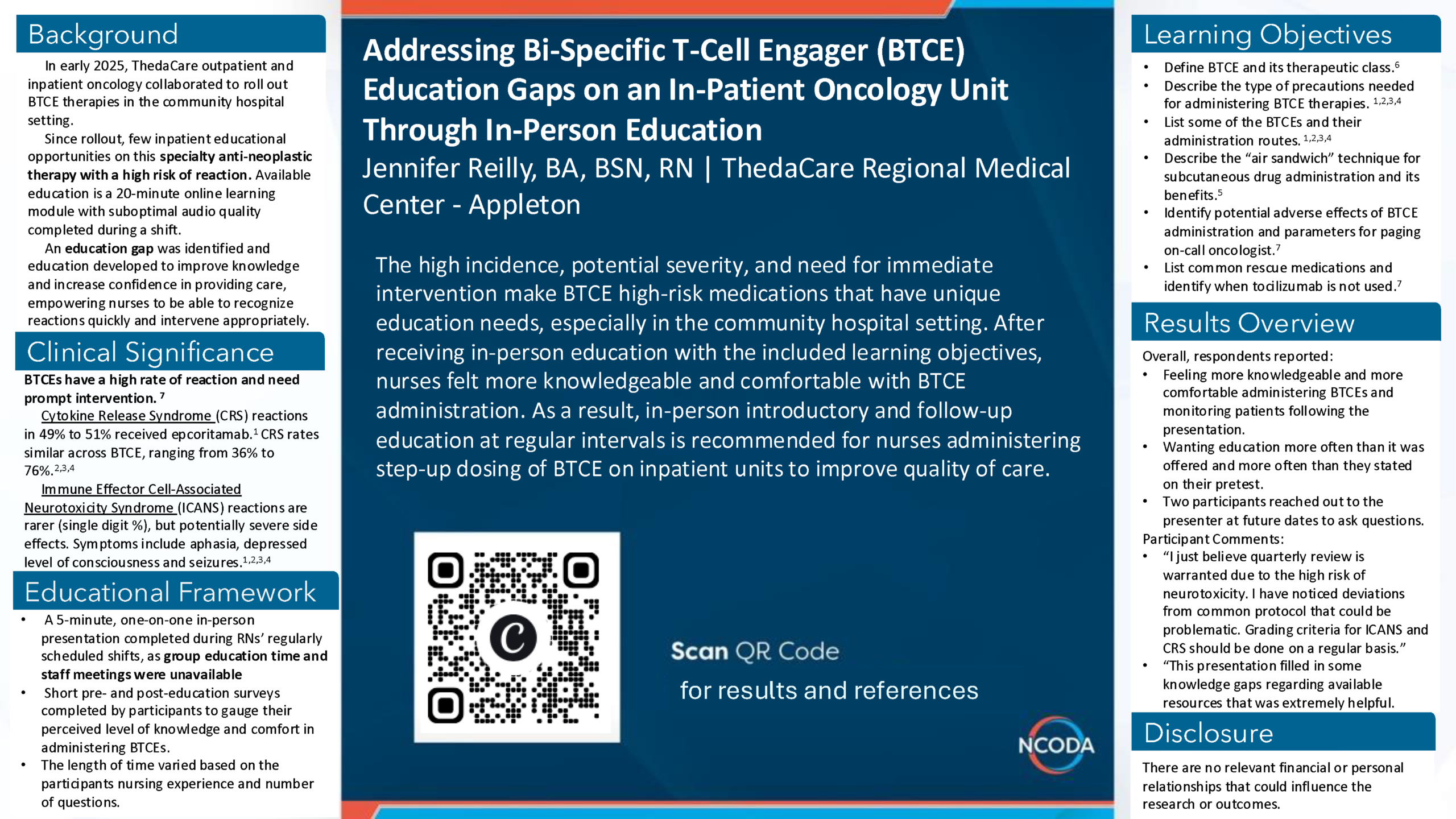
In early 2025, bispecific antibody (BsAb) therapies were rolled out in the community setting through the collaboration of the ThedaCare Regional Cancer Center and the inpatient oncology unit at ThedaCare Regional Medical Center in Appleton. Since that time, there have been few in-person educational opportunities on this special anti-neoplastic therapy with a high risk of reaction, possibly compounded by turnover and newly trained nurses. The only education available was a 20 minute-long online learning module with difficult-to-hear sound that must be completed during a shift. An opportunity was identified to improve knowledge and increase nurse confidence in providing care.
Objectives:
- Define BsAbs and their therapeutic class.
- Describe the type of precautions needed for administering BsAb therapies.
- List some of the BsAbs and their administration routes.
- Describe the “air sandwich” technique for subcutaneous drug administration and its benefits.
- Identify potential adverse effects of BsAb administration and parameters for paging the on-call oncologist.
- List common rescue medications and identify when tocilizumab is not used.
Significances:
BsAbs have a high rate of reaction—for example, 51% of large B-cell lymphoma patients and 49% of follicular lymphoma patients who received epcoritamab had cytokine release syndrome (CRS) reactions in the EPCORE NHL-1 trial. These CRS reaction rates are similar across medications included in this presentation, ranging from 36% to 76%. Immune effector cell-associated neurotoxicity syndrome (ICANS) happens at a much lower incidence, typically a single-digit percentage; however, the effects can be severe, including aphasia, depressed level of consciousness, and seizures. It is critical to intervene immediately to prevent progression to higher grades. It is evident that nurses caring for patients receiving BsAbs need to be able to recognize reactions quickly and intervene appropriately.
Methods:
As a result of limited educational opportunities and high risk associated with BsAbs, a PowerPoint was created addressing the above learning objectives. Group educational time and staff meetings were unavailable, so this education was provided individually in person during the writer’s already scheduled shifts. Participants, who are inpatient chemo nurses, were asked to participate in short pre- and post-education surveys to gauge their perceived level of knowledge and comfort in administering BsAbs. The presentation took about 5 minutes to deliver, with the length of time varying based on the participants’ experience and number of questions.
Results:
Ten percent of respondents to the pre-survey responded as having “no knowledge” in response to the question of how they would rate their knowledge of bispecific therapies and the care of patients receiving them. For the same question, 40% of respondents rated themselves as having “some knowledge.” Participants responded similarly regarding their comfort in caring for patients. In the post-education survey, all participants rated their knowledge level as “experienced” or higher. Similarly, all participants rated their comfort in taking care of patients receiving bispecific T-cell engager (BTCE) therapy as “comfortable” or better. Most interestingly, 80% of respondents to the post-education survey thought education should be offered quarterly.
Conclusions:
The high incidence, potential severity, and need for immediate intervention make BsAbs high-risk medications that have unique education needs, especially in the community inpatient setting. After receiving in-person education with the above learning objectives, nurses felt more knowledgeable and comfortable with BsAb administration. As an unintended consequence, the participants identified the educator as someone who could be contacted with future questions regarding BsAbs and multiple registered nurses (RNs) contacted the writer with questions after the education. As a result, in-person introductory and follow-up education at regular intervals is recommended for nurses administering step-up dosing of BsAbs on inpatient units to improve quality of care.
Funding: Not applicable.
Send your feedback
Please do not include any personal information or details.
"*" indicates required fields
Was this page
helpful?
Send your feedback
Please do not include any personal information or details.
"*" indicates required fields