
Healthcare professional perceptions of the accuracy and usability of Patient Education Sheets
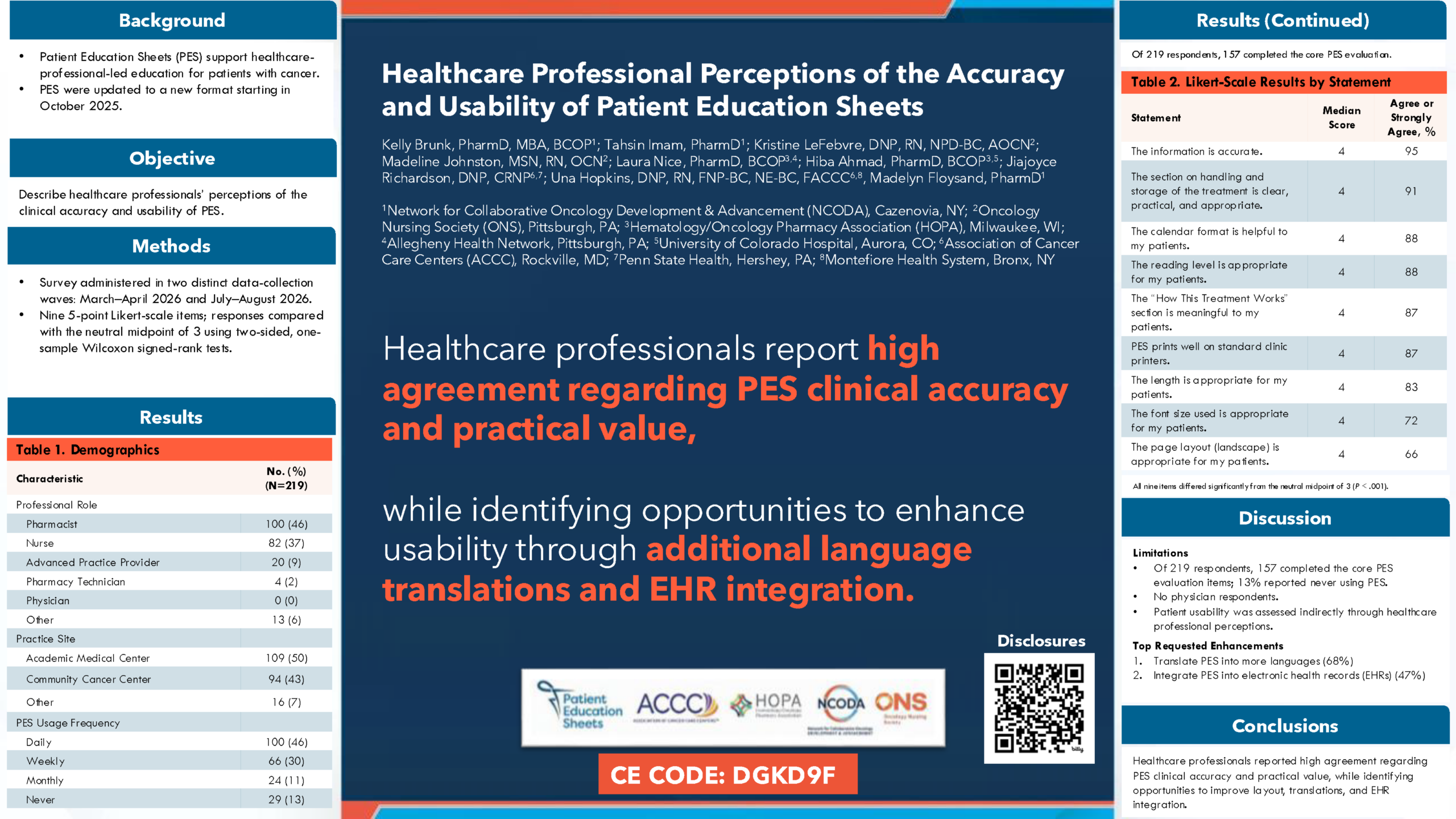
1Network for Collaborative Oncology Development & Advancement (NCODA), Cazenovia, NY; 2Oncology Nursing Society (ONS), Pittsburgh, PA; 3Hematology/Oncology Pharmacy Association (HOPA), Milwaukee, WI; 4Allegheny Health Network, Pittsburgh, PA; 5University of Colorado Hospital, Aurora, CO; 6Association of Cancer Care Centers (ACCC), Rockville, MD; 7Penn State Health, Hershey, PA; 8Montefiore Health System, Bronx, NY
Background:
Patient Education Sheets (PES) support healthcare professional–led education for patients with cancer. Following implementation of an updated PES format in October 2025, evaluating healthcare professionals’ perceptions of these materials is important for identifying opportunities to optimize their clinical utility and usability.
Objective:
Describe healthcare professionals’ perceptions of the clinical accuracy and usability of PES.
Purpose:
To assess healthcare professionals’ perceptions of the clinical accuracy and usability of PES.
Methods:
Data were collected in two distinct survey waves: March–April 2026 and July–August 2026. Respondents evaluated PES using nine 5-point Likert-scale items. Descriptive statistics were used to summarize responses, and two-sided, one-sample Wilcoxon signed-rank tests were used to compare each item with the neutral Likert midpoint of 3.
Results:
A total of 219 healthcare professionals responded, including pharmacists (46%), nurses (37%), advanced practice providers (9%), pharmacy technicians (2%), and other healthcare professionals (6%); no physicians responded. Among respondents, 157 completed the core PES evaluation. The median score was 4 for each of the nine items, and all item scores were significantly higher than the neutral midpoint of 3 (all P < .001). Agreement was highest for information accuracy (95%) and for the clarity, practicality, and appropriateness of treatment handling and storage information (91%). Agreement was also high for the calendar format (88%), reading level (88%), “How This Treatment Works” section (87%), printability (87%), and document length (83%). Lower levels of agreement were reported for font size (72%) and landscape page layout (66%). The most frequently requested enhancements were additional language translations (68%) and electronic health record integration (47%).
Conclusion:
Healthcare professionals reported high agreement regarding the clinical accuracy and practical value of PES while identifying opportunities to improve usability. Findings support continued optimization of page layout and font size, expansion of translated materials, and integration of PES into electronic health record workflows.
Funding: Not applicable.
Send your feedback
Please do not include any personal information or details.
"*" indicates required fields
Was this page
helpful?
Send your feedback
Please do not include any personal information or details.
"*" indicates required fields