

Glucagon-like-peptide-1 agonists and breast cancer outcomes: Emerging advancements in metabolic oncology
1Network for Collaborative Oncology Development & Advancement; Cazenovia, NY, USA
Discussion:
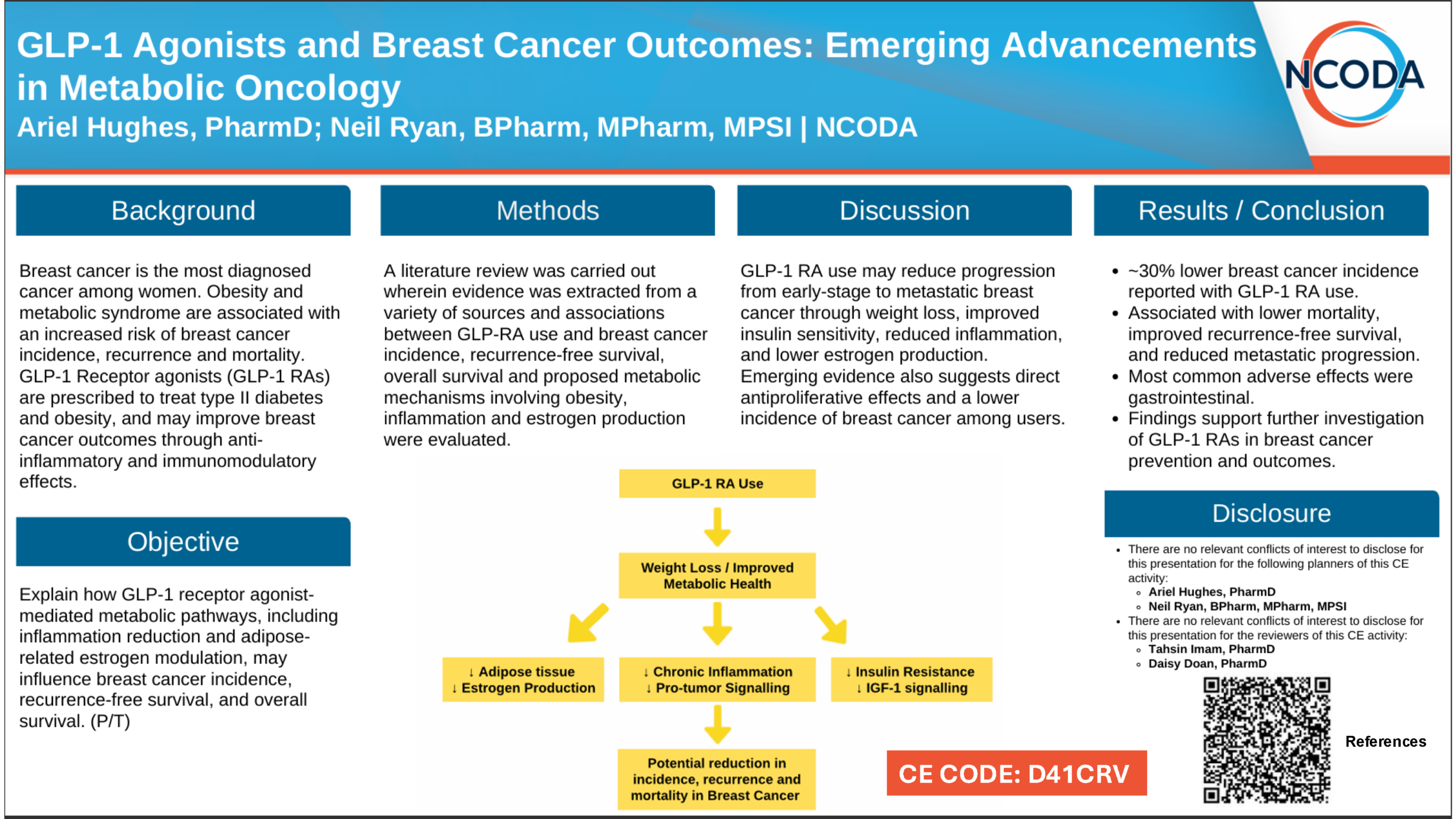
Breast cancer remains the most diagnosed cancer among women, and obesity and metabolic syndrome are associated with increased breast cancer risk, recurrence, and mortality. Prognosis is stage dependent, with nearly 100% 5-year survival for localized disease compared with 33.8% for metastatic disease. Glucagon-like peptide-1 (GLP-1) receptor agonists (RAs), used to treat obesity and type 2 diabetes, may improve outcomes through anti-inflammatory and immunomodulatory effects.
Objectives:
Explain how GLP-1 receptor agonist-mediated metabolic pathways, including inflammation reduction and adipose-related estrogen modulation, may influence breast cancer incidence, recurrence-free survival, and overall survival.
Purpose:
To analyze whether the use of GLP-1 RAs is associated with improved patient outcomes, namely the incidence, recurrence-free survival, progression, and overall survival of breast cancer patients.
Methods:
A literature review was carried out wherein evidence was extracted from a variety of sources including a retrospective analysis reported at American Society of Clinical Oncology (ASCO) 2026 and a cohort study reported in the Journal of the American Medical Association (JAMA) Network Open in 2026. Data were synthesized to evaluate associations between use of GLP-1 RAs and breast cancer incidence, recurrence-free survival, overall survival, and proposed metabolic mechanisms involving obesity, inflammation, and estrogen production.
Results:
Evidence suggests that GLP-1 RAs may influence breast cancer outcomes through both metabolic and potential antitumor effects. In a 2026 study, researchers observed a ~30% decrease in the incidence of breast cancer, which authors noted was comparable to early tamoxifen studies for breast cancer prevention. Across the included studies, use of GLP-1 RAs was consistently associated with improved breast cancer outcomes. The most reported adverse effects were gastrointestinal, including nausea, vomiting, diarrhea, and constipation. In patients with breast cancer and obesity or type 2 diabetes mellitus (T2DM), GLP-1 therapy was associated with reduced all-cause mortality (hazard ratio [HR] 0.09–0.35) and improved recurrence-free survival (HR 0.33–0.44) compared with nonuse or treatment with insulin/metformin. Additionally, GLP-1 exposure was associated with a significantly lower incidence of breast cancer among overweight and obese women undergoing screening (odds ratio [OR] 0.695; 95% confidence intervall [CI] 0.590–0.819; p<0.0001). Exposure to GLP-1 RAs was associated with reduced metastatic progression in breast cancer.
Discussion:
Use of GLP-1 RAs may be associated with a reduced risk of progression from early-stage breast cancer to metastatic disease. GLP-1 therapy promotes weight loss, improves insulin sensitivity, and reduces systemic inflammation, all of which could impact tumor growth. Reduced adiposity may lower estrogen production and other cancer-promoting signals that contribute to tumor growth and metastasis. Emerging evidence further suggests direct antiproliferative effects of GLP-1 signaling and a lower incidence of breast cancer among GLP-1 users.
Conclusion:
Studies highlight an association between the use of GLP-1 RAs and reductions in breast cancer incidence, recurrence, and progression; however, the reduction in all-cause mortality was comparable to sodium-glucose co-transporter 2 (SGLT2) inhibitors. These studies are observational, and further clinical trials are required before conclusions can be drawn. The mechanisms are unelucidated; however, the anti-inflammatory and immunomodulatory effects of GLP-1 RAs may have a positive effect on breast cancer patient outcomes. Comparisons should be made between GLP-1 RAs and other modern diabetes therapeutics such as SGLT2 inhibitors, as well as with bariatric surgery, which yields similar results.
Funding: Not applicable.
Editorial Disclosure:
Authors of this abstract serve as Editorial Fellows of NOHMA and were recused from its review, editorial decision-making, and publication review. The abstract was independently reviewed and approved without the authors’ involvement.
Send your feedback
Please do not include any personal information or details.
"*" indicates required fields
Was this page
helpful?
Send your feedback
Please do not include any personal information or details.
"*" indicates required fields