

Exploring key considerations for subcutaneous anticancer therapies
1Norton Cancer Institute, Louisville, KY, USA
Background:
The continuous climb in the number of available anticancer therapies offers a captivating alternative to traditional intravenous (IV) therapies. The incorporation of hyaluronidase has led to the rise in the development of therapies given subcutaneously. A review of the literature included 169 publications and found that when comparing subcutaneous (SC) versus IV administration, studies concluded similar efficacy and decreased infusion chair times. Studies also concluded that SC formulations saved time and in turn improved patient, caregiver, and nursing staff quality of life.
Objectives:
- List at least three advantages for patients and the practice of transitioning to SC anticancer therapies.
- Identify at least two challenges of transitioning to subcutaneous anticancer therapies.
- Discuss why hyaluronidase is used in some anticancer subcutaneous formulations.
- Describe some proper body mechanics and/or different ways to administer subcutaneous anticancer therapies to prevent nursing injuries.
- Discuss the appropriate subcutaneous anticancer administration site and needle angles that should be utilized when providing these medications.
Purpose:
The purpose of this project is to bring awareness of SC anticancer formulations available and the pros and cons when switching to SC formulations versus traditional IV formulations.
Methods:
A review of the literature was performed including journal articles, podcasts, and online resources. The primary themes were reviewed and pulled from the literature.
Results:
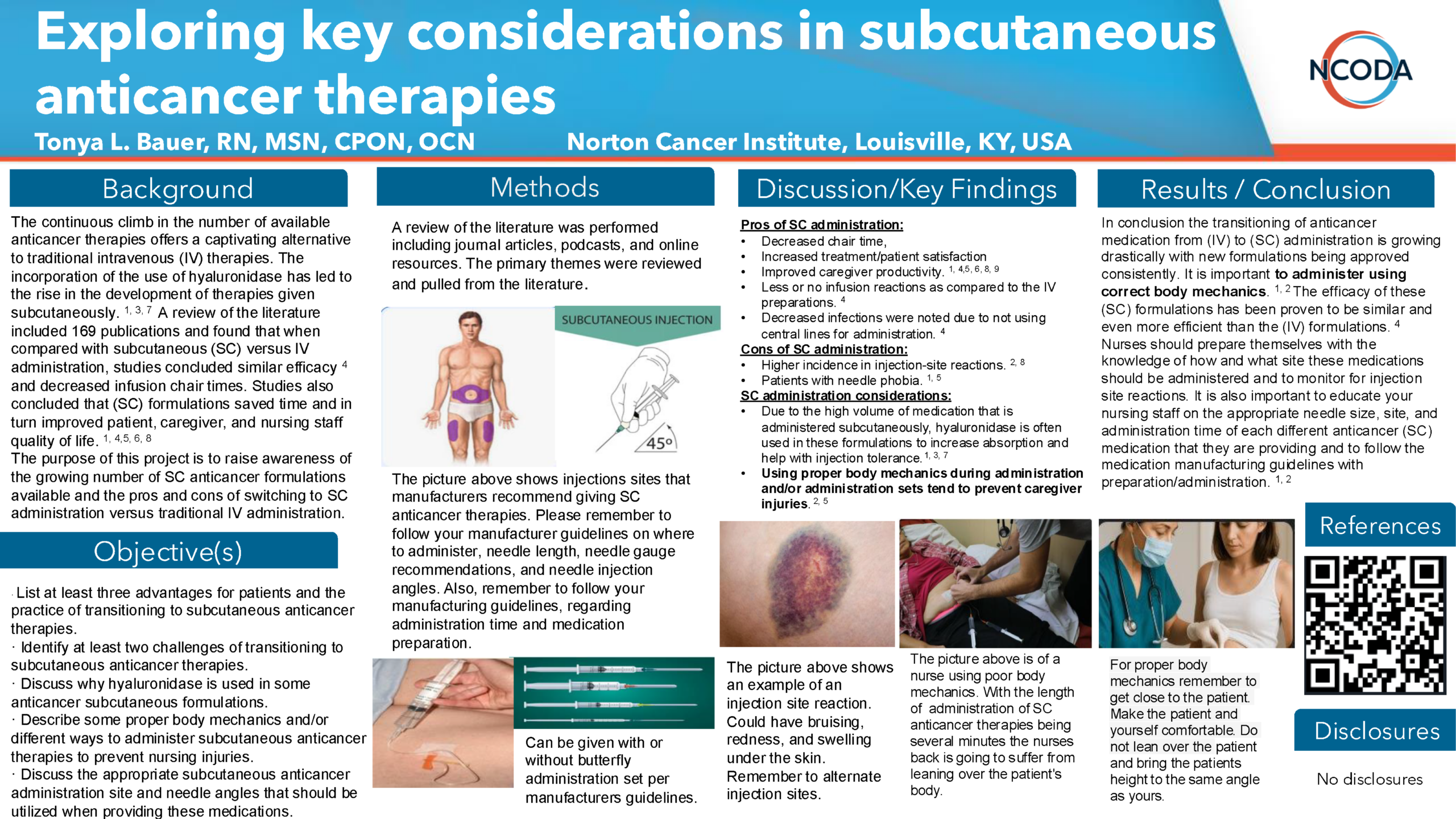
The key findings from the review included decreased chair time, increased treatment/patient satisfaction, and improved caregiver productivity. However, there was a higher incidence of injection-site reactions compared to IV formulations. Due to the high volume of medication that is administered subcutaneously, hyaluronidase is often used in these formulations to increase absorption and help with injection tolerance. The use of SC formulations was also shown to have fewer or no infusion reactions as compared to the IV preparations. Additionally, decreased infections were noted due to not using central lines for administration. Using proper body mechanics during administration and/or administration sets tends to prevent caregiver injuries. The main negative themes of these SC formulations consisted of injection-site reactions and patients who have needle phobia.
Conclusion:
In conclusion, the transition of anticancer medication from IV to SC administration is growing drastically with new formulations being approved consistently. It is important to use correct body mechanics during administration. Nurses should prepare themselves with the knowledge of how and at what site these medications should be administered and how to monitor for injection-site reactions. It is also important to educate your nursing staff on the appropriate needle size, site, and administration time of each anticancer SC medication that they are providing and to follow the medication manufacturing guidelines for preparation and administration.
Funding: Not applicable.
Send your feedback
Please do not include any personal information or details.
"*" indicates required fields
Was this page
helpful?
Send your feedback
Please do not include any personal information or details.
"*" indicates required fields