

Cutaneous recurrence of extramedullary multiple myeloma within surgical scar tissue
1Lake Erie College of Osteopathic Medicine, Erie, PA, USA; 2Department of Radiology, Brooke Army Medical Center, San Antonio, TX, USA; 3Department of Radiation Oncology, Brooke Army Medical Center, San Antonio, TX, USA
Background:
Multiple myeloma (MM) is a plasma cell malignancy that primarily involves the bone marrow and can cause systemic end-organ damage. In some patients, clonal plasma cells proliferate outside the marrow, resulting in extramedullary disease that is oftentimes aggressive. Cutaneous scarsite involvement is exceptionally uncommon, with only a few cases reported in current literature. This case discusses extramedullary relapse of IgA lambda multiple myeloma at a prior lumbar fusion and laminectomy scar, with paraspinal and intradural extension but without bone marrow involvement.
Objectives:
- Recognize an uncommon manifestation of extramedullary relapse of MM near prior surgical sites that clinicians should be aware of.
- Analyze current literature regarding extramedullary relapse of MM within surgical scar tissue, including case reports and proposed mechanism of disease.
- Address the evaluation and management of extramedullary relapse without detectable marrow involvement.
Case:
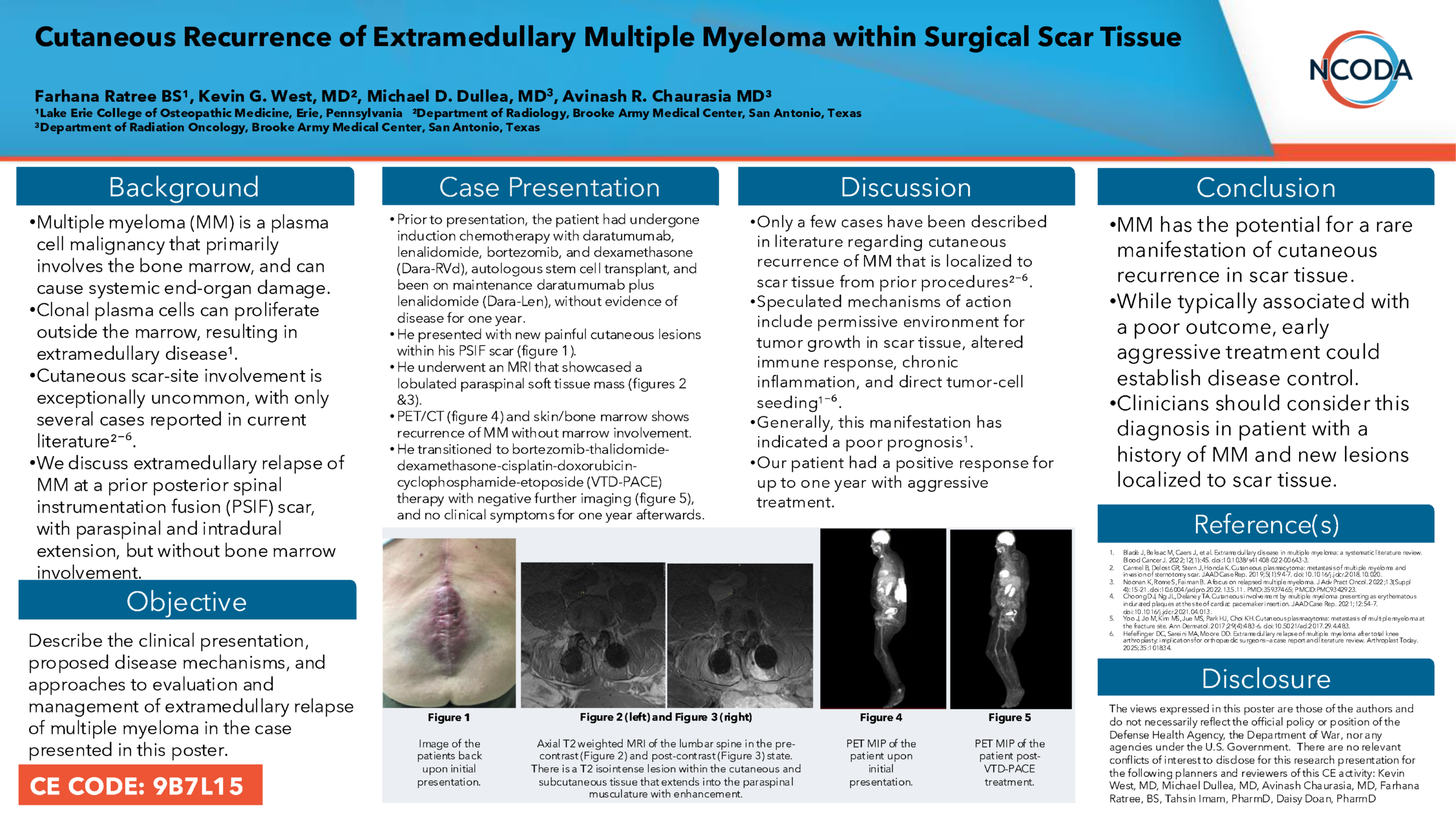
A 55-year-old man with IgA lambda MM status post induction chemotherapy, autologous stem cell transplant (SCT), and on maintenance chemotherapy presented with new painful cutaneous and subcutaneous lesions. One year prior, the patient had been diagnosed with MM, complicated by pathological fractures of his lumbar spine. As a result, he initially underwent posterior spinal instrumentation fusion (PSIF) of T12-L4, as well as an L2 laminectomy. He was then treated with induction daratumumab, lenalidomide, bortezomib, and dexamethasone (Dara-RVd), as well as an autologous SCT. After his induction period, he was placed on maintenance daratumumab plus lenalidomide (Dara-Len) with plans to continue for at least two years. At his current presentation one year later, he reported developing rapidly progressing painful erythematous cutaneous lesions along his previous PSIF surgical scar. He underwent magnetic resonance imaging (MRI) that revealed lobulated paraspinal soft tissue masses stretching from T11 to the sacrum. Additional imaging with positron emission tomography-computed tomography (PET/CT) further disclosed fluorodeoxyglucose (FDG)-avid subcutaneous masses along with scattered mildly FDG-avid mixed lytic/sclerotic skeletal lesions. Punch and bone marrow biopsies with flow cytometry testing confirmed recurrent cutaneous MM with no bone marrow involvement. He was then transitioned to bortezomib-thalidomide- dexamethasone-cisplatin-doxorubicin-cyclophosphamide- etoposide (VTD-PACE) chemotherapy. Since then, further surveillance imaging studies and clinical follow-up have been negative for active disease up to one year from initiation of VTD-PACE.
Discussion:
The case demonstrates a rare manifestation of cutaneous MM recurrence centered around a surgical scar. Cutaneous recurrences of MM localized to scar tissue have been rarely reported in the literature, with previously described cases involving incisional scar tissue from sternotomy, pacemaker placement, and orthopedic surgery sites. Current literature speculates that surgical trauma and tissue repair may create a permissive environment for tumor growth. Other proposed mechanisms include altered immune response, chronic inflammation, or direct tumor-cell seeding during procedures. Typically, this manifestation indicates a poor prognosis. The absence of bone-marrow disease suggests that malignant plasma cells can persist outside marrow stroma and later re-emerge at areas of prior tissue injury. The patient’s initial positive response to VTD-PACE chemotherapy demonstrates that intensive therapy may achieve disease control even when relapse occurs outside of the marrow.
Conclusion:
This case highlights an unusual pattern of cutaneous extramedullary MM recurrence originating at a surgical scar site. While typically representing a poor prognosis according to current literature, the patient initially responded well to aggressive treatment. This atypical presentation emphasizes the need for clinicians to consider extramedullary relapse in the differential diagnosis of new or rapidly progressing lesions arising from prior surgical scars in patients with a history of MM.
Funding: Not applicable.
Prior Presentations:
Presented virtually at the Pennsylvania Osteopathic Medical Association (POMA) 2026 Clinical Assembly, May 13–16.
Send your feedback
Please do not include any personal information or details.
"*" indicates required fields
Was this page
helpful?
Send your feedback
Please do not include any personal information or details.
"*" indicates required fields