

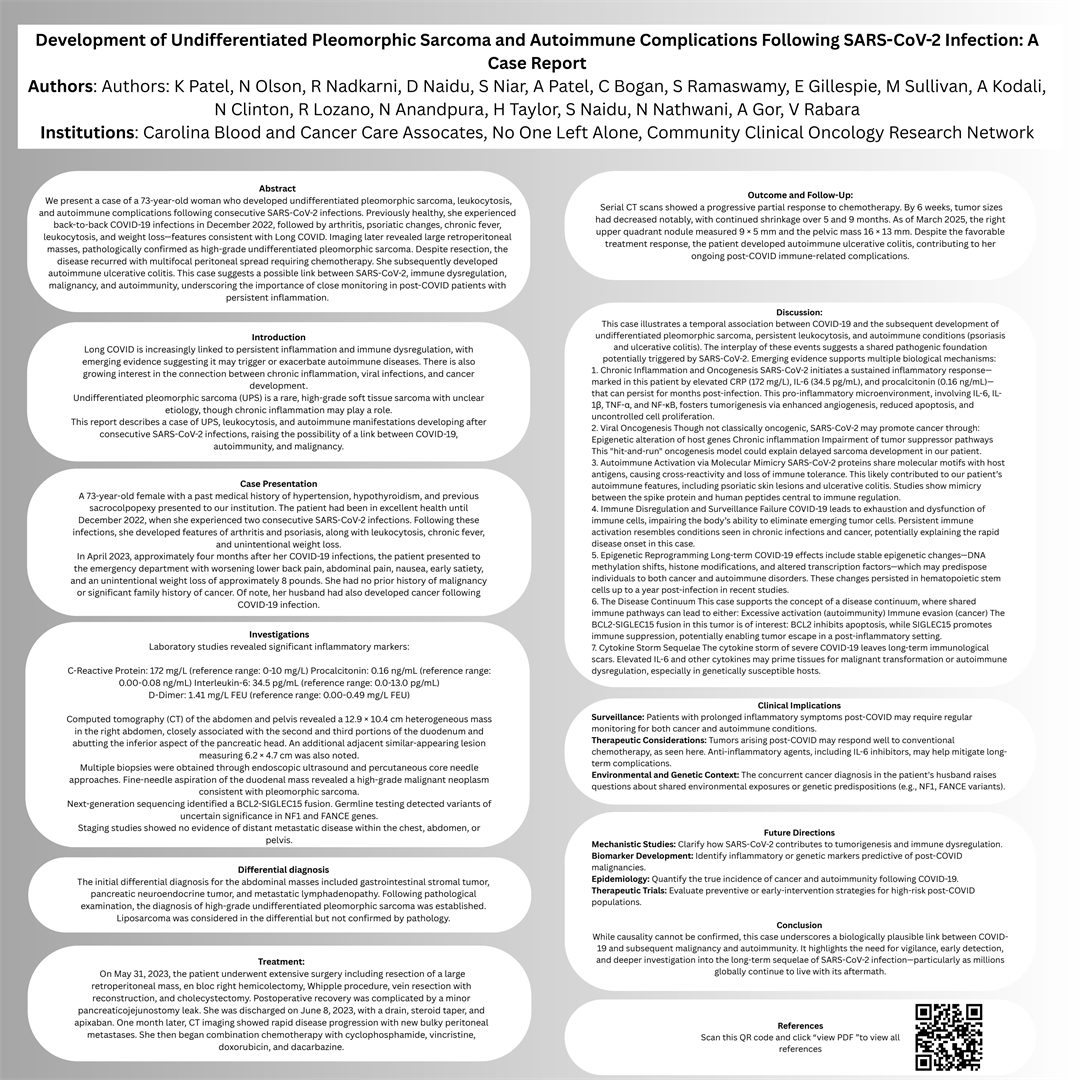
Development of undifferentiated pleomorphic sarcoma and autoimmune complications following severe acute respiratory syndrome coronavirus 2 infection: a case report
1Carolina Blood and Cancer Care Associates, 2Network for Collaborative Oncology Development & Advancement (NCODA), 3Community Clinical Oncology Research Network, 4Cencora
Background:
Undifferentiated pleomorphic sarcoma (UPS) is a rare, high-grade soft tissue sarcoma with a largely unknown etiology, though chronic inflammation has been proposed as a contributing factor. Long corona virus (COVID), characterized by persistent inflammation and immune dysregulation, has been associated with various autoimmune conditions. Emerging evidence suggests potential links between severe acute respiratory syndrome coronavirus 2 (SARS-CoV-2) infection and both malignancy and autoimmune disorders through mechanisms including chronic inflammation, immune surveillance impairment, and molecular mimicry.
Objectives:
- Describe a case of UPS, leukocytosis, and autoimmune manifestation developing after consecutive SARS-CoV 2 infections, raising the possibility of a line between COVID-19, autoimmunity, and malignancy.
Case Report:
We report a 73-year-old female who developed undifferentiated pleomorphic sarcoma, persistent leukocytosis, and autoimmune complications following consecutive SARS-CoV-2 infections in December 2022. The patient, previously in excellent health, subsequently developed arthritis, psoriatic features, chronic fever, and weight loss. Four months post-infection, imaging revealed large retroperitoneal masses (12.9 × 10.4 cm and 6.2 × 4.7 cm) with pathology confirming high-grade UPS containing a novel B-cell lymphoma 2 (BCL2-) and sialic acid-binding immunoglobulin-like lectin 15 (SIGLEC15) fusion. Despite extensive surgical resection, multifocal peritoneal recurrence occurred within one month, requiring systemic chemotherapy. The patient demonstrated progressive partial response to treatment over nine months but later developed autoimmune ulcerative colitis.
Discussion:
This case demonstrates a concerning temporal relationship between SARS-CoV-2 infection and subsequent development of both malignancy and autoimmune disorders. The pathophysiological mechanisms may involve chronic inflammation creating a microenvironment conducive to neoplastic transformation, viral-induced immune dysregulation impairing tumor surveillance, molecular mimicry triggering autoimmune responses, and epigenetic reprogramming predisposing to both cancer and autoimmunity. The novel BCL2-SIGLEC15 fusion represents a potential oncogenic driver linked to post- viral oncogenesis. The excellent response to chemotherapy suggests post- COVID malignancies may retain treatment sensitivity.
Results:
The mean age was 56.38 years, with many patients being postmenopausal. Most patients (83.8%) were within two years of diagnosis. Invasive ductal carcinoma was the most prevalent type. Key symptoms impacting quality of life (QOL) included hair loss, fever, vomiting, and fatigue. Post four chemotherapy cycles, 56.8% of patients underwent surgery. Functional Assessment of Cancer Therapy – Breast (FACT-B) Scores: Mean = 83.8 (Range: 54–118), indicating an average QOL. Functional Assessment of Cancer Therapy – Breast Cancer Symptom Index – 16 Item Version (FBSI-16) Scores: Mean = 27.78 (Range: 14–43), reflecting below-average QOL. Quality of Life Questionnaire – Breast Cancer Module, 23-item version (QLQ-BR23): Subscale scores were average; however, poor response was noted in sexual function domains. Statistically significant correlations were found between demographic variables and QOL scores, with most data being normally distributed.
Conclusions:
This case highlights the need for heightened surveillance for both neoplastic and autoimmune complications in patients with prolonged post-COVID inflammatory syndromes. Clinicians should maintain increased awareness for these complications, implement systematic evaluation protocols for persistent inflammatory symptoms, and consider multidisciplinary care approaches. Further research is urgently needed to establish casual relationships and develop preventive strategies for post-COVID malignancies and autoimmune disorders.
Funding: Not applicable.
Send your feedback
Please do not include any personal information or details.
"*" indicates required fields
Was this page
helpful?
Send your feedback
Please do not include any personal information or details.
"*" indicates required fields