

Response to avatrombopag among patients with chronic and acute or persistent primary immune thrombocytopenia: REAL-AVA 2.0 real-world study
<sup>1</sup>Baylor Charles A. Sammons Cancer Center, Texas Oncology, Dallas, USA; <sup>2</sup>Johns Hopkins School of Medicine, Division of Medicine–Hematology, Baltimore, USA; <sup>3</sup>Sobi Inc., Morrisville, USA; <sup>4</sup>Analysis Group, Boston, USA; <sup>5</sup>Miami Cancer Institute, Miami, USA
Background:
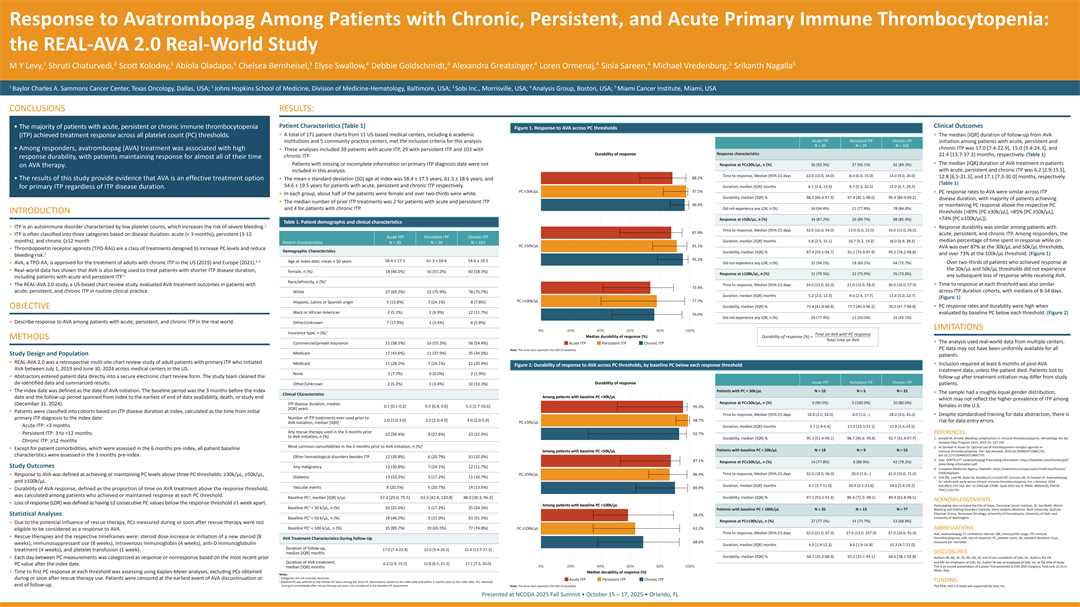
Immune thrombocytopenia (ITP) is an autoimmune disorder characterized by low platelet counts (PCs) and increased bleeding risk.Thrombopoietin receptor agonists (TPO-RA) aim to increase PCs to target levels to minimize this risk. ITP duration can be classified as acute (< 3 months), persistent (3-12 months) or chronic (≥1 year). Avatrombopag (AVA) is a TPO-RA that gained FDA approval for the treatment of adults with chronic ITP in 2019, but realworld data have also shown its use in acute and persistent ITP. The objective of this study is to describe response to AVA among patients with chronic and acute/persistent ITP.
Objectives:
- Describe response to AVA among patients with differing ITP disease duration.
Methods:
REAL-AVA 2.0 was a United States of America (USA) retrospective multi-site chart review that assessed patients with chronic or acute/persistent ITP who initiated AVA 7/2019-6/2024 in real-world clinical practice. The follow-up period spanned from index to earliest of end of data availability, death, or study end (12/2024). Patients were classified by ITP disease duration at index (acute/persistent: <12 months; chronic: ≥12 months). AVA response was defined as achieving or maintaining a threshold PC ≥30k, ≥50k, or ≥100k/µL; PCs obtained while the patient received rescue therapy were disregarded. At each response threshold, Kaplan-Meier analyses were used to assess time to earliest PC response. Response durability, defined as the proportion of time on AVA treatment with PCs above the threshold, was calculated among responders.
Results:
171 patients from 11 sites were included in the study; 68 (39.8%) had acute/persistent ITP and 103 (60.2%) had chronic ITP. At index, mean (SD) age was 59.6 (17.9) years among patients with acute/persistent ITP and 54.6 (19.5) years among patients with chronic ITP. Median [IQR] duration of follow-up and duration of AVA treatment were 16.5 [7.7-23.5] months and 8.5 [3.6-18.4] months among patients with acute/persistent ITP and 22.4 [13.7-37.3] months ITP and 17.1 [7.3-30.0] months among patients with chronic ITP, respectively. PC response rates were similar between patients with acute/persistent and chronic ITP at the ≥30k/ µL (92.6% versus (vs.) 89.3%), ≥50k/µL (88.2% vs. 85.4%), and ≥100k/µL (77.9% vs. 73.8%) thresholds. Time to response at each threshold was also similar across ITP duration cohorts, with medians of 14-32 days. Response durability ranged from 76.0% to 96.4% of the time on AVA treatment across cohorts and PC thresholds.
Conclusions:
The majority of patients with acute/persistent or chronic ITP achieved treatment response across all PC thresholds. These findings suggest that treatment response to AVA was consistent regardless of ITP disease duration before initiating AVA.
Funding: Sobi Inc.
Prior Presentations:
Presented at the European Hematology Association (EHA) Congress 2025, June 12-15, Milan, Italy
Send your feedback
Please do not include any personal information or details.
"*" indicates required fields
Was this page
helpful?
Send your feedback
Please do not include any personal information or details.
"*" indicates required fields