
Real-world treatment patterns and clinical outcomes in patients with myelofibrosis treated with pacritinib with platelets ≥50 × 10⁹/L at treatment initiation: interim results from the MY-PAC study
1Icahn School of Medicine at Mount Sinai, New York, USA; 2Sobi Inc., Waltham, USA; 3Cardinal Health, Dublin, USA; 4University of Texas MD Anderson Cancer Center, Houston, USA; 5University of Pittsburgh Medical Center, Pittsburgh, USA
Background:
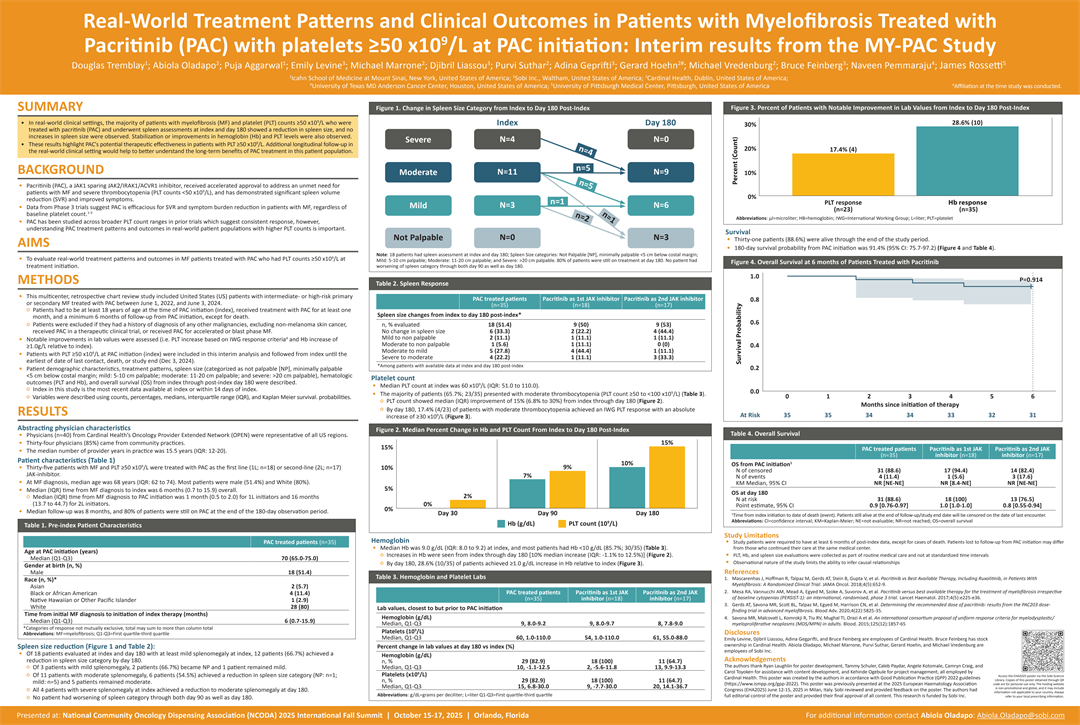
Pacritinib (PAC), a JAK1 sparing JAK2/IRAK1/ ACVR1 inhibitor is approved for patients with myelofibrosis (MF) and severe thrombocytopenia (platelet [PLT] counts <50 x109/L). There is growing evidence of PAC use in patients with higher PLT counts.
Objectives:
- Examine real-world treatment patterns and baseline characteristics of patients with myelofibrosis and platelet count ≥50 x 109/L treated with pacritinib.
- Identify the benefits of pacritinib in patients with myelofibrosis with higher platelet counts by evaluating clinical outcomes including spleen response and overall survival.
- Analyze hematologic parameters supporting benefit of pacritinib including platelet response and hemoglobin (Hb) response.
Methods:
Retrospective chart review of United States of America (USA) patients with MF treated with PAC between June 1, 2022 and June 3, 2024. Patients with PLT ≥50 x109/L at PAC initiation (index) were included in this interim analysis and followed from index to earliest of date of last contact, death, or study end (December 3, 2024).
Results:
Among 35 patients treated with PAC as the first (1L) (n=18) or second (2L; n=17) JAK-inhibitor, the median age was 68 years (interquartile range [IQR]: 62, 74) at MF diagnosis, and most were male (51.4%), or White (80%). Median follow-up was 8 months, with 80% of patients still on PAC at the end of the 180-day observation period. Of 18 patients evaluated with at least mild splenomegaly at index, 12 (66.7%) achieved reduction in spleen size category. Of 3 patients with mild splenomegaly (5-10 cm palpable), 2 (66.7%) became not palpable (NP) and 1 remained mild. Of 11 patients with moderate splenomegaly (11-20 cm palpable), 6 (54.5%) achieved reduction in spleen size category (NP: n=1; mild: n=5) and 5 remained moderate. All 4 patients with severe splenomegaly (>20 cm palpable) at index became moderate. No patient had worsening of spleen size category. At index, median PLT was 60 x109/L (51, 110) with most patients (65.7%; 23/35) presenting with PLT <100 x109/L. By day 180, PLT improved with a 15% median increase from index (IQR: 6.8%, 30%) and 17.4% (4/23) of patients with PLT <100 x109/L achieved an absolute increase ≥30 x109/L. Median Hb was 9.0 g/dL (IQR: 8.0 to 9.2) at index, and most patients had Hb <10 g/dL (85.7%; 30/35). Increases in Hb were seen from index through day 180 with a 10% median increase (IQR: -1.1% to 12.5%) and 28.6% (8/30) patients with Hb <10 g/dL at index achieved >1.0 g/dL increase in Hb. Through the end of observation, 88.6% (31/35) of patients were alive, and 180-day survival probability from PAC initiation was 91.4%.
Conclusions:
In this interim real-world analysis, PAC demonstrated clinical benefit in MF patients with PLT ≥50 x10⁹/L, including reductions in spleen size, improvement in hematologic parameters, and encouraging short-term survival. These findings support the utility of PAC in patients with moderate thrombocytopenia.
Funding: Sobi Inc.
Prior Presentations:
Presented at the European Hematology Association (EHA) Congress 2025, June 12-15, Milan, Italy.
Send your feedback
Please do not include any personal information or details.
"*" indicates required fields
Was this page
helpful?
Send your feedback
Please do not include any personal information or details.
"*" indicates required fields