
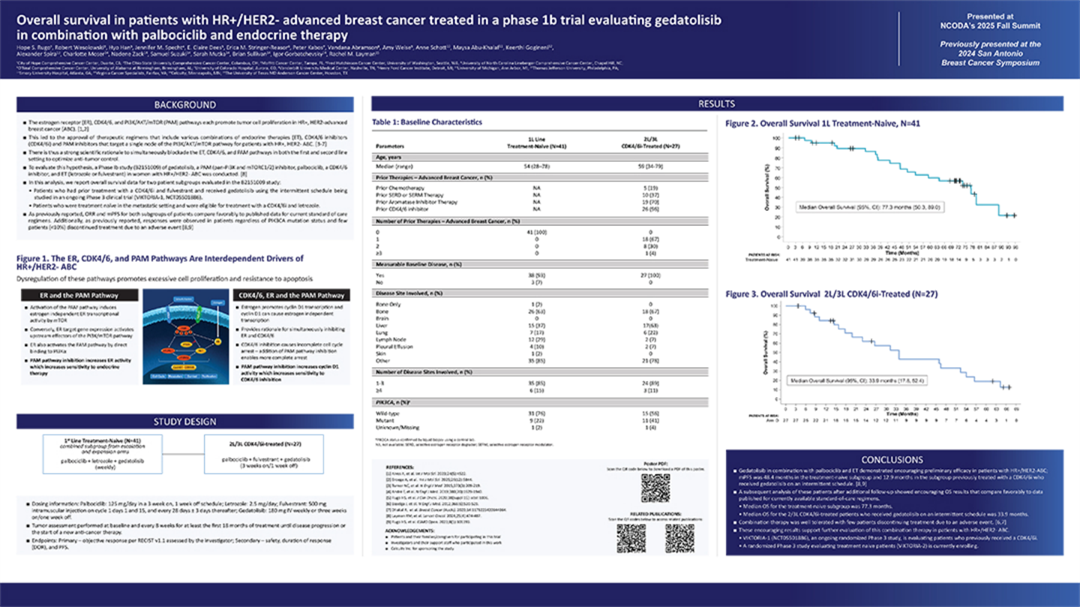
Overall survival in patients with hormone receptor–positive, human epidermal growth factor receptor 2–negative advanced breast cancer treated in a phase 1b trial evaluating gedatolisib in combination with palbociclib and endocrine therapy
1City of Hope Comprehensive Cancer Center, Duarte, CA; 2The Ohio State University Comprehensive Cancer Center, Columbus, OH; 3Moffitt Cancer Center, Tampa, FL; 4Fred Hutchinson Cancer Center, University of Washington, Seattle, WA; 5University of North Carolina Lineberger Comprehensive Cancer Center, Chapel Hill, NC; 6O’Neal Comprehensive Cancer Center, University of Alabama at Birmingham, Birmingham, AL; 7University of Colorado Hospital, Aurora, CO; 8Vanderbilt University Medical Center, Nashville, TN; 9Henry Ford Cancer Institute, Detroit, MI; 10University of Michigan, Ann Arbor, MI; 11Thomas Jefferson University, Philadelphia, PA; 12Emory University Hospital, Atlanta, GA; 13Virginia Cancer Specialists, Fairfax, VA; 14Celcuity, Minneapolis, MN; 15The University of Texas MD Anderson Cancer Center, Houston, TX
Background:
Gedatolisib is a pan phosphoinositide 3-kinase (PI3K)/mammalian target of rapamycin (mTOR) inhibitor and was evaluated in a multicenter, open-label, phase 1b dose-escalation and dose-expansion trial in combination with palbociclib and endocrine therapy in patients with hormone receptor-positive/human epidermal growth factor receptor 2-negative (HR+/HER2-) -breast cancer with varying categories of prior therapy (ClinicalTrials.gov NCT02684032). The primary objective of the dose-escalation cohorts was safety while the primary endpoint of the dose-expansion cohorts was investigator-assessed objective response. Median progression-free survival at 12 months was 72.1%, 54.5%, 23.6%, and 53.2% for Arms A, B, C, and D, respectively, as defined in the methods. In the dose-expansion cohorts gedatolisib triplet therapy achieved overall response rates (ORR) of 85%, 77%, 36% and 63% in Arm A, B, C and D respectively. Based on the promising ORR of the phase 1b trial, further follow-up was warranted to analyze survival outcomes. Here we report survival results of patients who received gedatolisib combined with palbociclib plus letrozole or fulvestrant.
Objectives:
- Understand the safety and efficacy profile of gedatolisib in combination with palbociclib and endocrine therapy in HR+/HER2- advanced breast cancer across varying lines of prior treatment.
- Evaluate overall survival outcomes for patients who received gedatolisib combined with palbociclib plus letrozole or fulvestrant, comparing those who were treatment naïve to those with prior lines of therapy, including a cyclin-dependent kinase 4/6 (CDK4/6) inhibitor.
Methods:
Female patients aged at least 18 years from 17 sites across the United States of America (USA) with HR+/ HER2- advanced breast cancer and an Eastern Cooperative Oncology Group (ECOG) performance status of 0-1 were enrolled in the phase 1b trial. There were 2 dose-escalation arms that assessed safety of gedatolisib 180 mg/week plus standard doses of palbociclib with endocrine therapy of letrozole or fulvestrant. The dose expansion portion had 4 patient cohorts based on prior treatment history, with Arm A comprising patients with no prior systemic treatment for breast cancer, Arm B with patients with 1-2 prior endocrine therapies but no history of CDK4/6 inhibitor, and Arms C and D with patients with one or more prior lines of therapy, including a CDK4/6 inhibitor. Gedatolisib 180 mg was administered intravenously weekly in 28-day treatment cycles for Arms A-C, and on days 1, 8, and 15 for Arm D. Endocrine therapy with letrozole or fulvestrant and CDK4/6 inhibition with palbociclib were administered at standard dose. Participating sites were asked to collect patient outcome for survival analysis.
Results:
Median overall survival (OS) for patients with no prior systemic treatment was 77.3 months (95% confidence interval [CI], 50.3-89.0). Median OS for patients with one or more prior lines of therapy, including a CDK4/6 inhibitor was 33.9 months (95% CI, 17.8-52.4).
Conclusions:
Gedatolisib in combination with palbociclib and letrozole demonstrated promising overall response rates and progression-free survival in patients with HR+/HER2- advanced breast cancer. A subsequent analysis of these patients after additional follow-up showed encouraging OS results.
Funding: Celcuity Inc.
Prior Presentations:
Presented at the San Antonio Breast Cancer Symposium (SABCS) 2024, December 10-13, San Antonio, TX.
Send your feedback
Please do not include any personal information or details.
"*" indicates required fields
Was this page
helpful?
Send your feedback
Please do not include any personal information or details.
"*" indicates required fields