
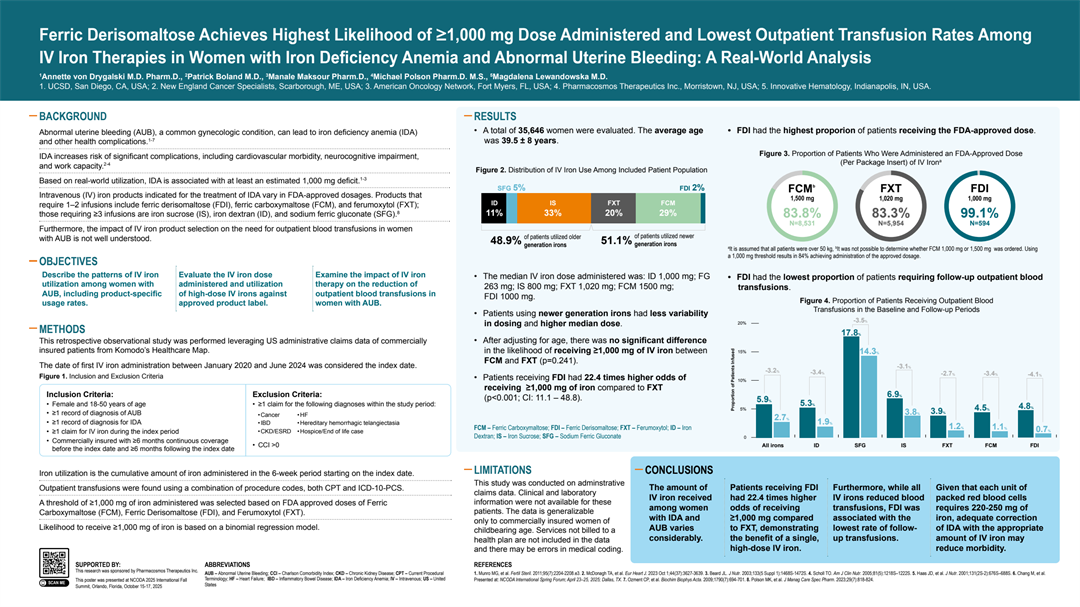
Ferric derisomaltose achieves highest likelihood of ≥1000-mg dose administered and lowest outpatient transfusion rates among intravenous iron therapies in women with iron deficiency anemia and abnormal uterine bleeding: a real-world analysis
1UCSD, San Diego, CA, USA; 2New England Cancer Specialists, Scarborough, ME, USA; 3American Oncology Network, Fort Myers, FL, USA; 4Pharmacosmos Therapeutics Inc., Morristown, NJ, USA; 5Innovative Hematology, Indianapolis, IN, USA
Background:
Abnormal uterine bleeding (AUB), a common gynecologic condition, can lead to iron deficiency anemia (IDA), which increases health complication risks and necessitates iron repletion. Intravenous (IV) iron products are a treatment modality for IDA; however, the amount of IV iron ordered varies among available products. These orders can differ from FDA-approved iron dosages; high-dose products—ferumoxytol (FXT), ferric carboxymaltose (FCM), and ferric derisomaltose (FDI)— have labeled dosing of at least 1000 mg, depending on the product. Furthermore, the impact of IV iron on reducing outpatient blood transfusions in women with AUB remains unknown.
Objectives:
- Describe the the patterns of IV iron utilization among women with AUB, including demographic distributions and product-specific usage rates.
- Evaluate the IV iron administered and utilization of high-dose IV irons against approved product label.
- Analyze the impact of IV iron therapy on the reduction of outpatient blood transfusions in women with AUB.
Methods:
This retrospective observational study leveraged United States of America (USA) administrative claims data of commercially insured patients from Komodo’s Healthcare Map. Inclusion criteria were women aged 18–50 years with diagnoses of AUB and IDA, identified using International Classification of Diseases, 10th Revision, Clinical Modification (ICD-10-CM) codes N93.8 and D50, respectively, and at least one claim for IV iron between January 1, 2020, and June 4, 2024. Exclusion criteria included evidence of other chronic bleeding conditions at any point. IV iron products evaluated were iron dextran (ID), ferric gluconate (FG), iron sucrose (IS), FXT, FCM, and FDI. The total amount of IV iron received within 6 weeks of the index date was measured, and utilization of high-dose iron was compared with product labeling. Outpatient transfusions were identified using a combination of current procedural terminology (CPT) and international classification of diseases (ICD)-10- procedure coding system (PCS) codes and were counted by iron administered.
Results:
A total of 35,646 women were evaluated. The median IV iron dose administered was 1000 mg for ID, 263 mg for FG, 800 mg for IS, 1020 mg for FXT, 1500 mg for FCM, and 1000 mg for FDI. After adjusting for age, there was no significant difference in the likelihood of receiving at least 1000 mg of IV iron between FCM and FXT (p = 0.241). Patients receiving FDI were 22 times more likely to receive at least 1000 mg of iron compared with those receiving FXT (p < 0.001; 95% CI, 11.1–48.8). Following IV iron administration, the proportion of patients receiving an outpatient blood transfusion decreased across all products, ranging from a reduction of 2.7% with FXT to a maximum reduction of 4.1% with FDI.
Discussion:
The amount of IV iron received among women with IDA and AUB varied considerably across products. Patients receiving FDI were substantially more likely to receive a full high-dose iron course compared with FXT, highlighting the potential advantage of single-dose, highdose IV iron formulations. Although all IV iron products were associated with reductions in outpatient transfusions, differences were observed between products.
Conclusions:
IV iron dosing in women with AUB-associated IDA varies widely in real-world practice. Ferric derisomaltose was associated with the highest likelihood of receiving at least 1000 mg of iron and the lowest rate of follow-up outpatient transfusions. Given that each unit of packed red blood cells requires approximately 220–250 mg of iron, adequate correction of IDA with appropriate IV iron dosing may reduce morbidity.
Funding: Pharmacosmos Therapeutics Inc.
Send your feedback
Please do not include any personal information or details.
"*" indicates required fields
Was this page
helpful?
Send your feedback
Please do not include any personal information or details.
"*" indicates required fields