

Ovarian cancer complications: clinical challenges following surgical rupture
1Florida A&M University College of Pharmacy and Pharmaceutical Sciences
Background:
Intraoperative rupture of ovarian tumors is a known risk factor for recurrence and disease upstaging. According to the International Federation of Gynecology and Obstetrics (FIGO) guidelines, tumor rupture during surgery advances staging to at least IC1, carrying a poorer prognosis compared to tumors confined within the ovary without surface involvement or rupture. This case describes a 41-year-old woman with FIGO stage IC1, grade 2 endometrioid ovarian adenocarcinoma complicated by surgical rupture and peritoneal fluid, which contributed to recurrence despite initial treatment success. This case aims to illustrate the clinical course and management of recurrent endometrioid ovarian carcinoma following surgical rupture, with a focus on complications during chemotherapy and transitions to surveillance.
Objectives:
- Describe the impact of surgical tumor rupture on disease staging, recurrence risk, and long-term treatment planning.
- Identify evidence-based alternative management strategies in patients with chemotherapy hypersensitivity.
- Discuss the pharmacist’s role in optimizing care through managing toxicity, interpreting lab trends, medication adjustments, and supporting care transitions during oncology treatment.
Methods:
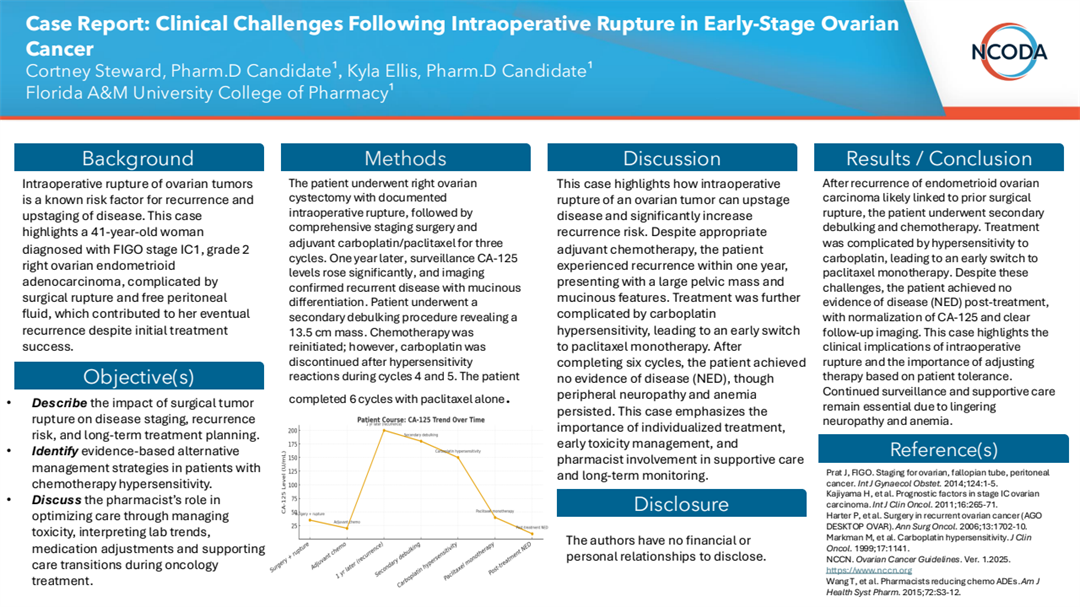
The patient underwent right ovarian cystectomy with documented intraoperative rupture, followed by comprehensive staging surgery and adjuvant carboplatin/paclitaxel for three cycles.
Results:
One year later, surveillance CA-125 levels rose significantly, and imaging confirmed recurrent disease with mucinous differentiation. The presence of mucinous differentiation at recurrence was unexpected. Secondary cytoreduction revealed a 13.5 cm pelvic mass. Re-initiation of chemotherapy was complicated by hypersensitivity to carboplatin during cycles 4 and 5, leading to discontinuation and completion of 6 cycles with paclitaxel monotherapy. Post-treatment imaging confirmed no evidence of disease (NED), and CA-125 normalized. The patient transitioned to surveillance. Persistent challenges included chemotherapy-induced peripheral neuropathy and anemia secondary to beta-thalassemia minor and iron deficiency, which were managed with supportive care and laboratory monitoring.
Discussion:
This case highlights the recurrence risk associated with intraoperative tumor rupture and the complexity of treatment decision-making in recurrent disease. Additionally, it emphasizes the importance of pharmacist involvement in toxicity monitoring and individualized supportive care planning, especially when standard regimens must be modified.
Conclusions:
This case illustrates the clinical course and management of recurrent endometrioid ovarian carcinoma following surgical rupture, including complications during chemotherapy and transition to surveillance.
Funding: Not applicable.
Send your feedback
Please do not include any personal information or details.
"*" indicates required fields
Was this page
helpful?
Send your feedback
Please do not include any personal information or details.
"*" indicates required fields