
Novel scoring framework to analyze and improve access pathways to oral oncology therapies
1Moffitt Cancer Center
Background:
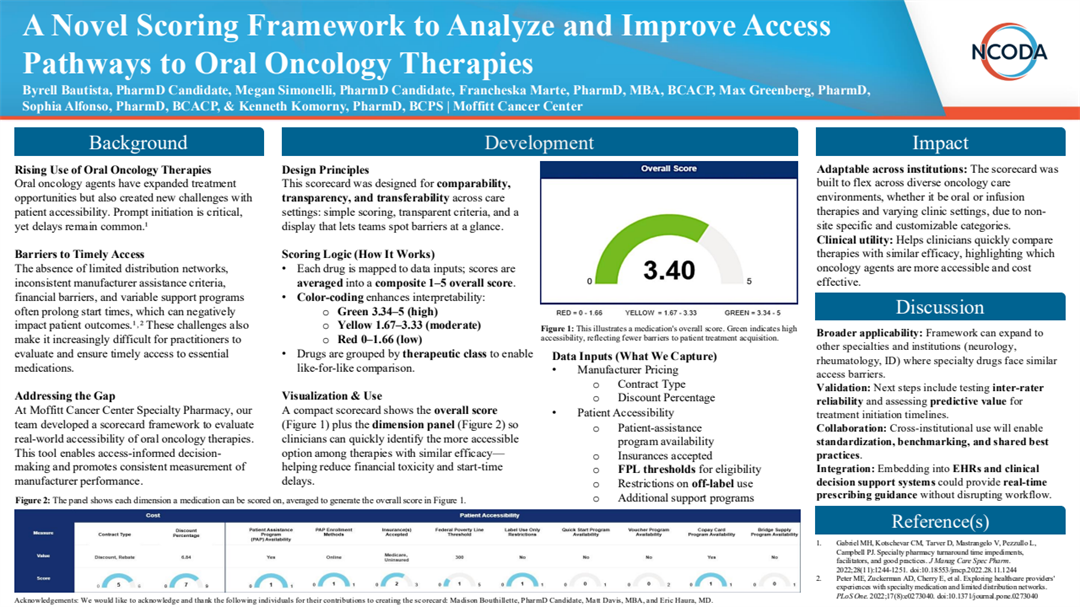
Timely access to oral oncology therapies remains a persistent challenge, hindered by complex distribution models, high out-of-pocket costs, and administrative barriers. These barriers can significantly delay treatment initiation, a key determinant of clinical outcomes in cancer care. A major limitation for clinicians is the absence of a centralized, standardized tool to compare medication access pathways across manufacturers. Without such a resource, this evaluation remains difficult and time-consuming. Delays in accessing specialty oncology medications have been linked to worsened survival and disease progression. Contributing factors include administrative complexity, lack of transparency in access logistics, and inconsistent communication, all of which amplify patient distress and increase provider workload. These issues underscore the need for a structured, comparative tool to help clinicians efficiently navigate medication access pathways and facilitate timely, equitable treatment decisions.
Objectives:
- Analyze key barriers to timely access for oral oncology medications, including distribution models, financial constraints, and variability in patient support programs.
- Describe the design and scoring methodology of a structured scorecard developed to analyze accessrelated barriers for oral oncology therapies.
- Evaluate how the scorecard can support clinicians in making informed, patient-centered treatment decisions to help reduce delays in care.
- Discuss potential opportunities to adapt and extend the scorecard framework to other therapeutic areas and broader healthcare systems.
Methods:
To address this gap, we developed a standardized oral oncology drug access scorecard to help clinicians evaluate therapies based on real-world accessibility and financial burden. The scorecard aims to analyze key cost and access variables, including manufacturer contract types, federal poverty level thresholds for assistance, off-label use restrictions, and patient support program logistics. Medications are assessed by therapeutic class and assigned a composite accessibility score on a 5-point scale, categorized as green (3.34–5), yellow (1.67–3.33), or red (0–1.66), with higher scores indicating greater accessibility. The scorecard was initially piloted in the Thoracic Clinic at Moffitt Cancer Center, leveraging financial data and contracting from its medically integrated specialty pharmacy. Although the initial design was based on site-specific data, the tool is intentionally built for adaptability. Core access components such as copay cards, manufacturer vouchers, free trial programs, and patient assistance are determined by each manufacturer and not specific to one institution, which enhances the tool’s transferability. Other institutions can customize the framework by integrating their own formulary and financial contracting.
Results:
Following its implementation in the Thoracic Clinic, the scorecard supported clinical evaluation of oral oncology therapies by clearly outlining available manufacturer support programs, including copay cards, one-month vouchers, rebates, and discounts. The tool is now being expanded to additional clinics across the institution to support broader oncology access initiatives.
Discussion:
This tool offers a novel approach to incorporating access considerations into clinical decision-making. By providing a structured, comparative framework, the scorecard aims to empower clinicians to supplement clinical decision-making with informed, patient-centered access considerations that minimize treatment delays and reduce financial toxicity. The scorecard provides a replicable framework for integrating access data into real-time treatment decisions, improving both equity and efficiency in oncology care.
Conclusions:
Looking ahead, implementation will continue to scale, with plans to pursue formal validation and engage in cross-institutional collaboration to support broader standardization of access-informed oncology care.
Funding: Not applicable.
Send your feedback
Please do not include any personal information or details.
"*" indicates required fields
Was this page
helpful?
Send your feedback
Please do not include any personal information or details.
"*" indicates required fields