

Evaluating the in vitro impact of fatty acid–binding protein 5 inhibition on bone marrow stromal cells and myeloma cells
University of New England School of Pharmacy1, MaineHealth Institute for Research2, Stony Brook University – State University of New York3
Background:
Multiple myeloma is a type of blood cancer that involves the uncontrolled proliferation of plasma cells. Despite advances in therapy, the disease will relapse and become resistant to therapy. This creates an unmet need to develop new drugs for myeloma therapy. Obesity is a known risk factor for multiple myeloma, which motivated us to study the role of fatty acids and fatty acid binding proteins (FABPs) as a potential new treatment target. FABPs are a family of lipid carriers that facilitate the intracellular transport of fatty acids and play an important role in cellular signaling. Our lab has shown that patients with higher FABP5 levels display more aggressive multiple myeloma. We also determined the efficacy of first-generation FABP5 inhibitors in limiting myeloma cell growth. More recently studies have demonstrated second generation FABP5 inhibitors to be effective in resistant prostate cancer and liver cancer.
Objectives:
- Evaluate the effects of FABP5 inhibition on bone marrow stromal cell lines.
- Determine the effect in vitro of an FABP5 inhibitor on 5TGM1-TK mouse multiple myeloma cell line.
- Analyze the difference in cell viability between multiple myeloma cells and bone marrow stromal cells when exposed to an FABP5 inhibitor.
Methods:
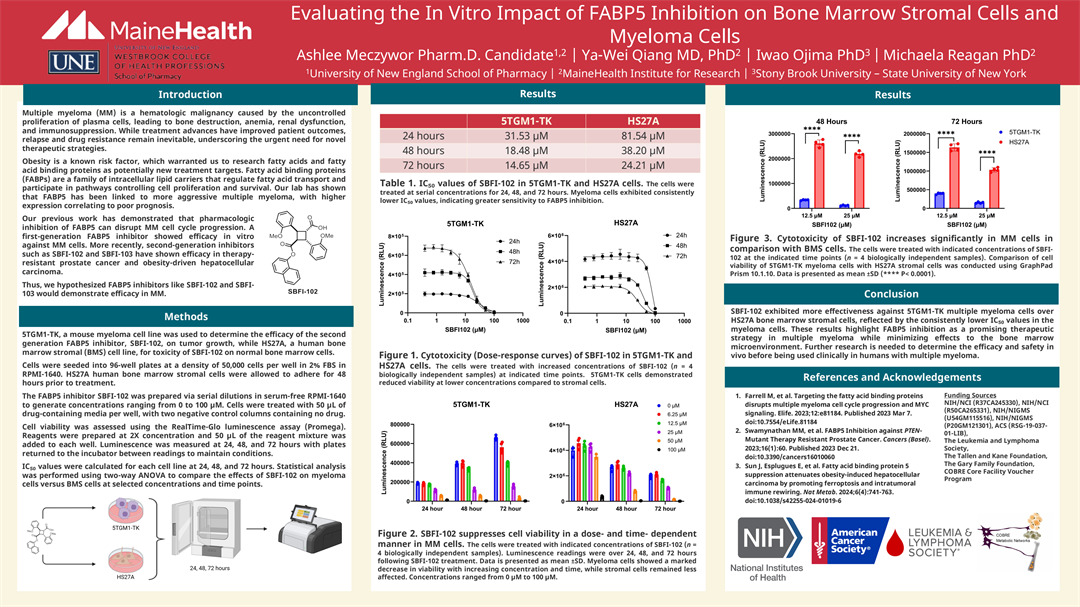
Here in, we examined the effects of a second-generation FABP5 inhibitor (SBFI-102) on the cell viability of the 5TGM1-TK multiple myeloma cell line and the HS-27A bone marrow stromal cell line. Using the RealTime-Glo luminescence assay, we monitored cell viability at 24-, 48- and 72-hours following treatment with SBFI-102 at serial concentrations.
Results:
Our results showed that the viability of myeloma cells were significantly impacted by the FABP5 inhibitor compared to the bone marrow stromal cells at both 48 hours (P<0.001) and 72 hours (P<0.0001). The IC50 values at 48 hours were lower in the myeloma cells (18.48 µM) than the bone marrow stromal cells (38.20 µM) as well as at 72 hours (14.65 µM and 24.21 µM, respectively). We determined that SBFI-102 has greater efficacy in myeloma cells than in bone marrow stromal cells as reflected by the lower IC50 value.
Discussion:
Our findings suggest the therapeutic potential of FABP5 inhibition in context of multiple myeloma. More recently studies have demonstrated second generation FABP5 inhibitors to be effective in resistant prostate cancer and liver cancer, supporting the relevance of this pathway across malignancies.
Conclusions:
Further research is needed to determine the efficacy and safety in vivo before being used clinically in humans with multiple myeloma.
Funding: Not applicable.
Send your feedback
Please do not include any personal information or details.
"*" indicates required fields
Was this page
helpful?
Send your feedback
Please do not include any personal information or details.
"*" indicates required fields