
Network for Collaborative Oncology Development and Advancement Immunotherapy Hub: a centralized resource for navigating bispecific T-cell engagers
1Network for Collaborative Oncology Development & Advancement (NCODA)
Background:
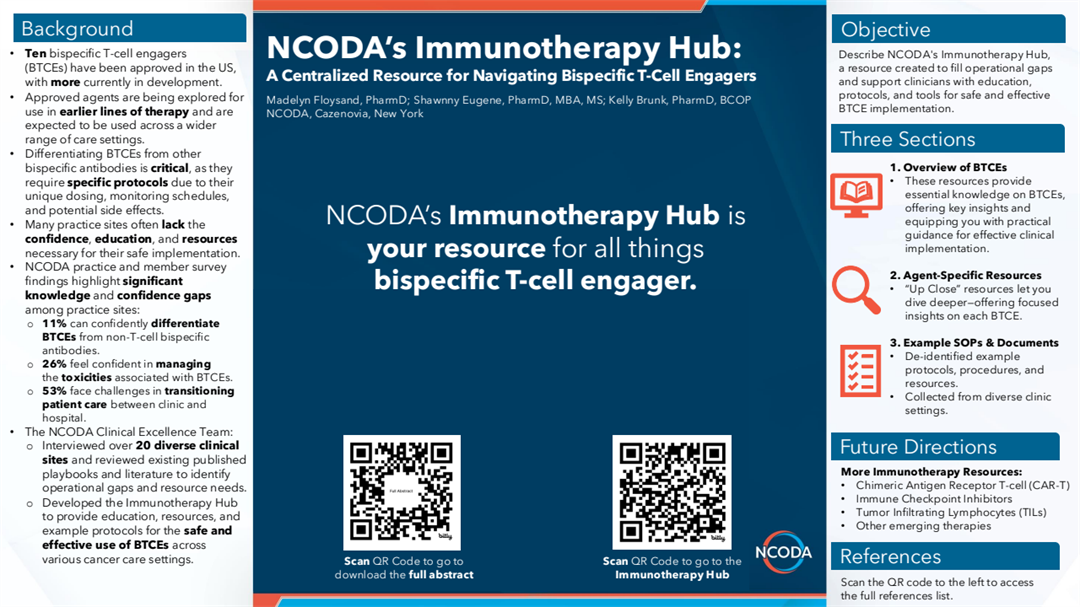
As of August 2025, ten bispecific T-cell engagers (BTCEs) have been approved in the United States for hematologic malignancies and solid tumors, with additional agents in development. These agents work by redirecting T cells to malignant cells by binding both a T-cell receptor and a tumor-associated antigen, creating a potent immune response. BTCEs are being studied in earlier therapy lines, expanding the eligible patient population. Their administration involves unique protocols, including step-up dosing to mitigate cytokine release syndrome (CRS) and monitoring for neurotoxicity such as immune effector cell–associated neurotoxicity syndrome (ICANS), which significantly impact care transitions. Certain BTCEs also carry Risk Evaluation and Mitigation Strategies (REMS) requirements. Practice settings vary, as some clinics manage all step-up doses outpatient while others partner with hospitals for toxicity management. Despite their growing use, many cancer centers lack tailored tools to support safe and efficient BTCE implementation. Available BTCE resources often provide broad overviews of these agents but are not tailored to operational realities.
Objectives:
Describe the structure and purpose of Network for Collaborative Oncology Development & Advancement (NCODA’s) Immunotherapy Hub in supporting the safe and effective implementation of BTCEs.
Methods:
An NCODA survey of 19 oncology professionals revealed critical gaps, only 11% reported confidence in distinguishing BTCEs from other non-T-cell-engaging bispecifics, while just 26% felt confident managing associated toxicities. Additionally, 53% identified transitions of care as challenging, and 67% saw the need for process improvement. These findings highlight the urgent need for practical, agent-specific operational and clinical tools to facilitate safe, efficient, and confident implementation across diverse healthcare environments.
Discussion:
To address these challenges, NCODA developed the Immunotherapy Hub, a centralized, accessible platform designed to support the safe and effective clinical use of BTCEs. NCODA conducted interviews with over 20 diverse clinical sites, from small community clinics to large academic medical centers, and reviewed existing published playbooks to identify operational gaps and resource needs. These findings informed the creation of a comprehensive digital platform structured around three core resource types: (1) overview of BTCEs, including foundational knowledge guides that incorporate operational best practices and comparative charts by disease state, such as Engaging With Bispecific T-Cell Engagers, Putting BTCEs Into Action, and Clearing Up Confusion Around BTCEs; (2) agent-specific resources, with detailed information on individual BTCE agents; (3) practice resources, including de-identified standard operating procedures (SOPs) and documents sourced from various clinics to illustrate realworld practices. Each component is structured to be practical and adaptable to diverse practice settings.
Conclusions:
Looking ahead, NCODA plans to expand the Immunotherapy Hub to include immune checkpoint inhibitors, chimeric antigen receptor T-cells (CAR-T), and emerging therapies, such as trispecific antibodies and natural killer (NK)-cell engagers. As immunotherapy continues to advance, the Immunotherapy Hub will evolve to provide current resources that empower oncology teams to safely integrate complex immunotherapy agents with greater confidence and consistency.
Funding: Not applicable
Send your feedback
Please do not include any personal information or details.
"*" indicates required fields
Was this page
helpful?
Send your feedback
Please do not include any personal information or details.
"*" indicates required fields