
Familial cancer clustering following the coronavirus disease 2019 pandemic: evidence for long COVID-associated inflammatory carcinogenesis in genetically susceptible individuals
1Carolina Blood and Cancer Care Associates, 2Network for Collaborative Oncology Development & Advancement (NCODA), 3Community Clinical Oncology Research Network, 4Cencora
Background:
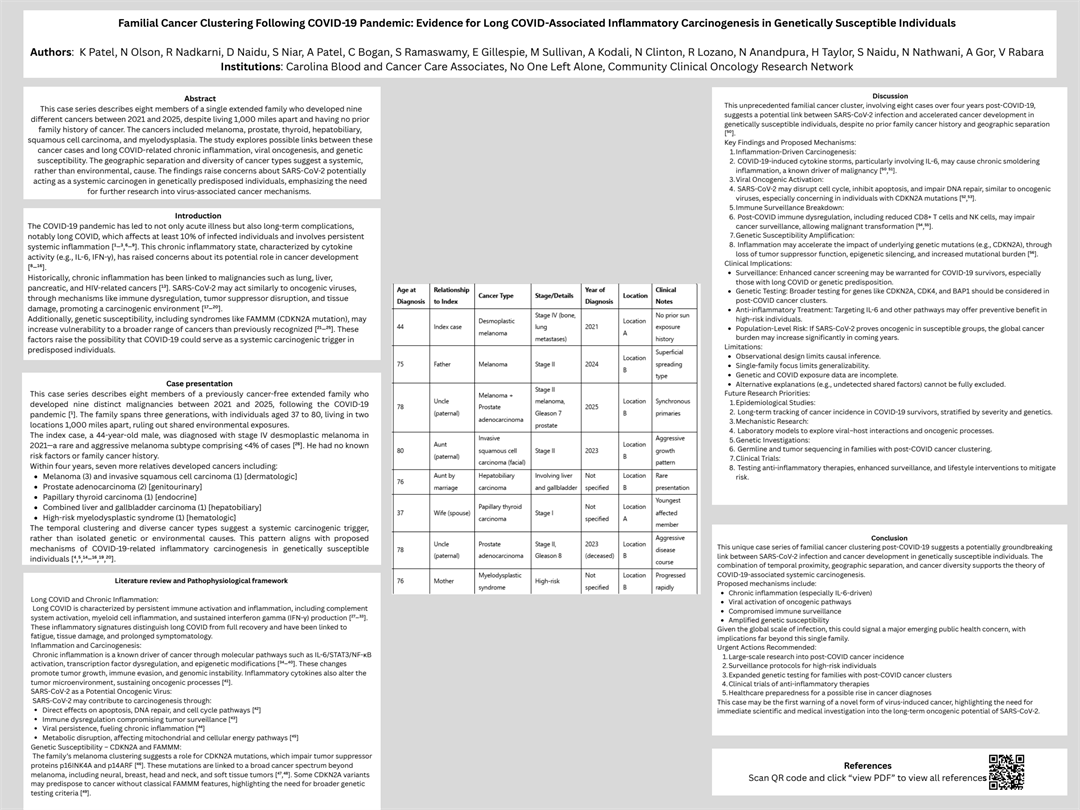
Emerging evidence suggests potential associations between severe acute respiratory syndrome coronavirus 2 (SARS-CoV-2) infection, long coronavirus disease (COVID), and subsequent cancer development through chronic inflammatory mechanisms. We present an unprecedented case series of multiple cancer diagnoses within a single extended family following the COVID-19 pandemic, with analysis of potential inflammatory carcinogenesis pathways and genetic susceptibility factors.
Objectives:
- Describe a familial case series of post-COVID-19 cancer diagnoses.
- Discuss potential inflammatory and genetic mechanisms linking SARS-CoV-2 infection to carcinogenesis.
Methods:
This observational case series documents eight family members who developed nine distinct malignancies between 2021-2025, residing in geographically distant location approximately 1,0000 miles apart. We analyzed the temporal clustering, cancer diversity, familial relationships, and potential mechanisms including long COVID-associated chronic inflammation, viral-induced oncogenic pathways, and hereditary cancer susceptibilities. A comprehensive literature review was conducted examining COVID-19 carcinogenesis, inflammatory biomarkers, and genetic predisposition syndromes.
Results:
Eight family members (ages 37-80 years) developed nine malignancies including melanoma (3 cases), prostate cancer (2 cases), thyroid cancer (1 case), hepatobiliary cancer (1 case), invasive squamous cell carcinoma (1 case), and myelodysplasia (1 case). Notably, the family had no documented cancer history prior to 2021. Three members developed multiple primary malignancies. The geographic separation (1,000 miles) suggests systemic rather than environmental factors. The diversity of malignancies across multiple organ systems indicates a potential systemic carcinogenic process.
Conclusions:
This familial clustering of diverse cancer types following COVID-19 pandemic onset, combined with emerging evidence of long COVID-associated persistent inflammation and viral-induced carcinogenic mechanisms, warrants urgent investigation into COVID-19 as a potential systemic carcinogen in genetically susceptible individuals. The temporal relationship, geographic distribution, and cancer diversity suggest novel mechanisms of virus-associated carcinogenesis requiring immediate research attention. Keywords: COVID-19, long COVID, familial cancer, inflammatory carcinogenesis, genetic susceptibility, melanoma, cytokine storm, SARS-CoV-2, hereditary cancer syndrome.
Funding: Not applicable.
Send your feedback
Please do not include any personal information or details.
"*" indicates required fields
Was this page
helpful?
Send your feedback
Please do not include any personal information or details.
"*" indicates required fields