
Empowering oncology nurses in Papua New Guinea: a grassroots education initiative by Papua New Guinea Oncology Nurses Association
1Port Moresby General Hospital, Papua New Guinea Oncology Nurses Association (PaNGONA)
Background:
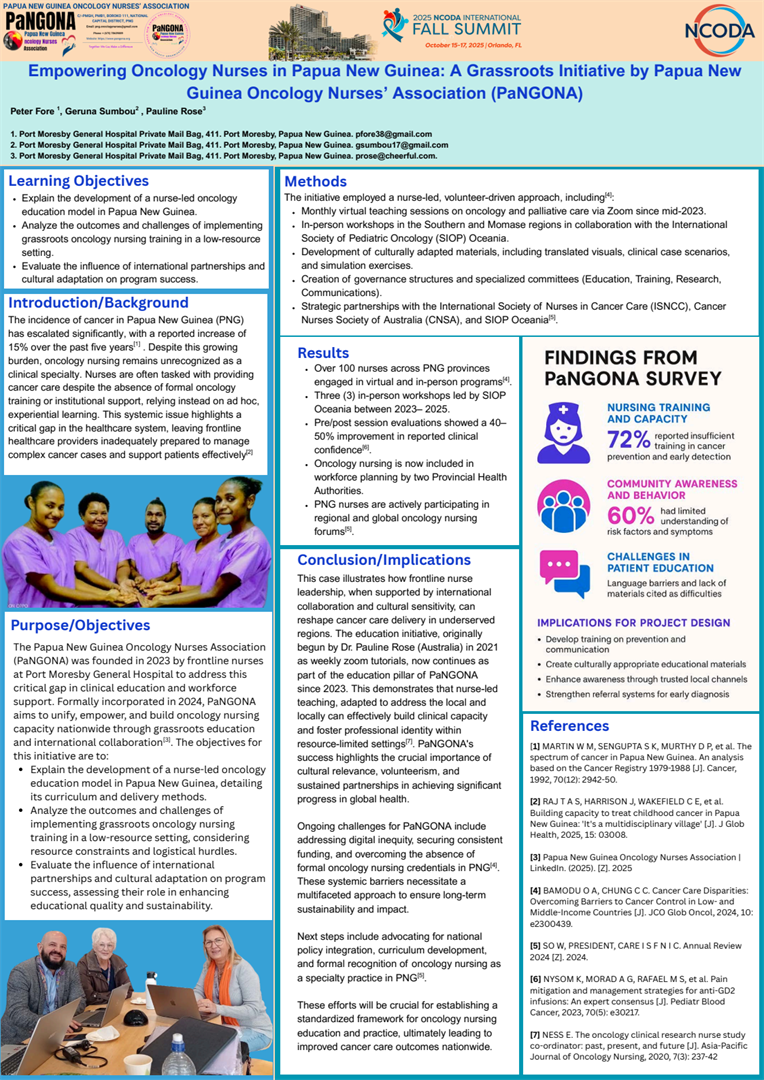
Cancer incidence in Papua New Guinea (PNG) is increasing rapidly, yet oncology nursing remains unrecognized as a clinical specialty. Nurses are often expected to provide cancer care without formal training, relying instead on informal, on-the-job learning with limited resources or institutional support.
Objectives:
- Describe the establishment of the Papua New Guinea Oncology Nurses Association (PaNGONA) in 2023 by frontline nurses at Port Moresby General Hospital to address gaps in oncology nursing support and education.
- Explain PaNGONA’s mission, formally incorporated in 2024, to unify and empower oncology nurses while building national capacity through grassroots education and international collaboration.
Methods:
The initiative employed a nurse-led, volunteer-driven approach, including: (1) monthly virtual teaching sessions on oncology and palliative care via Zoom since mid-2023; (2) in-person workshops in the Southern and Momase regions in collaboration with the International Society of Pediatric Oncology (SIOP) Oceania; (3) development of culturally adapted materials, including translated visuals, clinical case scenarios, and simulation exercises; (4) creation of governance structures and specialized committees (Education, Training, Research, Communications); (5) strategic partnerships with the International Society of Nurses in Cancer Care (ISNCC), the Cancer Nurses Society of Australia (CNSA), and SIOP Oceania.
Results:
Over 100 nurses across PNG provinces engaged in virtual and in person programs. Three in-person workshops led by SIOP Oceania between 2023– 2025. Pre/post session evaluations showed a 40–50% improvement in reported clinical confidence. Oncology nursing is now included in workforce planning by two Provincial Health Authorities. PNG nurses are actively participating in regional and global oncology nursing forums.
Conclusions:
This grassroots education initiative illustrates how community-based, nurse-led models—supported by international mentorship and locally adapted content— can build clinical capacity and professional identity in resource-limited settings. PaNGONA’s success highlights the importance of cultural relevance, volunteerism, and sustained partnerships. Ongoing challenges include digital inequity, limited funding, and the absence of formal oncology nursing credentials in PNG. Future efforts will focus on policy integration and national recognition of oncology as a nursing specialty.
Funding: Not applicable.
Send your feedback
Please do not include any personal information or details.
"*" indicates required fields
Was this page
helpful?
Send your feedback
Please do not include any personal information or details.
"*" indicates required fields