
Zidesamtinib efficacy and safety in patients with advanced ROS1-positive solid tumors other than non-small cell lung cancer in the ARROS-1 study
1Peter MacCallum Cancer Centre, Melbourne, Australia; 2Lung Unit, Royal Marsden Hospital, London, UK; 3Vall d’Hebron University Hospital and Vall d’Hebron Institute of Oncology, Barcelona, Spain; 4Memorial Sloan Kettering Cancer Center and Weill Cornell Medical Center, New York, NY, USA; 5Paris Saclay University, Gustave Roussy, Villejuif, France; 6Okayama University Hospital, Okayama, Japan; 7Kindai University Hospital, Osaka, Japan; 8National Cancer Center Hospital, Tokyo, Japan; 9Ohio State University, Columbus, OH, USA; 10START Madrid, Madrid, Spain; 11Japanese Foundation for Cancer Research, Tokyo, Japan; 12Wakayama Medical University Hospital, Wakayama, Japan; 13University of Chicago, Chicago, IL, USA; 14Fred Hutchinson Cancer Center, Seattle, WA, USA; 15Nuvalent, Inc., Cambridge, MA, USA; 16Center for Integrated Oncology, University Hospital, K.ln, Germany
Background:
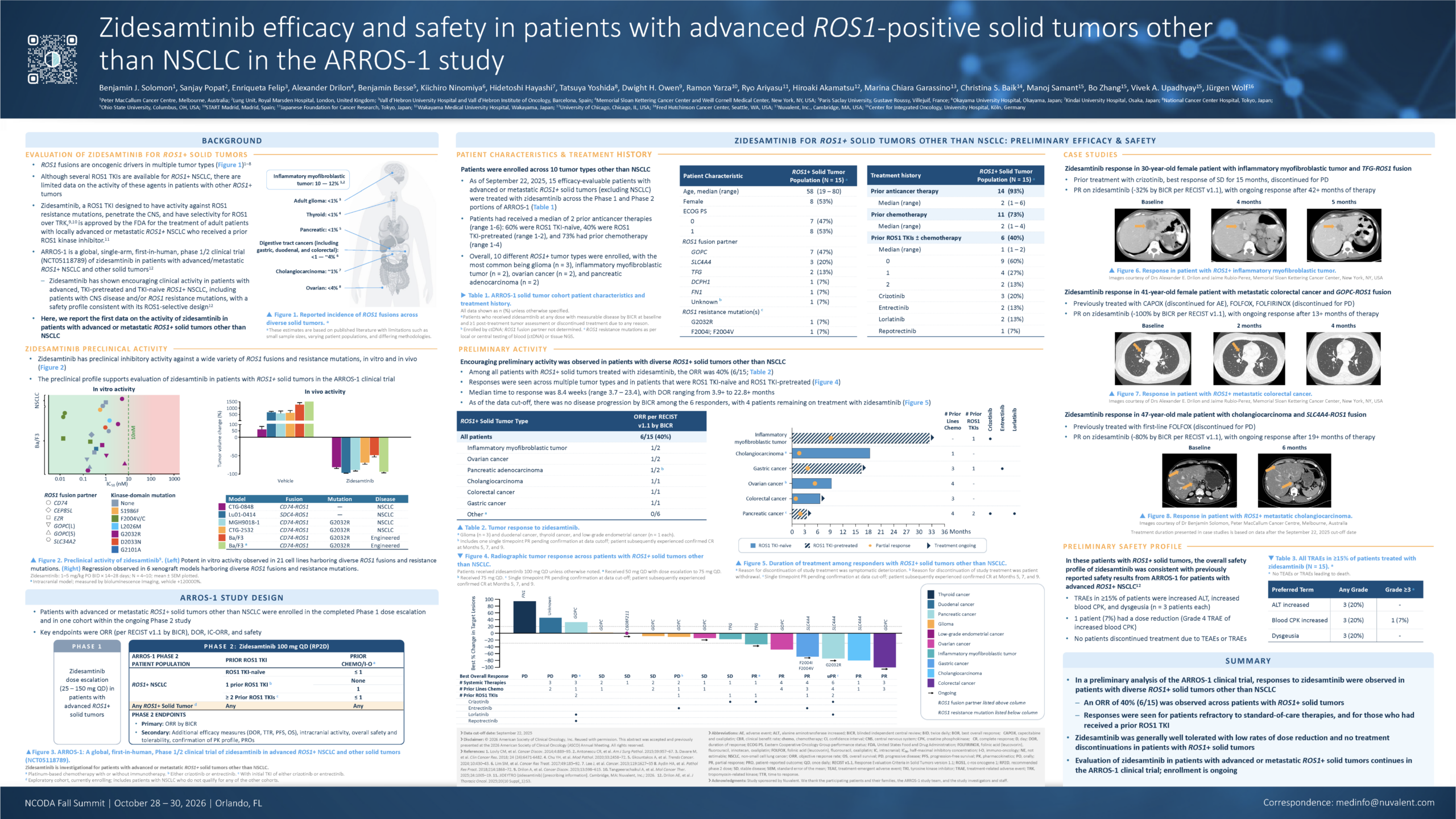
ROS1 fusions are oncogenic drivers in various cancers. Multiple ROS1 tyrosine kinase inhibitors (TKIs) are available for ROS1-positive non-small cell lung cancer (NSCLC); however, there are limited data on the activity of these agents in patients with other ROS1-positive tumors. In patients with advanced ROS1-positive NSCLC (TKI-pretreated and TKInaïve), zidesamtinib has demonstrated encouraging clinical activity, including in patients with central nervous system (CNS) disease and/or ROS1 G2032R mutation, and a safety profile consistent with its highly ROS1-selective design.
Objectives:
- Evaluate the efficacy of zidesamtinib in patients with advanced or metastatic ROS1-positive solid tumors other than NSCLC in the ARROS-1 study.
- Describe safety outcomes in patients with ROS1-positive solid tumors other than NSCLC treated with zidesamtinib in ARROS-1.
Purpose:
To evaluate the antitumor activity and safety of zidesamtinib in patients with advanced ROS1-positive solid tumors other than NSCLC.
Study Design:
The global phase 1/2 ARROS-1 study (NCT05118789) includes a cohort of patients with advanced or metastatic ROS1-positive solid tumors other than NSCLC whose disease has progressed on any prior therapy.
Methods:
Key endpoints are objective response rate (ORR) per Response Evaluation Criteria in Solid Tumors (RECIST) version 1.1 by blinded independent central review (BICR), duration of response (DOR), and safety. The data cutoff date was September 22, 2025.
Results:
Overall, 15 efficacy-evaluable patients with ROS1-positive solid tumors (10 non-NSCLC tumor types) received zidesamtinib. Patients received a median of 2 prior anticancer therapies (range, 1–6); 60% were ROS1 TKI-naïve, 40% were ROS1 TKI-pretreated (range, 1–2), and 73% had received prior lines of chemotherapy (range, 1–4). The ORR was 40% (6/15, including 1 partial response pending confirmation), with no disease progression by BICR among responders (DOR range, 3.9+ to 22.8+ months). Responses were observed across multiple tumor types, including cholangiocarcinoma, colorectal cancer, gastric cancer, inflammatory myofibroblastic tumor, ovarian cancer, and pancreatic cancer. Two ROS1 TKI-pretreated patients had ROS1 resistance mutations (G2032R and F2004I/F2004V) at baseline, and both achieved a partial response (1 pending confirmation). Treatment-related adverse events (TRAEs) in ≥15% of patients were increased alanine aminotransferase, increased blood creatine phosphokinase, and dysgeusia (3 patients each). No patient discontinued zidesamtinib due to TRAEs, and 1 patient had a dose reduction due to a TRAE.
Conclusion:
Zidesamtinib demonstrated encouraging activity in patients with diverse ROS1-positive solid tumors, including those refractory to standard-of-care therapies. The safety profile of zidesamtinib was consistent with its ROS1-selective design. Enrollment is ongoing.
Funding: Nuvalent, Inc.
Prior Presentations:
Presented at the 2026 American Society of Clinical Oncology (ASCO) Annual Meeting, May 29–June 2, 2026, in Chicago, IL, USA.
© 2026 American Society of Clinical Oncology, Inc. Reused with permission. This abstract was accepted and previously presented at the 2026 ASCO Annual Meeting. All rights reserved.
Send your feedback
Please do not include any personal information or details.
"*" indicates required fields
Was this page
helpful?
Send your feedback
Please do not include any personal information or details.
"*" indicates required fields