
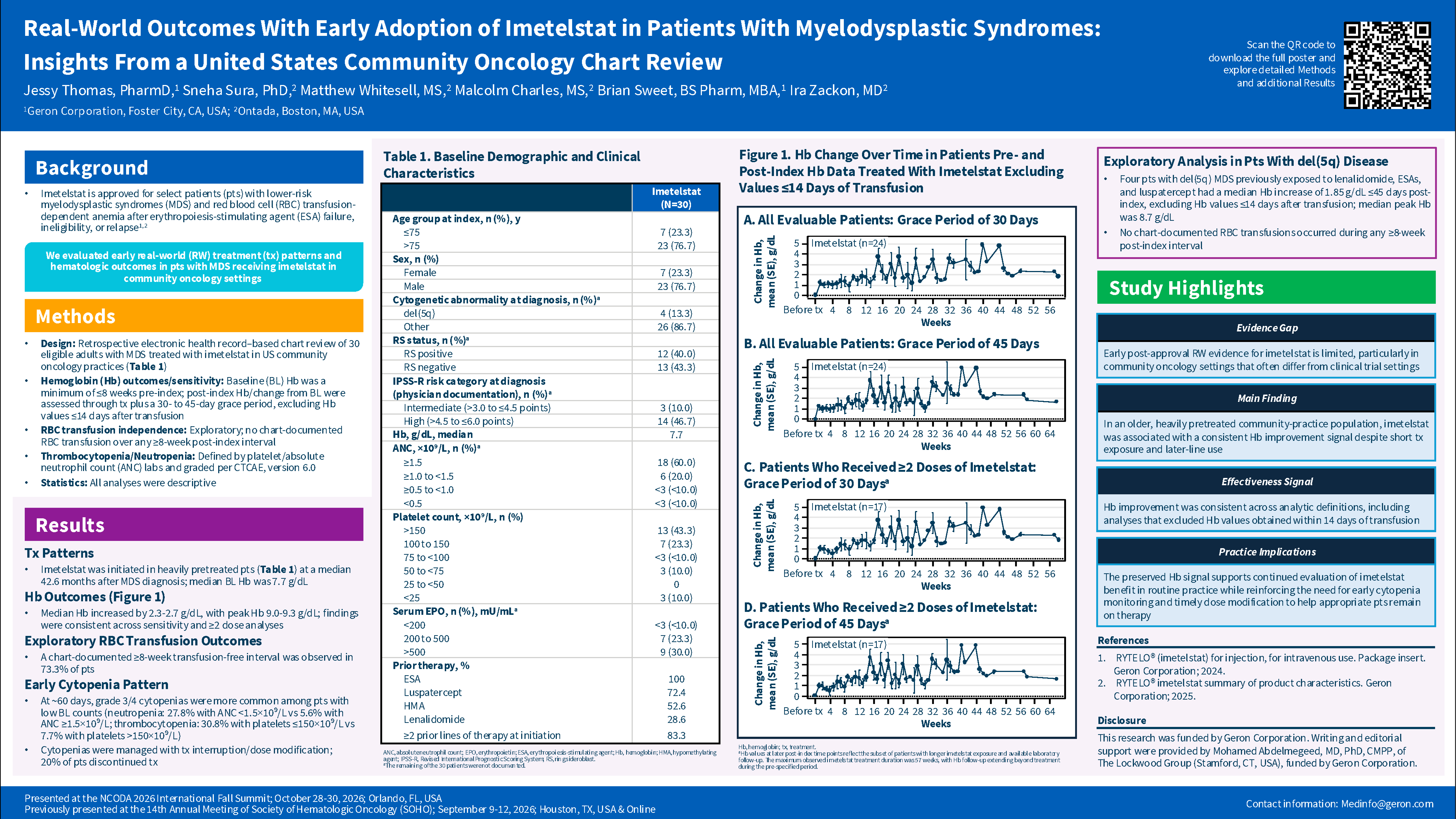
Real-world outcomes with early adoption of imetelstat in patients with myelodysplastic syndromes: Insights from a United States community oncology chart review
1Geron Corporation, Foster City, CA, USA; 2Ontada, Boston, MA, USA
Background:
Imetelstat is approved for lower-risk myelodysplastic syndromes (MDS) with red blood cell transfusion- dependent anemia. Real-world evidence early after approval remains limited, particularly as community practices have gained familiarity with patient selection and cytopenia management.
Objectives:
- Describe early (approximately 6 months after approval) imetelstat treatment patterns and hematologic outcomes in lower-risk MDS, focusing on hemoglobin response, based on a retrospective chart review of U.S. community oncology practices.
- Identify barriers to optimal use of imetelstat in realworld clinical practice that may impact treatment duration and hinder the achievement of clinical benefit.
Purpose:
To evaluate early imetelstat treatment patterns and hematologic outcomes, focusing on hemoglobin response given known limitations in chart-captured transfusion data.
Study Design:
This multicenter chart abstraction study included 30 patients with MDS treated with imetelstat in U.S. community oncology practices between July 2024 and April 2025 (approximately 6 months after approval).
Methods:
Data included baseline characteristics, prior therapies, labs, transfusion documentation, and treatment outcomes. Hemoglobin change was defined as the difference between average post-index and minimum pre-index values ≤8 weeks before initiation. Analyses were descriptive.
Results:
Patients were elderly (77% aged ≥75 years) and heavily pretreated; most received imetelstat in later lines (83% received ≥3 lines of therapy [LOTs]), suggesting initial adoption in more refractory populations rather than optimal earlier-line use. Median baseline hemoglobin was 7.7 g/dL at imetelstat initiation. Median treatment duration was short (8.9 weeks); the longest imetelstat treatment duration was 57 weeks. Baseline transfusion burden was incompletely captured in 27% of patients despite documented transfusion dependence, underscoring real-world documentation gaps and supporting the use of hemoglobin as a pragmatic effectiveness endpoint. Among evaluable patients (n=24), median hemoglobin increased by 2.25 g/dL despite limited treatment duration. Median peak hemoglobin was 9.0 g/dL (range, 6.2–14.3). In patients who received ≥2 doses of imetelstat, a transfusion-adjusted analysis that excluded hemoglobin values within ≤14 days of transfusion showed a median hemoglobin increase of 2.3 g/dL (n=17), with a median peak of 9.1 g/dL (range, 7.3–14.3). Thrombocytopenia and neutropenia were common and frequently led to treatment discontinuation. Although consistent with the known safety profile, early discontinuations, rather than dose modification or treatment interruption and reinitiation, suggest limited realworld experience with cytopenia management during the early postapproval period.
Conclusion:
Imetelstat demonstrated clinically meaningful hemoglobin improvements despite short treatment duration and later-line use during the initial adoption period. Findings support a treatment effect while highlighting implementation gaps, including suboptimal LOT selection and limited familiarity with proactive cytopenia management. Earlier use and optimized cytopenia management may improve real-world outcomes.
Funding: Geron Corporation.
Prior Presentations:
Previously presented at the 14th Annual Meeting of the Society of Hematologic Oncology (SOHO), September 9–12, 2026, in Houston, TX, USA.
Send your feedback
Please do not include any personal information or details.
"*" indicates required fields
Was this page
helpful?
Send your feedback
Please do not include any personal information or details.
"*" indicates required fields