
New York Oncology Hematology development and implementation of outpatient bispecific antibody therapy program
1New York Oncology Hematology, Albany, NY, USA
Background:
Bispecific treatment is a type of immunotherapy which binds to two targets with one agent. Bispecific treatments consist of bispecific antibodies (BsAbs) which are artificial proteins that simultaneously bind two distinct antigens on a cell’s surface. In terms of oncology, bispecific T-cell engagers are designed to target an antigen on cancer cells and immune effectors.
Objective:
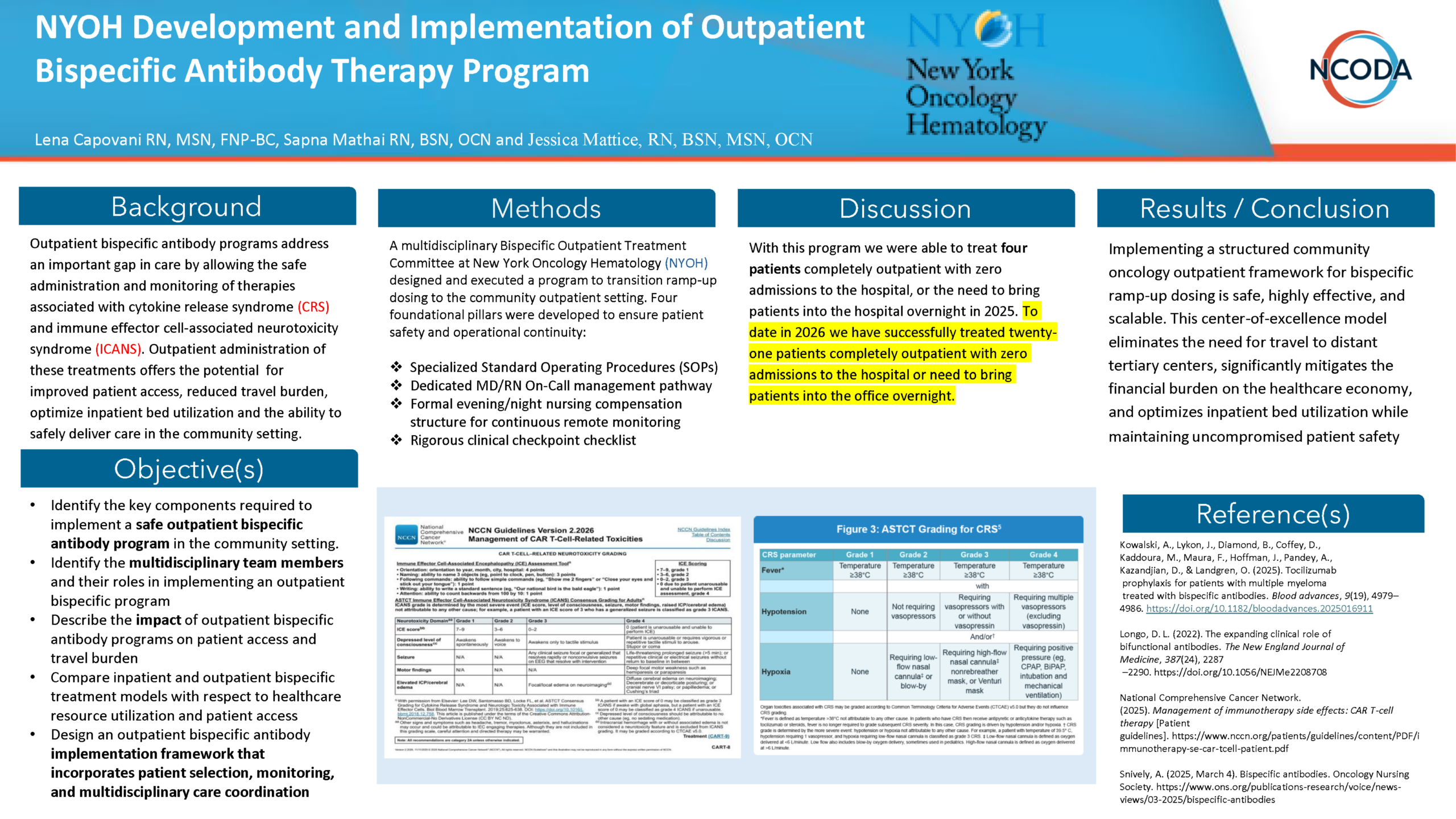
- Identify the key components required to implement a safe outpatient bispecific antibody program in the community setting.
- Identify the multidisciplinary team members and their roles in implementing an outpatient bispecific program.
- Describe the impact of outpatient bispecific antibody programs on patient access and travel burden.
- Compare inpatient and outpatient bispecific treatment models with respect to healthcare resource utilization and patient access.
- Design an outpatient bispecific antibody implementation framework that incorporates patient selection, monitoring, and multidisciplinary care coordination.
Significance:
Outpatient bispecific antibody programs address an important gap in care by allowing the safe administration and monitoring of therapies associated with cytokine release syndrome (CRS) and immune effector cell-associated neurotoxicity syndrome (ICANS).
Justification:
Outpatient administration of bispecific antibody treatments offers the potential for improved patient access, reduced travel burden, optimized inpatient bed utilization, and the ability to safely deliver care in the community setting.
Adaptability:
We have designed a program that offers patients outpatient administration and monitoring for the ramp-up dosing of bispecific treatments. This program can be adapted by other healthcare clinics by establishing patient selection criteria, CRS/ICANS monitoring and prophylactic strategies as well as including the multidisciplinary team for clearly defined roles and responsibilities.
Methods:
A multidisciplinary Bispecific Outpatient Treatment Committee at New York Oncology Hematology (NYOH) designed and executed a comprehensive program to transition ramp-up dosing to the community outpatient setting. The committee developed four foundational pillars to ensure patient safety and operational continuity: specialized standard operating procedures (SOPs) for daytime outpatient administration, a dedicated physician/nurse on-call management pathway, a formal evening/night nursing compensation structure for continuous remote monitoring, and a rigorous clinical checkpoint checklist.
Results:
With this program, we were able to treat four patients entirely in the outpatient setting with zero hospital admissions or need for overnight hospitalization in 2025. To date in 2026, we have successfully treated twenty-one patients entirely in the outpatient setting with zero admissions to the hospital or need to bring patients into the office overnight.
Conclusion:
Implementing a structured community oncology outpatient framework for bispecific ramp-up dosing is safe, highly effective, and scalable. This center-of-excellence model eliminates the need for travel to distant tertiary centers, significantly mitigates the financial burden on the healthcare economy, and optimizes inpatient bed utilization while maintaining uncompromised patient safety.
Funding: New York Oncology Hematology (NYOH).
Send your feedback
Please do not include any personal information or details.
"*" indicates required fields
Was this page
helpful?
Send your feedback
Please do not include any personal information or details.
"*" indicates required fields