
Impact of the Inflation Reduction Act on out-of-pocket costs and patient financial burden for ibrutinib at medically integrated dispensaries
1House Rx, San Francisco, CA, USA
Background:
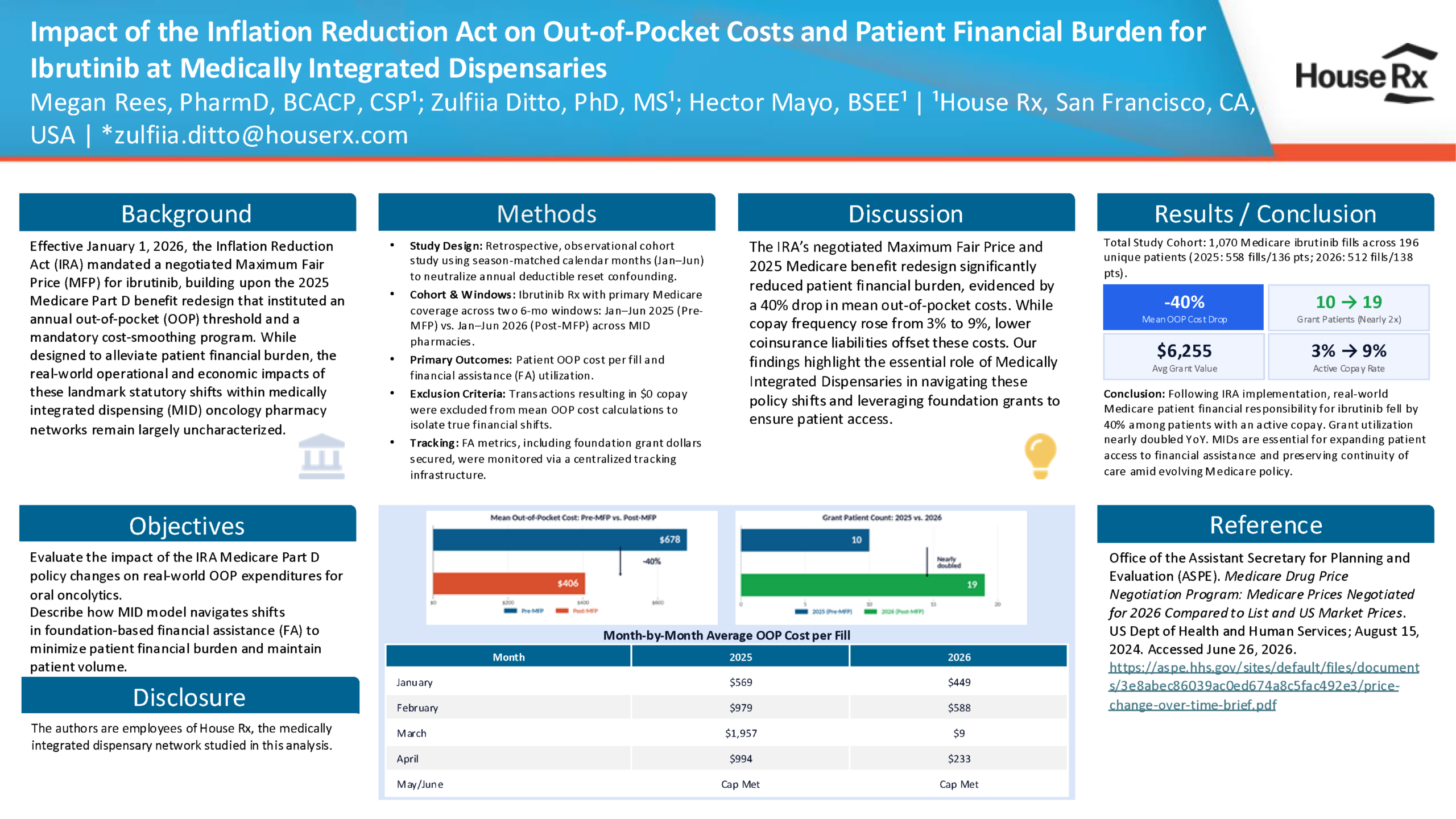
Effective January 1, 2026, the Inflation Reduction Act (IRA) mandated a negotiated Maximum Fair Price (MFP) for ibrutinib, building upon the 2025 Medicare Part D benefit redesign that instituted an annual out-of-pocket (OOP) threshold and a mandatory cost-smoothing program. While designed to alleviate patient financial burden, the realworld operational and economic impacts of these landmark statutory shifts within medically integrated dispensing (MID) oncology pharmacy networks remain largely uncharacterized.
Objective:
- Evaluate the impact of the Inflation Reduction Act (IRA) Medicare Part D policy changes on real-world patient out-of-pocket (OOP) expenditures for oral oncolytics.
- Describe how a medically integrated dispensing (MID) model navigates shifts in foundation-based financial assistance (FA) to minimize patient financial burden and maintain patient volume.
Purpose:
This study evaluated the impact of IRA-mandated policy provisions on real-world patient OOP expenditures for ibrutinib and characterized longitudinal shifts in financial assistance (FA) program utilization within a MID infrastructure.
Methods:
A retrospective, observational cohort study was conducted using a season-matched analysis to align specific calendar months across years, neutralizing the confounding effect that annual deductible resets have on patient financial responsibility and medication adherence patterns. Prescriptions for ibrutinib dispensed to patients with primary Medicare coverage were evaluated during two 6-month windows: January–June 2025 (pre-MFP) and January–June 2026 (post-MFP) across multiple MID pharmacies. Primary outcomes included patient OOP cost per fill and financial assistance utilization. To isolate true financial shifts, transactions resulting in a $0 patient copay were excluded from the mean OOP expenditure analysis. Financial assistance metrics were evaluated per patient via a centralized tracking infrastructure to monitor funding categories and total grant dollars secured from independent charitable foundations.
Results:
The final cohort included 1,070 Medicare ibrutinib prescriptions across 196 unique patients: 558 fills (136 patients) in 2025 and 512 fills (138 patients) in 2026. Patient volume remained stable within the managed MID network year over year. Across the full study period, the percentage of fills requiring active patient financial responsibility rose slightly from 3% to 9% (calculated as total fills with a copay >$0 divided by total fills across the full 6-month window). However, the mean OOP cost among those with an active copay decreased by 40%, dropping from $678 to $406. Consistent with active administrative navigation, grant procurement successfully shifted toward foundation-based assistance: the number of patients utilizing foundation grants nearly doubled from 10 patients in 2025 to 19 patients in 2026, while the average secured grant value rose from $5,850 to $6,255. Separately, month-by-month tracking of patient OOP costs during the January deductible reset showed that while the proportion of fills requiring patient financial responsibility rose from 21% to 29%, the mean OOP cost per fill fell from $569 to $449. This trend of lower mean OOP costs persisted through February ($979 to $588), March ($1,957 to $9), and April ($994 to $233). By May and June, required patient financial responsibility dropped to ≤1% in both cohorts as patients met their annual OOP thresholds.
Conclusion:
Following full IRA implementation, real-world Medicare patient financial responsibility for ibrutinib fell by 40% among patients with an active copay, consistent with the lower MFP-negotiated price reducing per-fill coinsurance amounts. Residual financial liabilities were effectively managed through foundation grants, with foundation grant utilization nearly doubling year over year, underscoring the critical role of MID-based financial navigation in a shifting policy landscape. Ultimately, MIDs are essential for expanding patient access to financial assistance and preserving continuity of care amid evolving Medicare policy. Study limitations include a single-drug focus, a short post-implementation observation window, and an inability to track year-over-year enrollment in free drug programs. Multicenter, multi-drug studies are needed to validate these long-term health policy trends.
Funding: Not applicable.
Send your feedback
Please do not include any personal information or details.
"*" indicates required fields
Was this page
helpful?
Send your feedback
Please do not include any personal information or details.
"*" indicates required fields