
Closing the oncology education gap: Design and implementation of NCODA’s Oncology Fundamentals and Business of Oncology courses
1NCODA, Cazenovia, NY, USA
Background:
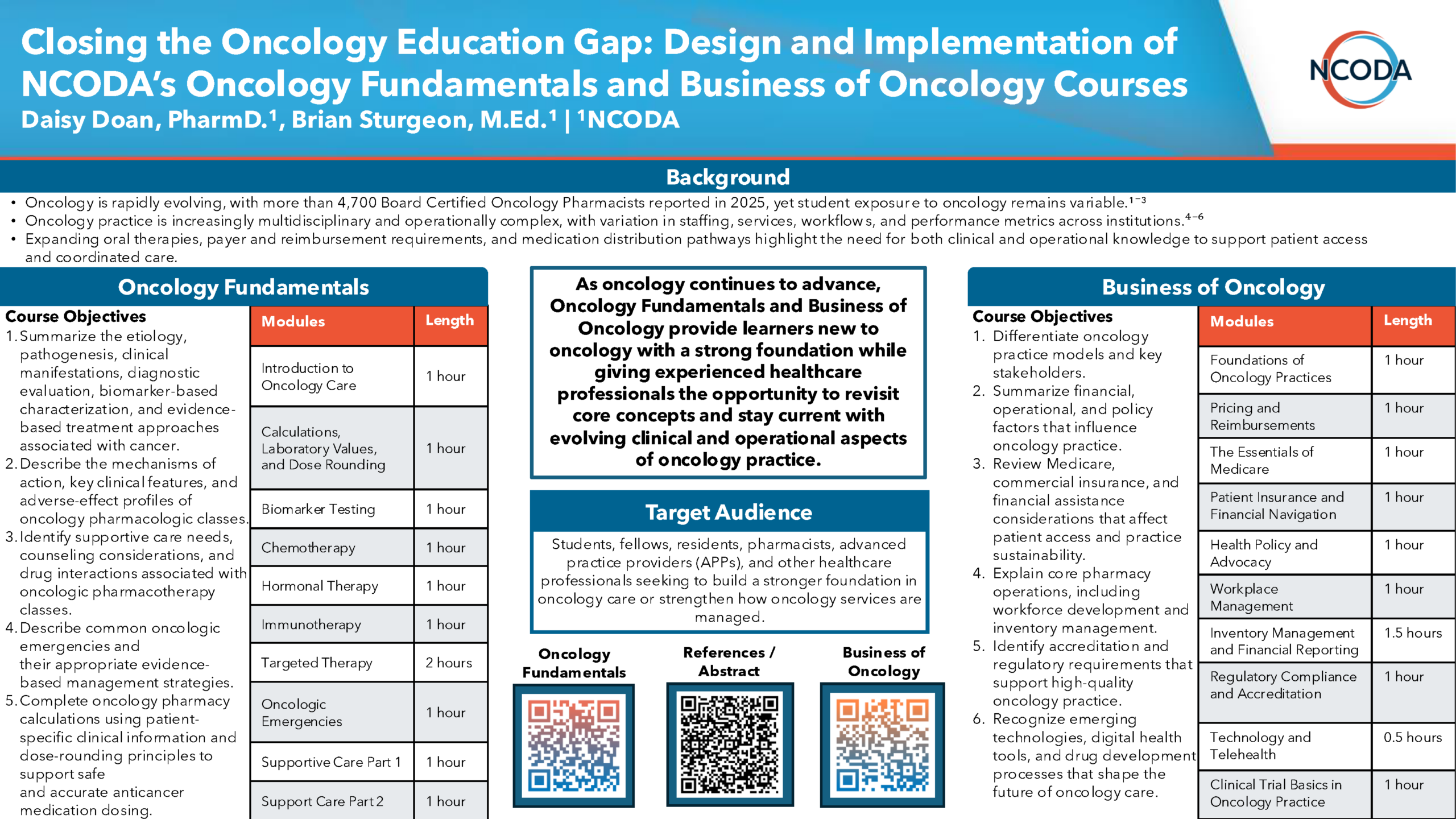
Oncology is a rapidly growing specialty, with the number of Board-Certified Oncology Pharmacists increasing from 836 in 2008 to a reported 4,700 in 2025. However, student exposure to oncology remains variable, and relatively few students complete required or elective oncology experiences. Simultaneously, oncology care has become increasingly multidisciplinary and operationally complex. Practice models vary across institutions in staffing, services, workflows, and performance metrics, while the expansion of oral anticancer therapies, payer requirements, reimbursement models, and medication distribution pathways continues to affect care delivery. These changes require healthcare professionals to understand both clinical oncology and the operational structures that support patient access and coordinated care. In response, Network for Collaborative Oncology Development and Advancement (NCODA) developed Oncology Fundamentals & Business of Oncology self-paced courses to address these educational needs for healthcare professionals seeking to learn or refresh foundational clinical and operational knowledge in oncology.
Objectives:
- Describe the educational and workforce factors supporting the need for accessible, foundational oncology education.
- Explain how objective alignment, modular design, applied learning, and assessments were used to create scalable, self-paced oncology courses.
- Discuss how foundational oncology education can address gaps in formal training and support onboarding, professional development, and multidisciplinary workforce readiness.
Justification:
Evidence demonstrates gaps in both oncology preparation and business-related competencies. Oncology advanced pharmacy practice experience (APPE) exposure and perceived preparedness from didactic education have been associated with pursuit of advanced oncology training. Additionally, a nationwide survey identified substantial variation in oncology pharmacy staffing, practice models, services, and commonly used metrics, highlighting the need for a baseline understanding of oncology pharmacy operations. Literature also supports the need for greater education in business, management, and professional development skills. NCODA developed these courses through needs assessment, content gap review, learner feedback, adult learning principles, and curriculum and assessment alignment to prepare healthcare professionals for contemporary oncology practice. These courses can be used to address knowledge gaps through onboarding training and didactic curriculum.
Methods:
Oncology Fundamentals and Business of Oncology launched in 2026 as self-paced, continuing education (CE)-accredited courses. Oncology Fundamentals provides 11 hours of instruction, while Business of Oncology provides 10 hours and can be completed with or without CE credit. Both courses were created using the same instructional design standards and development process. Course-to-module objective maps guided content development by subject matter experts, and each course includes an orientation and 10 content modules developed in Articulate Storyline and delivered through Lecture Panda. Learning objectives are aligned with interactive content, knowledge checks, and practical resources. Each module has a multiple-choice postquiz containing at least two questions per objective. Quizzes were developed using a quiz-to-module objective alignment mapping and supported by the module objective-to-course objective map to ensure complete alignment. Shared documentation, development, and review processes provide a standardized structure and consistent learner experience across both courses. Their modular design supports flexible use for individual onboarding, organizational training, and academic integration.
Significance:
Oncology Fundamentals addresses foundational clinical topics, including cancer biology, diagnosis and staging, treatment modalities, anticancer pharmacotherapy, supportive care, survivorship, end-of-life care, and patient education. Business of Oncology builds on this foundation by addressing the operational knowledge required to function within oncology practice. Together, the courses provide an accessible, scalable entry point into oncology for learners who may have received limited exposure during formal education or healthcare professionals who need to revisit core competencies. Their standardized, multidisciplinary, and application-focused design may support workforce development by improving access to foundational oncology education across academic, organizational, and individual learning environments.
Funding: Not applicable.
Editorial Conclusion:
An author of this abstract serves as an Assistant Editor of NOHMA and was recused from its review, editorial decision-making, and publication review. The abstract was independently reviewed and approved without the author’s involvement.
Send your feedback
Please do not include any personal information or details.
"*" indicates required fields
Was this page
helpful?
Send your feedback
Please do not include any personal information or details.
"*" indicates required fields