

Re-engineering systemic anticancer therapy delivery: A multi-faceted model for enhancing oncology day ward capacity and key performance indicators
1Pharmacy Department, University Hospital Waterford, Waterford, Ireland
Background:
Traditional scheduling structures and centralised compounding workflows routinely compound chair-capacity constraints, directly damaging key performance indicators (KPIs). This service evaluation systematically assessed integrated capacity-optimisation mechanisms within an oncology day ward. Specific objectives were to evaluate an on-site day ward clinical pharmacist, engineer high-throughput rapid-treatment pathways, formalise extended-interval immunotherapy protocols, and transition eligible maintenance cohorts into a structured community homecare model.
Objectives:
Optimize dayward capacity within oncology services to meet burgeoning demand for systemic anti-cancer therapy (SACT).
Methods:
Multi-faceted operational adaptations were deployed in the day ward. First, an on-site pharmacist workflow was embedded using the National Cancer Information System (NCIS), facilitating direct dispensing of subcutaneous monoclonal antibodies to nursing staff trained in using closed-system transfer devices for rapid bedside preparation. Second, a dedicated “FAST immunotherapy chair” model replaced rigid morning/afternoon blocks with an hourly scheduling matrix. Third, an institutional preference policy mandated subcutaneous alternatives over intravenous SACT delivery across all licensed indications, including switching patients to subcutaneous nivolumab to maximise FAST chair utility. Fourth, consensus with oncology and haematology consultants formalised an extended-interval protocol for intravenous pembrolizumab and nivolumab: patients receive low-dose, short-interval SACT for cycles 1–2 to monitor initial toxicities, before escalating to extended-interval SACT regimens (pembrolizumab 400mg every six weeks or nivolumab 480mg every four weeks). Finally, eligible patients receiving non-SACT maintenance therapy (subcutaneous immunoglobulin; HyQvia) were transitioned to a community homecare framework managed by TCP Home Care for SACT administration and self-administration training. Governance approval was obtained to evaluate these data.
Results:
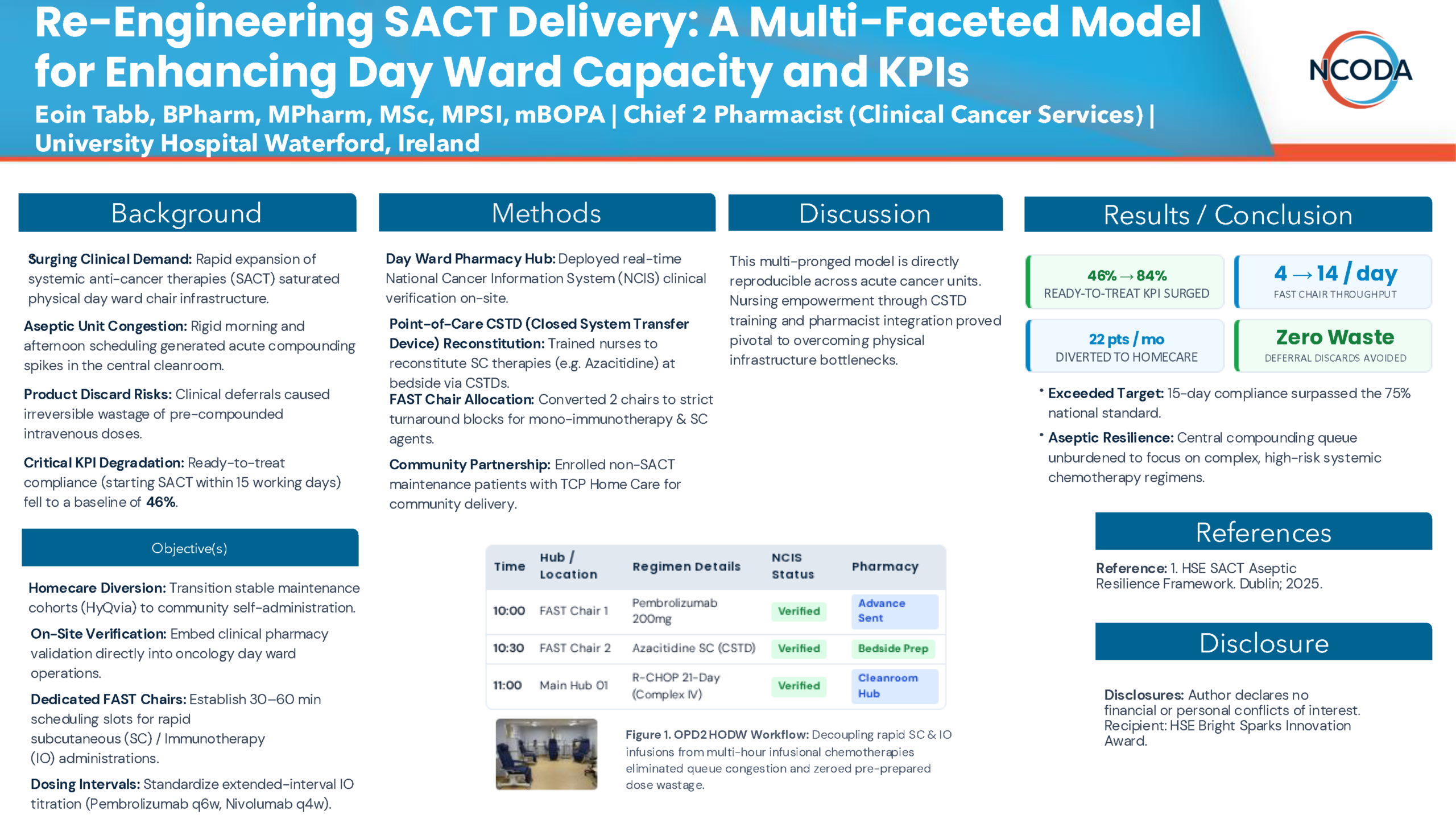
The adaptations yielded substantial SACT operational capacity enhancements, securing a “Health Service Executive (HSE) Bright Sparks” award. Transitioning to hourly FAST chair scheduling escalated daily throughput from a baseline maximum of 4 patients across two chairs to 7 patients per chair per day, SACT totalling 14 patients daily. This dynamic transformation is synchronised through an integrated digital diary matrix, tracking patient status from clinical validation to product dispatch, while sorting complex SACT regimens (e.g., rituximab, cyclophosphamide, doxorubicin, vincristine, and prednisone [R-CHOP]) to the main treatment hub. The direct pharmacy-to-nurse dispensing pathway minimised product wastage from clinical SACT deferrals and redirected aseptic compounding capacity toward complex SACT. The homecare pipeline successfully moved an average of 22 patients per month entirely out of acute day ward chairs. Crucially, the hospital’s primary oncology KPI—the percentage of patients commencing SACT within 15 working days of being denoted ready to treat—surged from 46% in January to 84% in May 2026. Internal capacity was the primary scope; patient-reported experience measures represent an area for future research.
Conclusions:
Synthesising on-site pharmacy workflows, extended-interval SACT dosing, and externalised community integration provides a powerful framework to alleviate acute day ward SACT congestion and optimise delivery. This model is highly replicable across the majority of oncology day wards, provided proactive multidisciplinary engagement occurs regarding SACT nursing workflows and physical accommodations are resourced for on-site pharmacy personnel. For the membership of Network for Collaborative Oncology Development & Advancement (NCODA) and the Irish Pharmacy Haematology Oncology Society (IPHOS), these scalable mechanisms offer SACT transferable solutions to enhance operational resilience and improve acute systemic SACT care delivery.
Funding: Not applicable.
Send your feedback
Please do not include any personal information or details.
"*" indicates required fields
Was this page
helpful?
Send your feedback
Please do not include any personal information or details.
"*" indicates required fields