
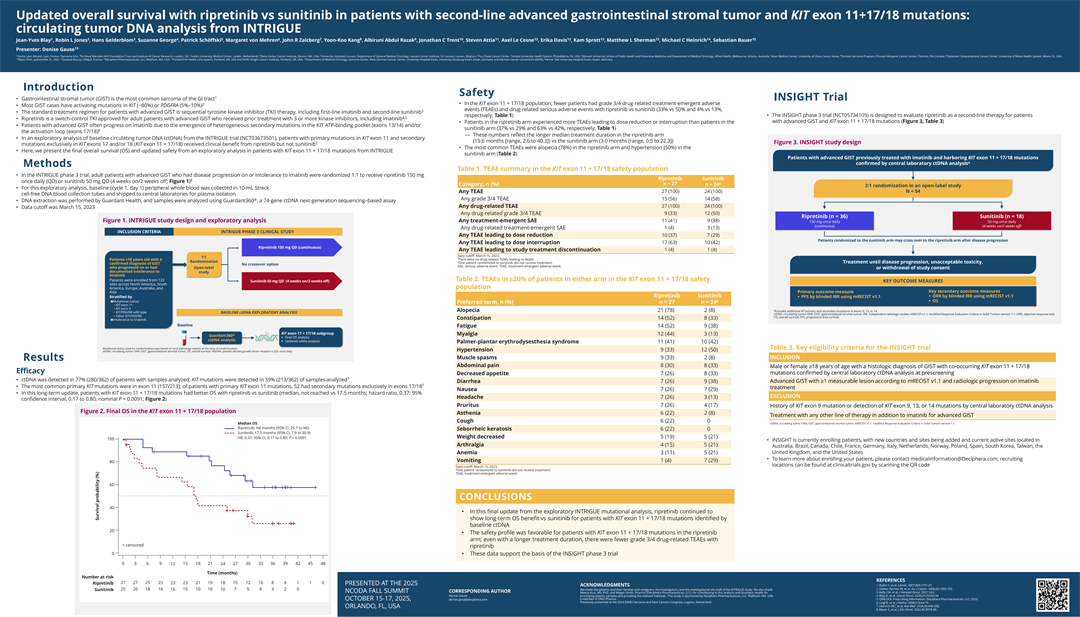
Updated overall survival and safety with ripretinib versus sunitinib in patients with advanced gastrointestinal stromal tumor previously treated with imatinib and harboring KIT exon 11 and 17/18 mutations: circulating tumor DNA analysis from INTRIGUE
1Essen, Essen, GermanyCentre Léon Bérard, Lyon, France; 2Sarcoma Unit, The Royal Marsden NHS Foundation Trust and Institute of Cancer Research, London, UK; 3Leiden University Medical Center, Leiden, Netherlands; 4Dana-Farber Cancer Institute, Boston, MA, USA; 5University Hospitals Leuven, Department of General Medical Oncology, Leuven Cancer Institute, KU Leuven, Leuven, Belgium; 6Fox Chase Cancer Center, Temple University Health System, Philadelphia, PA, USA; 7Monash University School of Public Health and Preventive Medicine and Department of Medical Oncology, Alfred Health, Melbourne, VIC, Australia; 8Asan Medical Center, University of Ulsan, Seoul, South Korea; 9Toronto Sarcoma Program, Princess Margaret Cancer Center, Toronto, ON, Canada; 10Sylvester Comprehensive Cancer Center, University of Miami Health System, Miami, FL, USA; 11Mayo Clinic, Jacksonville, FL, USA; 12Gustave Roussy, Villejuif, France; 13Deciphera Pharmaceuticals, LLC, Waltham, MA, USA; 14Portland VA Health Care System and OHSU Knight Cancer Institute, Portland, OR, USA; 15Department of Medical Oncology, Sarcoma Center, West German Cancer Center, University Hospital Essen, University Duisburg-Essen, Essen, Germany, and German Cancer Consortium (DKTK), Partner Site University Hospital Essen, Essen, Germany
Background:
Ripretinib is a switch-control tyrosine kinase inhibitor approved for patients with gastrointestinal stromal tumor (GIST) who received prior treatment with 3 or more kinase inhibitors, including imatinib. Sunitinib is approved for advanced GIST after imatinib failure. In an exploratory analysis of baseline circulating tumor DNA (ctDNA) from the INTRIGUE trial, patients with primary mutations in KIT exon 11 and secondary mutations exclusively in KIT exons 17/18 (KIT exon 11 + 17/18) received clinical benefit from ripretinib but not sunitinib (Heinrich MC, et al. Nat Med. 2024). We present the final overall survival (OS) analysis and updated safety data in these patients.
Objectives:
- Describe the overall survival benefit of ripretinib compared with sunitinib in patients with KIT exon 11 + 17/18 mutations identified by baseline circulating tumor DNA.
- Summarize the safety profile of ripretinib in patients with KIT exon 11 + 17/18 mutations, including the incidence of grade 3/4 drug-related treatment-emergent adverse events despite longer treatment duration.
- Explain how these exploratory findings support the rationale for the INSIGHT phase 3 trial.
- Critique the methods and limitations of disproportionality analysis.
Methods:
INTRIGUE (NCT03673501) is an open-label, phase 3 study of adults with advanced GIST who had disease progression on or intolerance to imatinib. Randomization was 1:1 to ripretinib 150 mg once daily (QD) or sunitinib 50 mg QD (4 weeks on/2 weeks off). Final OS analysis was prespecified to occur with at least 200 and at least 145 events in the all-patient intent-to-treat (ITT) and KIT exon 11 ITT populations, respectively. Baseline peripheral whole blood was analyzed by Guardant360, a 74-gene ctDNA next-generation sequencing–based assay. The data cutoff was March 15, 2023. Results: Of 453 patients, ctDNA was analyzed in an exploratory analysis for 362 patients; 52 had mutations exclusively in KIT exon 11 + 17/18 (ripretinib, n = 27; sunitinib, n = 25). Patients with KIT exon 11 + 17/18 mutations had better OS with ripretinib compared with sunitinib (median, not reached vs 17.5 months; hazard ratio, 0.37; 95% confidence interval, 0.17–0.80; nominal P = 0.0091). Fewer patients experienced grade 3 or 4 drug-related treatment-emergent adverse events and serious adverse events with ripretinib compared with sunitinib (33% versus [vs] 50% and 4% vs 13%, respectively). Median treatment duration for ripretinib versus sunitinib was 15.6 versus 3.0 months in this subgroup.
Discussion:
This updated exploratory analysis from INTRIGUE demonstrates longer OS with ripretinib compared with sunitinib in patients with KIT exon 11 + 17/18 mutations identified by baseline ctDNA. The findings support the relevance of ctDNA-based mutation profiling to inform treatment outcomes in advanced GIST.
Conclusions:
Ripretinib demonstrated improved overall survival and a favorable safety profile compared with sunitinib in patients with advanced GIST harboring KIT exon 11 + 17/18 mutations. These results further support ripretinib as a treatment option in this molecularly defined patient population. Funding: Deciphera Pharmaceuticals, LLC.
Prior Presentations:
Presented at the European Society for Medical Oncology (ESMO) Sarcoma and Rare Cancer Congress 2024, March 14-16, Lugano, Switzerland.
Send your feedback
Please do not include any personal information or details.
"*" indicates required fields
Was this page
helpful?
Send your feedback
Please do not include any personal information or details.
"*" indicates required fields