
Tarlatamab versus chemotherapy as second-line treatment for small cell lung cancer: primary analysis of the phase 3 DeLLphi-304 trial
1Fiona and Stanley Druckenmiller Center for Lung Cancer Research, Memorial Sloan Kettering Cancer Center, New York, NY, USA; 2Henry Dunant Hospital Center, Athens, Greece; 3The First Affiliated Hospital of Nanchang University, Nanchang, China; 4Yonsei University College of Medicine, Seoul, South Korea; 5Memorial Ankara Hospital, Ankara, Turkey; 6Interbalkan European Medical Center, Thessaloniki, Greece; 7Istanbul Medeniyet University, Istanbul, Turkey; 8Azienda Ospedaliera San Giovanni Addolorata Hospital, Rome, Italy; 9Institutul Oncologic Prof. Dr Ion Chiricuța, Cluj-Napoca, Romania; 10Samsung Medical Center, Sungkyunkwan University School of Medicine, Seoul, South Korea; 11Vall d’Hebron University Hospital, Barcelona, Spain; 12The Second Affiliated Hospital of Army Medical University, Chongqing, China; 13Christie NHS Foundation Trust and University of Manchester, Manchester, UK; 14National Cancer Center Hospital, Tokyo, Japan; 15University of Maryland Greenebaum Comprehensive Cancer Center, Baltimore, MD, USA; 16CNIO-H12O Lung Cancer Unit, Complutense University and CIBERONC, Madrid, Spain; 17Amgen Inc., Thousand Oaks, CA, USA; 18Department of Medical Oncology, West German Cancer Center, University Hospital Essen, Essen, Germany, and National Center for Tumor Diseases (NCT), NCT West, Essen, German
Background:
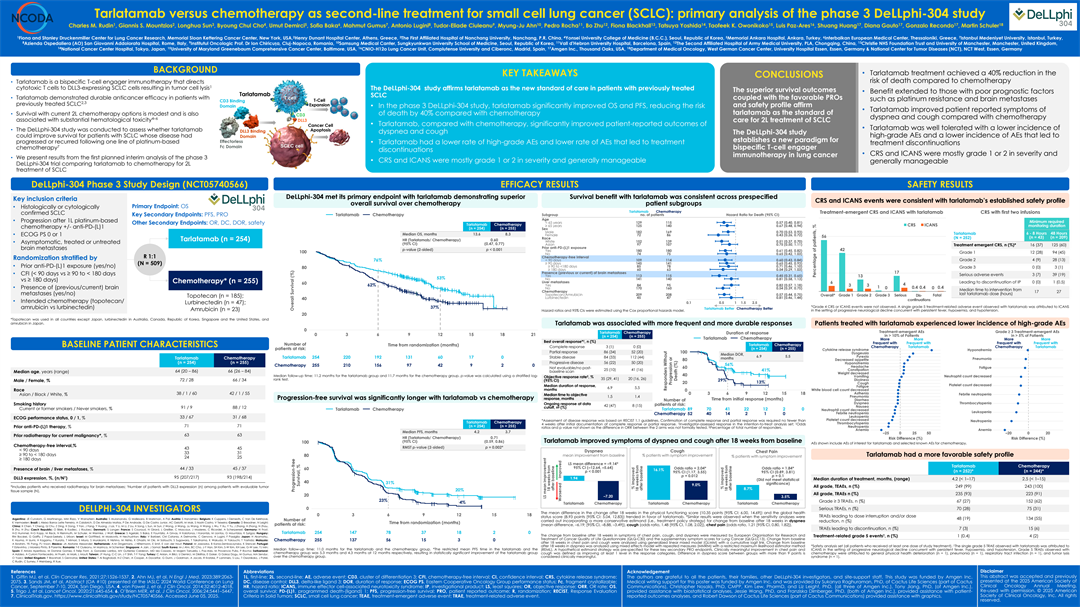
Tarlatamab, a bispecific T-cell engager (BiTE) immunotherapy, demonstrated promising activity in patients (pts) with previously treated small cell lung cancer (SCLC) in phase 1/2 trials. We report results from the primary analysis of the randomized controlled, phase 3 DeLLphi-304 study, evaluating tarlatamab versus (vs) CTx (topotecan, lurbinectedin, or amrubicin) in pts with SCLC following progression on or after platinum-based chemotherapy.
Objectives:
- Summarize the primary efficacy, safety, and patient-reported outcomes from the Phase 3 DeLLphi-304 trial evaluating tarlatamab versus chemotherapy as second-line treatment for SCLC and be able to identify the potential implications and relevance for treatment of SCLC.
Methods:
Patients were randomized 1:1 to tarlatamab or CTx, stratified by prior treatment with a programmed death-ligand 1 (PD-L1) inhibitor, chemotherapy-free interval, brain metastases, and intended CTx. Primary endpoint was overall survival (OS). Key secondary endpoints were progression-free survival (PFS) and patient-reported outcomes (PRO). Other secondary endpoints included objective response rate (ORR), duration of response (DOR), disease control rate (DCR), and safety.
Results:
509 pts were randomized (254, tarlatamab; 255, CTx). At median follow-up of 11.2 months (mo) for tarlatamab and 11.7 mo for CTx, pts in the tarlatamab arm had significantly longer OS (median OS: 13.6 vs 8.3 mo; hazard ratio [HR], 0.60 [95% CI: 0.47, 0.77]; P < 0.001) and PFS (median PFS: 4.2 vs 3.2 mo; HR, 0.72 [95% CI: 0.59, 0.88]; P < 0.001) vs pts in the CTx arm. Tarlatamab improved cancer-related symptoms of dyspnea and cough compared to CTx. Patients treated with tarlatamab showed higher ORR (35% vs 20%), median DOR (6.9 vs 5.5 months), and DCR (68% vs 64%) compared with patients treated with CTx. Lower rates of grade (Gr) ≥3 treatment-related adverse events (TRAEs) occurred with tarlatamab vs CTx (27% vs 62%); discontinuations due to TRAEs were lower with tarlatamab (3% vs 6%). The most common Gr ≥3 TRAEs were neutropenia (4%) and lymphopenia (4%) with tarlatamab and anemia (28%) and neutropenia (22%) with CTx. Cytokine release syndrome with tarlatamab was primarily low grade (42% Gr1; 13% Gr2; 1% Gr3) and manageable.
Conclusions:
The DeLLphi-304 trial showed tarlatamab significantly improved OS, PFS, and PROs, with a favorable safety and tolerability profile compared to CTx in pts with SCLC that progressed on or after initial platinum-based CTx, defining a new standard of care for these patients.
Funding: Amgen Inc.
Prior Presentations:
Presented at the American Society of Clinical Oncology Annual Meeting (ASCO) 2025, May 30-June 3, Chicago, IL.
Send your feedback
Please do not include any personal information or details.
"*" indicates required fields
Was this page
helpful?
Send your feedback
Please do not include any personal information or details.
"*" indicates required fields