

Platelet response to avatrombopag among patients with primary immune thrombo-cytopenia who switched from eltrombopag or romiplostim: REAL-AVA 2.0 real-world study
1Johns Hopkins School of Medicine; 2Texas Oncology; 3Sobi Inc.; 4Analysis Group; 5Miami Cancer Institute
Background:
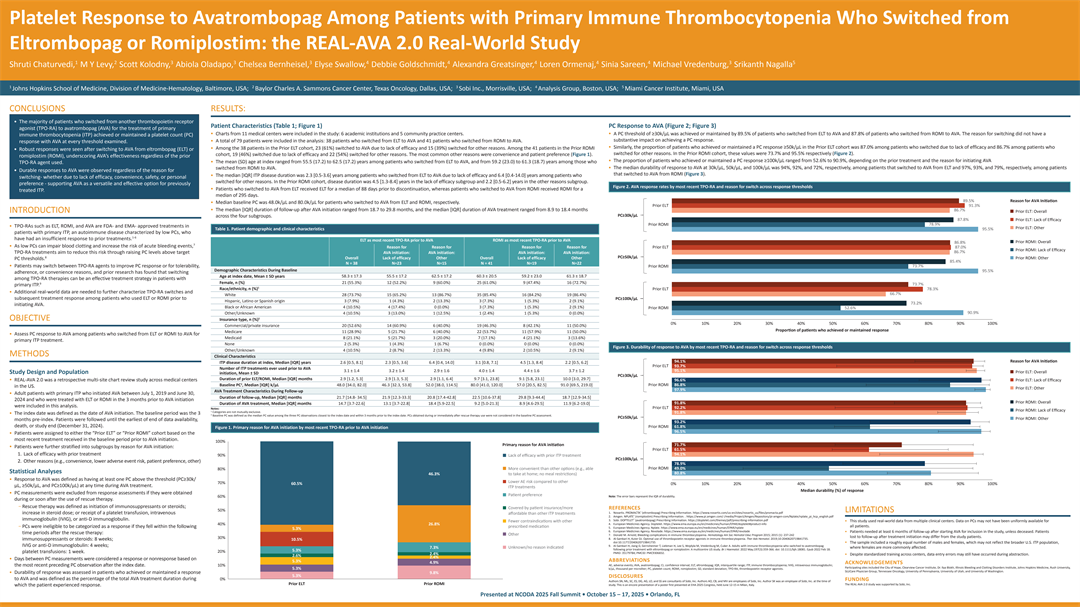
Thrombopoietin receptor agonists (TPO-RAs), including eltrombopag (ELT), romiplostim (ROMI), and avatrombopag (AVA), are United States Food and Drug Administration (FDA)-approved treatments for chronic immune thrombocytopenia (ITP), an autoimmune disorder characterized by low platelet counts (PCs) and risk of severe bleeding. TPO-RA treatments aim to raise PCs above targeted thresholds. Prior research has found that switching TPO-RAs because of tolerability, adherence, or convenience reasons can improve PC response. This study aimed to assess TPO-RA switches and treatment response among patients who used ELT or ROMI before initiating AVA using real-world data.
Objectives:
- Assess PC response to AVA among patients who switched from ELT or ROMI to AVA for primary ITP treatment.
- Descriptively evaluate differences in PC response between patients who switched to AVA from another TPO-RA due to lack of efficacy compared to those who switched for other reasons.
Methods:
The REAL-AVA 2.0 study was a retrospective multi-site chart review that assessed PC response to AVA among patients who switched from ROMI or ELT to AVA for primary ITP treatment. Patients from 11 participating sites with primary ITP who initiated AVA 7/2019-6/2024 and who used ELT or ROMI within 3 months pre-AVA initiation were included in the study. Patients were assigned to a cohort (i.e., ELT or ROMI) based on the treatment received immediately prior to AVA initiation and stratified by reason for AVA initiation (i.e., lack of efficacy with prior treatment or other reasons). Baseline was 3 months pre-AVA initiation (index) and follow-up ended at earliest of end of data availability, death, or study end (12/2024). Response to AVA was defined as achieving or maintaining PC ≥30k, ≥50k, or ≥100k/µL; PCs obtained during rescue therapy use were disregarded.
Results:
Among the 38 patients who switched to AVA from ELT, 23 (61%) did so due to lack of efficacy and 15 (39%) for other reasons. Among the 41 who switched from ROMI, 19 (46%) switched for efficacy and 22 (54%) for other reasons (e.g., convenience, adverse events, patient preference). At index, mean age across the four subgroups ranged from 55.5-62.5 years. Median baseline PC was 48k/µL and 80.0k/µL for patients who switched from ELT and ROMI to AVA, respectively. A PC threshold of ≥30k/μL was achieved or maintained by 89.5% of ELT to AVA and 87.8% of ROMI to AVA switchers. Switching reason did not substantially impact PC response rates. Similar response rates were observed at PC ≥50k/µL. The proportion of patients with response at PC≥100k/µL ranged from 52.6% to 90.9% across cohorts. Conclusions: Most patients who switched to AVA from another TPO-RA for the treatment of primary ITP achieved or maintained PC response with AVA, suggesting consistency of response to AVA regardless of prior TPO-RA or reason for treatment switch.
Funding: Sobi Inc.
Prior Presentations:
Presented at the European Hematology Association (EHA) Congress 2025, June 12-15, Milan, Italy.
Send your feedback
Please do not include any personal information or details.
"*" indicates required fields
Was this page
helpful?
Send your feedback
Please do not include any personal information or details.
"*" indicates required fields