

Reporting atrial fibrillation with bispecific T-cell engagers in the Food and Drug Administration Adverse Event Reporting System
1UConn School of Pharmacy
Background:
Recently, institutions have transitioned the use of bispecific T-cell engagers (BTCEs) from the inpatient to outpatient setting, using step-up dosing strategies and monitoring protocols. BTCE therapies activate cytotoxic T cells and promote cytokine release, which may contribute to atrial fibrillation (AF) by inducing inflammation that alters atrial electrophysiology, disrupts autonomic regulation, and facilitates atrial arrhythmogenesis. AF has been reported with other immunotherapies, including chimeric antigen receptor T-cell (CAR-T) therapies and immune checkpoint inhibitors. Despite biological plausibility, the atrial arrhythmic risk of BTCE therapies has not been well characterized in post-marketing studies. This study sought to determine whether AF was reported at a disproportionately higher frequency in association with BTCE therapies compared with other drugs in the United States Food and Drug Administration Adverse Event Reporting System (FAERS).
Objectives:
- Identify the mechanism by which bispecific T-cell engagers and other T-cell mediated immunotherapies may increase a patient’s risk for atrial fibrillation.
- Describe case-non-case and disproportionality analysis methodologies.
- Calculate and interpret signals of disproportionate reporting including reporting odds ratios and information components.
- Critique the methods and limitations of disproportionality analysis.
Methods:
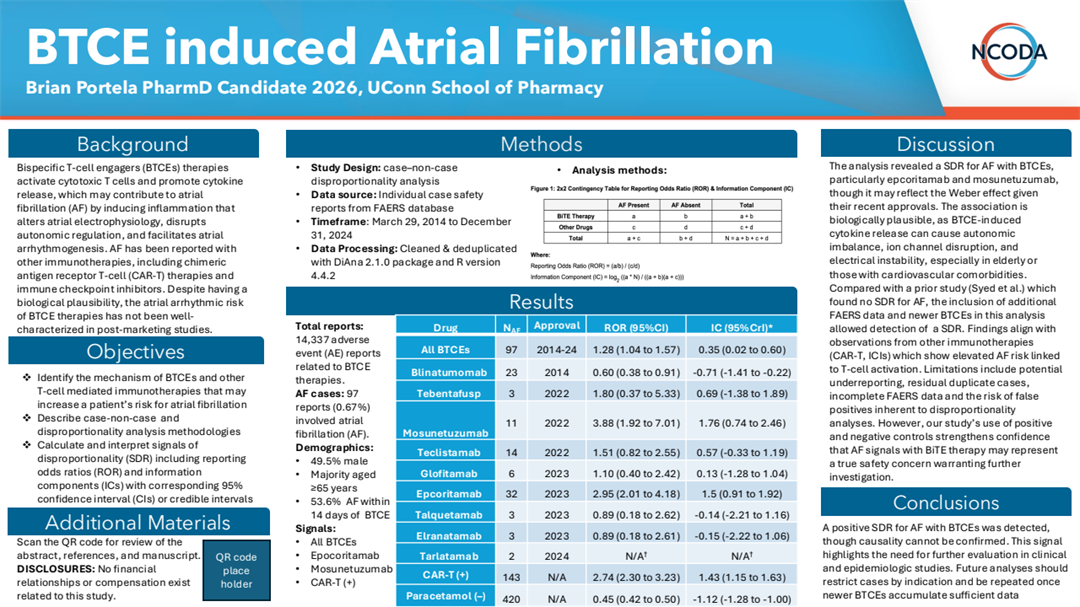
This was a case-non-case disproportional analysis. Using individual case safety reports (ICSRs) from the FAERS database, data were accessed for the period of March 29, 2014 (date of first FDA-approved BTCE therapy) to December 31, 2024. The DiAna 2.1.0 package and R version 4.4.2 were used to clean data, remove duplicate cases, and perform disproportionality analyses. Reporting odds ratios (RORs) and information components (ICs) with 95% confidence intervals (CIs) were used to assess whether signals for disproportional reporting (SDRs) for AF were present with BTCE therapy compared with all other drug reports in FAERS.
Results:
Among 14,337 adverse event reports related to BTCE therapies, 97 (0.67%) involved patients with atrial fibrillation. For cases with demographic data available, men comprised 49.5% of reports, most patients were aged 65 years or older, and 53.6% developed atrial fibrillation within 14 days of initiating BTCE therapy. A SDR of AF with BTCE therapies as a class was observed (ROR 1.28, 95% confidence interval [CI] 1.04–1.57; information coefficient [IC] 0.35, 95% CI 0.02–0.60). Individually, epocoritamab (ROR 2.95, 95% CI 2.01–4.18; IC 1.50, 95% CI 0.91–1.92) and mosunetuzumab (ROR 3.88, 95% CI 1.92–7.01; IC 1.76, 95% CI 0.74–2.46) were associated with SDRs. No other BTCE therapies demonstrated a positive signal. CAR-T therapy, the positive control, demonstrated a SDR for AF (ROR 2.40, 95% CI 2.05–2.79; IC 1.24, 95% CI 0.99–1.42). In contrast, the negative control, paracetamol, did not demonstrate a SDR (ROR 0.45, 95% CI 0.42–0.50; IC −1.12, 95% CI −1.28 to −1.00).
Discussion:
AF appears to be reported at a disproportionately higher frequency with BTCE therapy in FAERS. The identification of SDRs for select BTCE agents aligns with prior observations of atrial arrhythmias reported with other immune-based therapies, such as CAR-T therapy, supporting biological plausibility for this association.
Conclusions:
These findings suggest a potential association between BTCE therapy and atrial fibrillation reporting in post-marketing surveillance data. Further investigation is warranted to better characterize this risk and to determine clinical implications for monitoring and management in patients receiving BTCE therapies.
Funding: Not applicable.
Send your feedback
Please do not include any personal information or details.
"*" indicates required fields
Was this page
helpful?
Send your feedback
Please do not include any personal information or details.
"*" indicates required fields