
Investigation of antitumor effects of a sodium–glucose cotransporter 2 inhibitor for treatment of prostate cancer
1Larkin University
Background:
Prostate cancer (PCa) is the second most common malignancy among men worldwide. A hallmark of PCa is metabolic reprogramming, characterized by increased glucose uptake to support rapid tumor growth. Sodium–glucose cotransporter-2 (SGLT2) inhibitors are a relatively new class of antidiabetic agents that have demonstrated antitumor effects by disrupting glucose uptake and cellular energetics in various tumor models. By lowering glucose and insulin levels, improving insulin sensitivity, and reducing chronic inflammation, these agents create a metabolically unfavorable environment for tumor progression.
Objectives:
- Describe the antitumor effects of the SGLT2 inhibitor canagliflozin on androgen-dependent and androgen-independent prostate cancer cell lines.
- Explain the potential role of metabolic modulation through SGLT2 inhibition as a therapeutic strategy in prostate cancer.
Research Question:
This study aimed to evaluate the antitumor potential of canagliflozin, an SGLT-2 inhibitor, in PCa.
Methods:
We performed cell viability assays using three well-characterized human PCa cell lines that were selected to model different clinical stages and treatment responses. DU145 and PC-3 are androgen-independent cell lines commonly used as in vitro models of castration-resistant prostate cancer (CRPC), which represents the advanced disease stage where tumors no longer respond to androgen deprivation therapy. LNCaP is androgen-dependent and serves as a model for hormone-sensitive PCa, representative of earlier-stage disease where androgen receptor signaling remains a key driver of tumor growth. This selection allowed evaluation of canagliflozin’s antitumor potential across clinically distinct disease states. Canagliflozin was dissolved in dimethyl sulfoxide (DMSO), and control groups received an equivalent concentration of DMSO alone to ensure assay consistency. Cells were cultured and allowed to adhere for 24 hours before treatment. They were then exposed to increasing concentrations of canagliflozin (10–50 µM) for 72 hours. Cell viability was then assessed using the 3-(4,5-dimethylthiazol-2-yl)-5-(3- carboxymethoxyphenyl)-2-(4-sulfophenyl)-2H-tetrazolium (MTS) assay, which estimates the number of viable cells based on the biochemical reduction of a tetrazolium compound into a colored product by metabolically active cells. After addition of the MTS reagent, cells were incubated at 37°C for approximately 2 hours, and absorbance was measured at 490 nm using a SpectraMax190 M-Series MultiMode Microplate Reader.
Results:
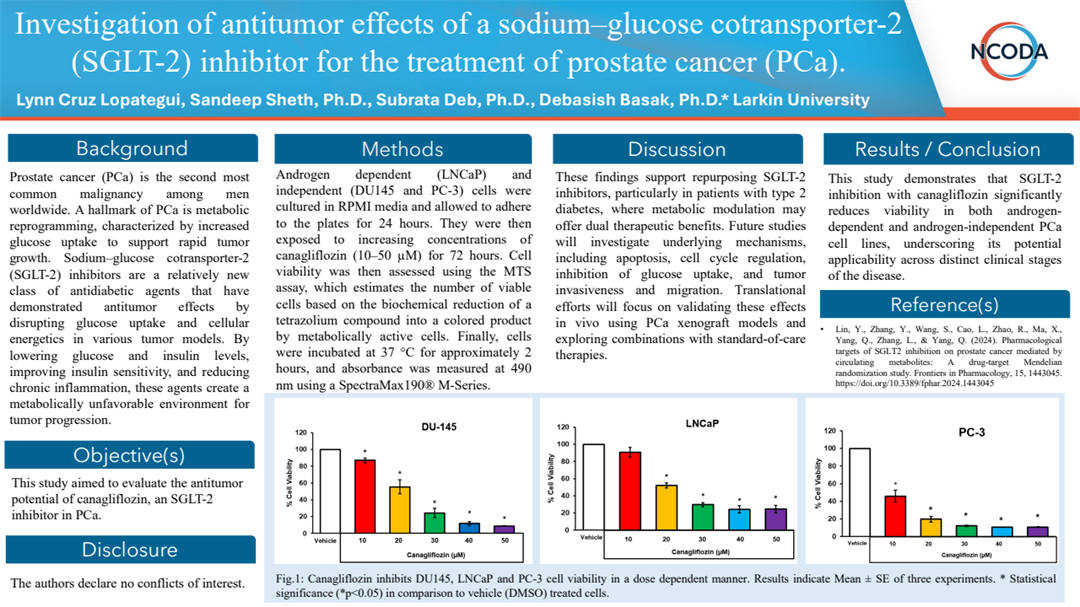
Canagliflozin demonstrated a dose-dependent reduction in PCa cell viability, indicating a potent antiproliferative effect. Notably, this cytotoxicity occurred independently of androgen receptor signaling.
Discussion:
This study demonstrates that SGLT2 inhibition with canagliflozin significantly reduces viability in both androgen-dependent and androgen-independent PCa cell lines, underscoring its potential applicability across distinct clinical stages of the disease. The findings support the repurposing of SGLT2 inhibitors, particularly in patients with concurrent type 2 diabetes, where metabolic modulation could provide dual benefit.
Conclusions:
Future studies will include mechanistic studies assessing apoptosis, cell cycle regulation, glucose uptake inhibition, and invasion and migration potential. Translational studies will aim to confirm these effects in vivo using PCa xenograft models and to explore combination strategies with standard-of-care therapies. Collectively, these steps aim to advance SGLT2 inhibition toward clinical evaluation as part of an integrated metabolic-targeted strategy for PCa management.
Funding: Not applicable.
Send your feedback
Please do not include any personal information or details.
"*" indicates required fields
Was this page
helpful?
Send your feedback
Please do not include any personal information or details.
"*" indicates required fields