

Evaluating subcutaneous versus intravenous immunotherapies: considerations for clinical practice
1University of Illinois at Chicago Retzky College of Pharmacy, University of Illinois Hospital & Health Sciences System
Background:
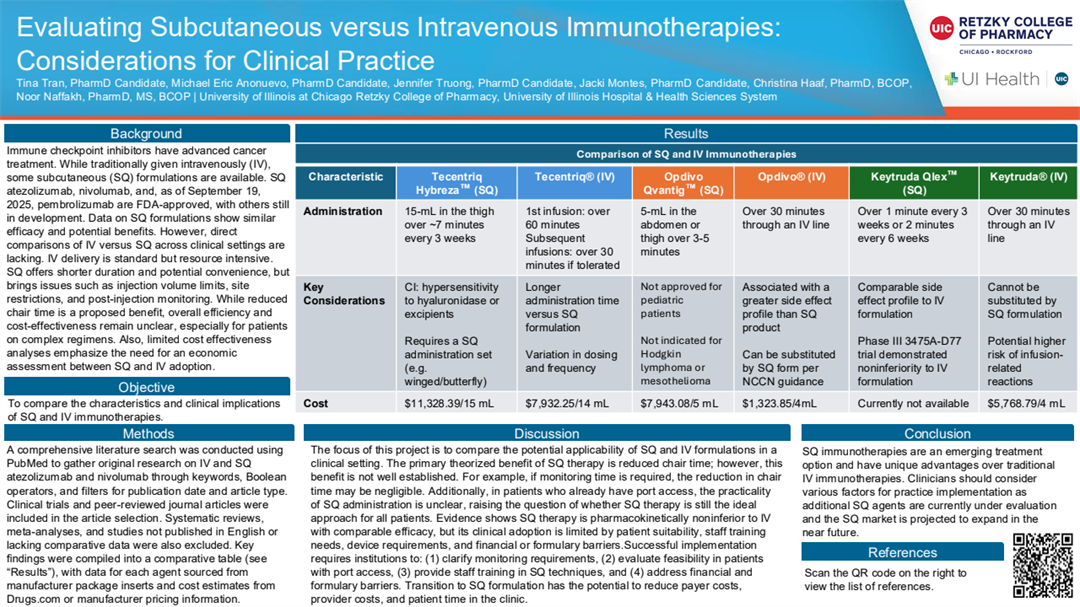
Immune checkpoint inhibitors have significantly advanced cancer treatment. Traditionally administered intravenously, recent approvals of subcutaneous (SQ) formulations of agents such as nivolumab and atezolizumab have introduced alternative administration methods. Although preliminary literature suggests comparable efficacy and potential benefits of SQ delivery, objective evaluation of SQ versus intravenous (IV) approaches across diverse clinical settings remains necessary. IV administration, while resource-intensive due to longer infusion times and infusion center utilization, is well-established in oncology practice. Conversely, SQ administration, marketed for shorter administration durations and potential convenience, introduces new logistical considerations including injection volume limitations, administration site restrictions, and specific monitoring and observation requirements post-injection. Despite claims of reduced chair time, realworld efficiency gains remain inadequately quantified, especially in patients already utilizing ports for multi-drug regimens. Additionally, comprehensive cost-effectiveness analyses are limited, warranting a detailed assessment of the true economic impact of SQ adoption compared to IV.
Objectives:
- Compare the pharmacokinetics, administration requirements, monitoring protocols, and cost implications of SQ and IV immunotherapies.
- Evaluate clinical scenarios and patient populations in which SQ administration may or may not offer significant advantages over IV administration.
- Discuss considerations for integrating SQ immunotherapies into oncology practice, emphasizing operational, financial, and clinical impacts.
Methods:
Institutions considering integrating SQ immunotherapies must evaluate multiple factors including patient selection criteria, appropriateness in combination therapy regimens, staff training, formulary decisions, and overall financial implications. Clinical pathways for patient qualification, including transitioning protocols from IV to SQ and managing reactions, must be clearly defined and evidence-based.
Results:
At this time, data collection and evaluation related to the comparison of SQ and IV immunotherapy administration are ongoing. Results will be reported following completion of institutional assessments and analysis of operational, economic, and clinical considerations.
Discussion:
Ongoing research is critical to clarify optimal patient populations and practice settings where SQ administration demonstrates unequivocal benefit. Understanding the nuanced differences between SQ and IV immunotherapy administration is essential to inform clinical decisions and institutional policy.
Conclusions:
An evidence-based, patient-centered approach requires balanced consideration of administration logistics, patient preference, economic impact, and clinical outcomes. This comprehensive assessment addresses significant knowledge gaps, facilitating informed implementation of SQ therapies in appropriate clinical contexts.
Funding: Not applicable.
Send your feedback
Please do not include any personal information or details.
"*" indicates required fields
Was this page
helpful?
Send your feedback
Please do not include any personal information or details.
"*" indicates required fields