

Effects of proteasome inhibitor drugs on double-strand break repair pathways
1Stanford University Medical Center
Background:
Deoxyribonucleic acid (DNA) double-strand breaks (DSBs) are among the most lethal forms of DNA damage, and their repair is essential for cell survival. Cancer cells often rely on lower fidelity backup DSB repair pathways to rapidly evolve and thrive in the tumor microenvironment, and targeting those poorly understood mechanisms can sensitize them to DNA-damaging agents or impair their survival. The proteasome plays a crucial role in the regulated degradation of DNA repair proteins, recognizing ubiquitin and ubiquitin-like polypeptide tags to orchestrate the timing, fidelity, and choice of primary DSB repair pathways, including homologous recombination and nonhomologous end joining, as well as several alternative end joining mechanisms, some of which utilize junctional microhomologies (MHs).
Objectives:
- Understand the implications of proteasome inhibitor drugs.
- Differentiate between different repair pathways.
Methods:
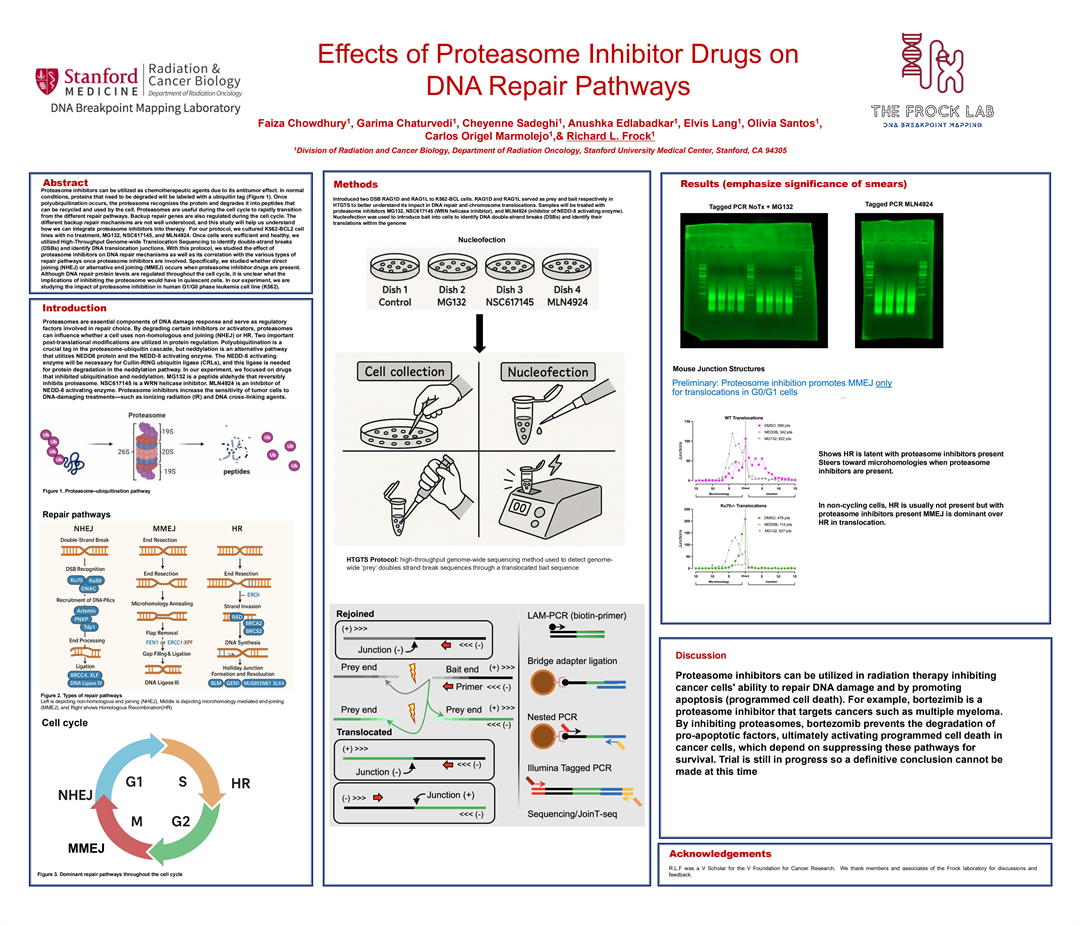
In this study, we investigated how pharmacological inhibition of the proteasome using MG132 or inhibition of a subset of tagged proteasome targets using MLN4924 alters the DNA repair landscape in cycling and quiescent K562 cancer cell lines, a human leukemia cell line. High-Throughput Genome-wide Translocation Sequencing (HTGTS) was used to allow for an unbiased, genome-wide assessment of DSB repair outcomes and translocation junctions.
Results:
Preliminary data from a prior study in quiescent murine cancer stem cells indicate that proteasome inhibitors specifically increase MH utilization for chromosome translocations. At present, sequencing results from the current study are pending, and comprehensive results will be reported once data analysis is complete.
Discussion:
Proteasome-mediated regulation of DNA repair pathway choice represents a potentially important mechanism influencing genomic stability in cancer cells. Alterations in repair pathway utilization, particularly increased reliance on microhomology-mediated end joining, may contribute to chromosomal instability and therapeutic vulnerability in malignancies exposed to proteasome inhibition.
Conclusions:
This study aims to further define how proteasome inhibition reshapes the DNA double-strand break repair landscape in cycling and quiescent leukemia cells. Final conclusions will be drawn upon completion of sequencing analysis and full evaluation of DSB repair outcomes.
Funding: Not applicable.
Send your feedback
Please do not include any personal information or details.
"*" indicates required fields
Was this page
helpful?
Send your feedback
Please do not include any personal information or details.
"*" indicates required fields