

Systematic review of frontline tyrosine kinase inhibitors for chronic myeloid leukemia
1Florida Cancer Specialists & Research Institute, Rx-To-Go Specialty Pharmacy
Background:
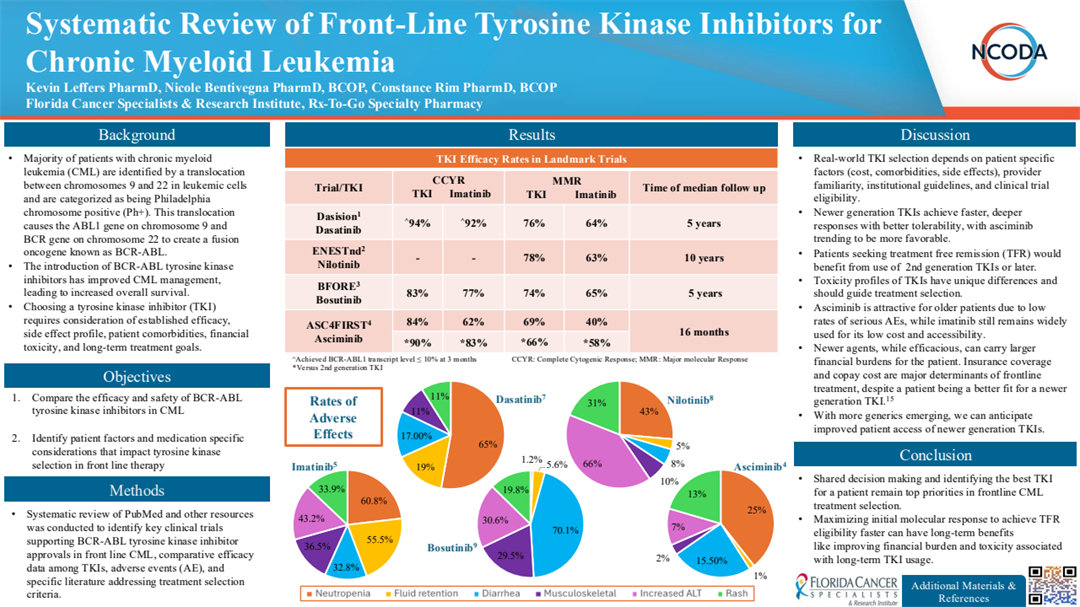
Chronic myeloid leukemia (CML) accounts for ~15% of newly diagnosed adult leukemias annually. Majority of patients with CML are identified by a translocation between chromosomes 9 and 22 in leukemic cells and are categorized as being Philadelphia chromosome positive (Ph+). This translocation causes the Abelson murine leukemia 1 (ABL1) gene on chromosome 9 and breakpoint cluster region (BCR) gene on chromosome 22 to create a fusion oncogene known as BCR-ABL. The introduction of BCR-ABL tyrosine kinase inhibitors has improved CML management, leading to increased overall survival. Choosing a tyrosine kinase inhibitor requires consideration of established efficacy, side effect profile, patient comorbidities, financial toxicity, and long-term treatment goals.
Objectives:
- Compare efficacy and safety of BCR-ABL tyrosine kinase inhibitors (TKIs) for CML.
- Identify patient specific and medication specific barriers in TKI selection.
Methods:
A systematic review of PubMed and other databases was conducted to identify: (1) key clinical trials supporting BCR-ABL inhibitor approvals for front-line CML, (2) comparative studies evaluating efficacy and safety of TKIs, (3) articles outlining treatment selection criteria in CML.
Results:
Newer generation TKIs have shown positive efficacy and safety in clinical trials. Tolerability and toxicities should be considered when choosing initial therapy and continuously assessed throughout treatment.
Discussion:
Selection of front-line therapy for newly diagnosed CML is continually evolving, with newer generation TKIs. Although clinical trials provide new guidance for front-line therapy, real-world treatment selection is often far more complex. Variables like cost, comorbidities, and patient adherence play a role in determining selection of front-line treatment. This highlights the importance of shared decision making and individualized care in CML.
Conclusions:
Front-line TKI selection requires individualized treatment utilizing efficacy and safety data, as well as patient specific factors, to improve outcomes in CML patients.
Funding: Not applicable.
Send your feedback
Please do not include any personal information or details.
"*" indicates required fields
Was this page
helpful?
Send your feedback
Please do not include any personal information or details.
"*" indicates required fields