
Treatment patterns and outcomes among patients treated with second-generation Bruton tyrosine kinase inhibitors in chronic lymphocytic leukemia
1University of California, San Francisco, CA, USA; 2BeOne Medicines, Ltd., San Carlos, CA, USA
Background:
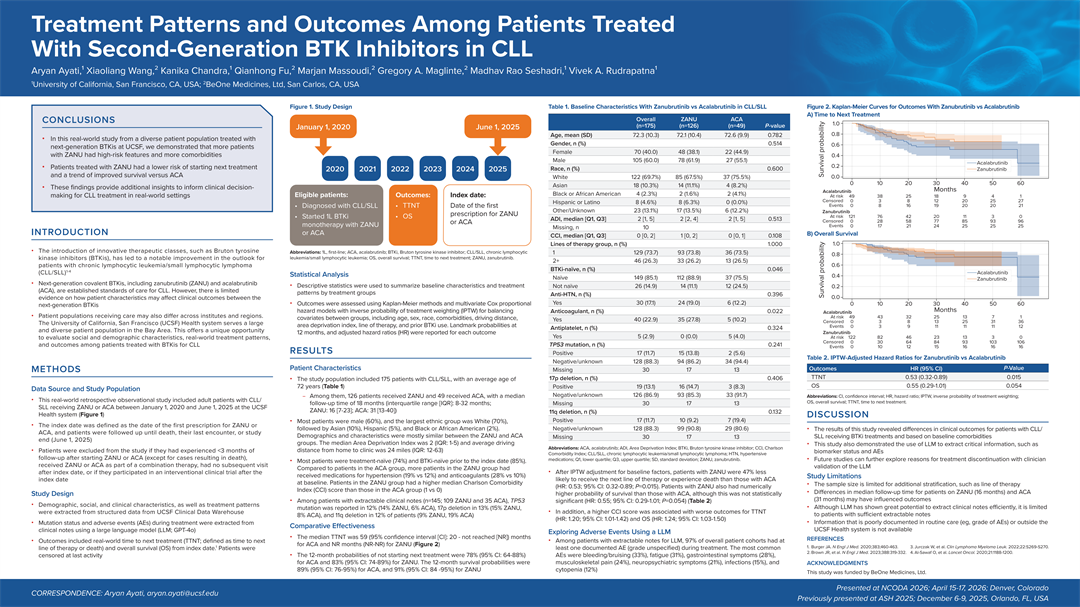
Next-generation Bruton tyrosine kinase inhibitors (BTKis) are standards of care for chronic lymphocytic leukemia (CLL). This study evaluated demographic and clinical characteristics, real-world treatment patterns, and outcomes among patients treated with a BTKi for CLL in the University of California, San Francisco (UCSF) Health System.
Objectives:
- Examine the demographic and clinical characteristics of patients diagnosed with CLL and treated with a next-generation BTKi in a real-world setting.
- Understand the outcomes in patients diagnosed with CLL treated with zanubrutinib or acalabrutinib in a real-world setting.
Methods:
This real-world retrospective study included adult patients with CLL who received a second-generation BTKi, zanubrutinib or acalabrutinib, between January 1, 2020, and June 1, 2025, in the UCSF Health system Index was date of the first prescription for the BTKi, and patients were followed for a minimum of 3 months, until death, last encounter, or study end (June 1, 2025). Demographic, clinical characteristics, and treatment patterns were summarized overall and by treatment. Outcomes including time to next treatment (TTNT) and overall survival (OS) were estimated using Kaplan-Meier methods and Cox model with inverse probability of treatment weighting (IPTW).
Results:
A total of 175 patients were identified, 126 (72%) treated with zanubrutinib, and 49 (28%) with acalabrutinib. Median follow-up was 18 months. Mean age was 72 years (standard deviation, SD: 10), with 60% male. Most patients were treatment-naïve (74%) and BTKi-naïve (85%). TP53 mutation was reported in 12% of patients (zanubrutinib: 14% versus (vs) acalabrutinib: 6%), 17p deletion in 13% (15% vs 8%), and 11q deletion in 12% (9% vs 19%). More patients treated with zanubrutinib versus (vs) acalabrutinib received antihypertensives (19% vs 12%) and anticoagulants (28% vs 10%) at baseline. For adverse events, 97% had at least one documented event during treatment, most commonly bleeding/bruising (33%), fatigue (31%), gastrointestinal symptoms (28%), musculoskeletal pain (24%), and neuropsychiatric symptoms (21%). Overall, median TTNT was 59 months. The 12-month probability of not starting next treatment was 83% (95% confidence interval [CI]: vs 78% 95% CO; 64-88%) for zanubrutinib vs acalabrutinib, respectively. After IPTW adjustment, patients with zanubrutinib were 47% less likely to receive the next line of therapy or death than those with acalabrutinib (hazard ratio [HR]: 0.53, 95% CI: 0.32-0.89; P=.015). The 12-month survival probabilities were 91% (95% CI: 84-95%) vs 89% (95% CI: 76-95%) for zanubrutinib vs acalabrutinib, respectively. After IPTW adjustment, patients with zanubrutinib had numerically higher probability of survival vs acalabrutinib, although not statistically significant (HR: 0.55, 95% CI: 0.29-1.01; P=.054).
Conclusions:
The results demonstrated that patients treated with zanubrutinib had a lower risk of starting next treatment and a trend for improved survival compared to acalabrutinib. These findings provide additional insights for CLL treatment in a real-world setting.
Funding: BeOne Medicines Ltd.
Prior Presentations:
Presented at the American Society of Hematology (ASH) Annual Meeting 2025, December 6-9, Orlando, FL.
Send your feedback
Please do not include any personal information or details.
"*" indicates required fields
Was this page
helpful?
Send your feedback
Please do not include any personal information or details.
"*" indicates required fields